The agent interface used to be easy to underestimate. A prompt went in, a response came out, and the surrounding terminal or app looked like presentation. The newest source trail says that surface is becoming something more operational: a control room for supervising work that can run, branch, ask, stream, and fail.
That continues the thread from yesterday's edition, which followed context becoming runtime state. Today moves the question outward. If the runtime is carrying more state, then the user interface needs better handles for seeing it, clicking through it, interrupting it, and moving between live streams of work.
Codex turns terminal output into linkable material
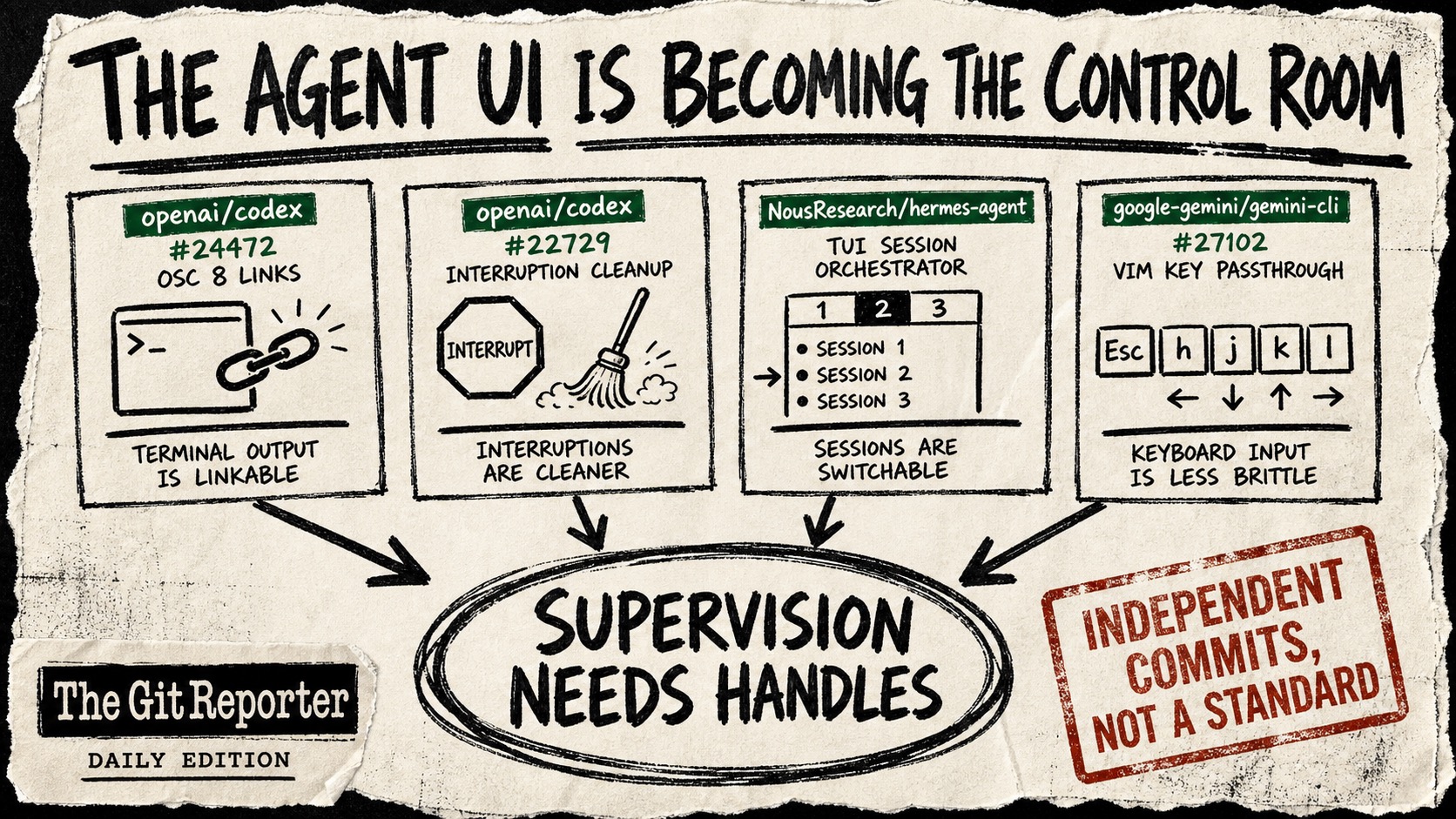
OpenAI Codex commit 7a264978 adds OSC 8 web-link support to rich TUI content. The practical problem is small enough to miss until it breaks a workflow: URLs rendered inside Markdown tables can wrap across terminal rows, leaving visible fragments that no longer behave like the full destination.
The commit says Codex now validates http:// and https:// destinations, sanitizes terminal payloads, and applies link metadata separately from visible layout width. It also says the link target is preserved through table wrapping, narrow pipe fallback, streaming, transcript overlay rendering, history insertion, and resize replay.
That is a supervision feature, not just polish. Agent output often contains the evidence trail: docs, issues, commits, logs, dashboards, and generated plans. If those references survive terminal layout as clickable links, the terminal becomes less like a transcript and more like an inspection surface.
Interruption becomes part of the contract
A second Codex commit, 9152ebd2, treats stopping work as another serious interface boundary. The commit addresses interrupted shell_command calls that can race with outer tool-dispatch cancellation, causing the runtime future to be dropped before a spawned process can run cleanup.
The fix keeps shell-command dispatch alive long enough for cancellation cleanup, folds shell-turn cancellation into the existing exec-expiration path, sends SIGTERM first, waits briefly, then hard-kills remaining descendants in the process group. It also adds regression coverage for shell cancellation and cleanup behavior.
For a person supervising an agent, "stop" cannot mean only "make the UI quiet." It has to mean the underlying work was given a coherent shutdown path. The commit is narrow, and specifically about shell-command cancellation and Linux sandbox cleanup, but it makes the bigger point: interruption is part of the agent control surface.
Hermes makes live sessions switchable
NousResearch Hermes Agent commit 0a83247e adds a first-class active-session orchestrator for the Ink TUI. The commit message describes listing, activating, closing, and launching live process-local TUI sessions; hydrating committed and in-flight output when switching sessions; dispatching a new prompt session from a +new row with session-scoped model picks; and exposing a clickable live-session count in the status chrome.
That is a different kind of handle. It assumes agent work may not be one linear exchange. There may be several live sessions, each with state worth returning to, output worth hydrating, and lifecycle actions worth exposing without forcing the user to reason from hidden process state.
The article should not pretend this is the same architecture as Codex. It is not. The shared signal is simpler: once agent work becomes multi-session, the UI has to show the operator where the work is and how to switch rooms.
Gemini CLI tightens the keyboard edge
Google Gemini CLI commit 5cac7c10 is smaller, but it belongs in the same pattern. The patch changes Vim normal-mode handling so unmapped printable keys are ignored while modifier-key chords such as control, alt, or command can still fall through to other handlers. The accompanying tests cover several unmapped printable keys.
That is not a grand redesign. It is the kind of edge that matters when a terminal agent is used repeatedly. A UI that treats every stray normal-mode key as text input is harder to trust; a UI that swallows unmapped Vim keys but preserves modifier chords is a little less brittle for keyboard-heavy users.
The interface is where trust becomes usable
None of these commits prove coordination. They do not define a shared agent UI standard. They are independent changes in separate projects. But they point to the same pressure: as agent runtimes become more capable, the human-facing surface has to become more than a chat window with logs.
The interface needs handles. Links have to stay attached to evidence. Interruptions have to clean up real work. Sessions have to be visible and switchable. Keyboard semantics have to respect the people who live in terminals all day.
That is why the agent UI is starting to look like the control room. Not because it controls everything yet, but because supervision is becoming the job. The next thing to watch is whether these handles move from isolated commits into a common expectation: every serious agent tool should show what it is doing, let the operator move between workstreams, and stop work without leaving the room in a mess.