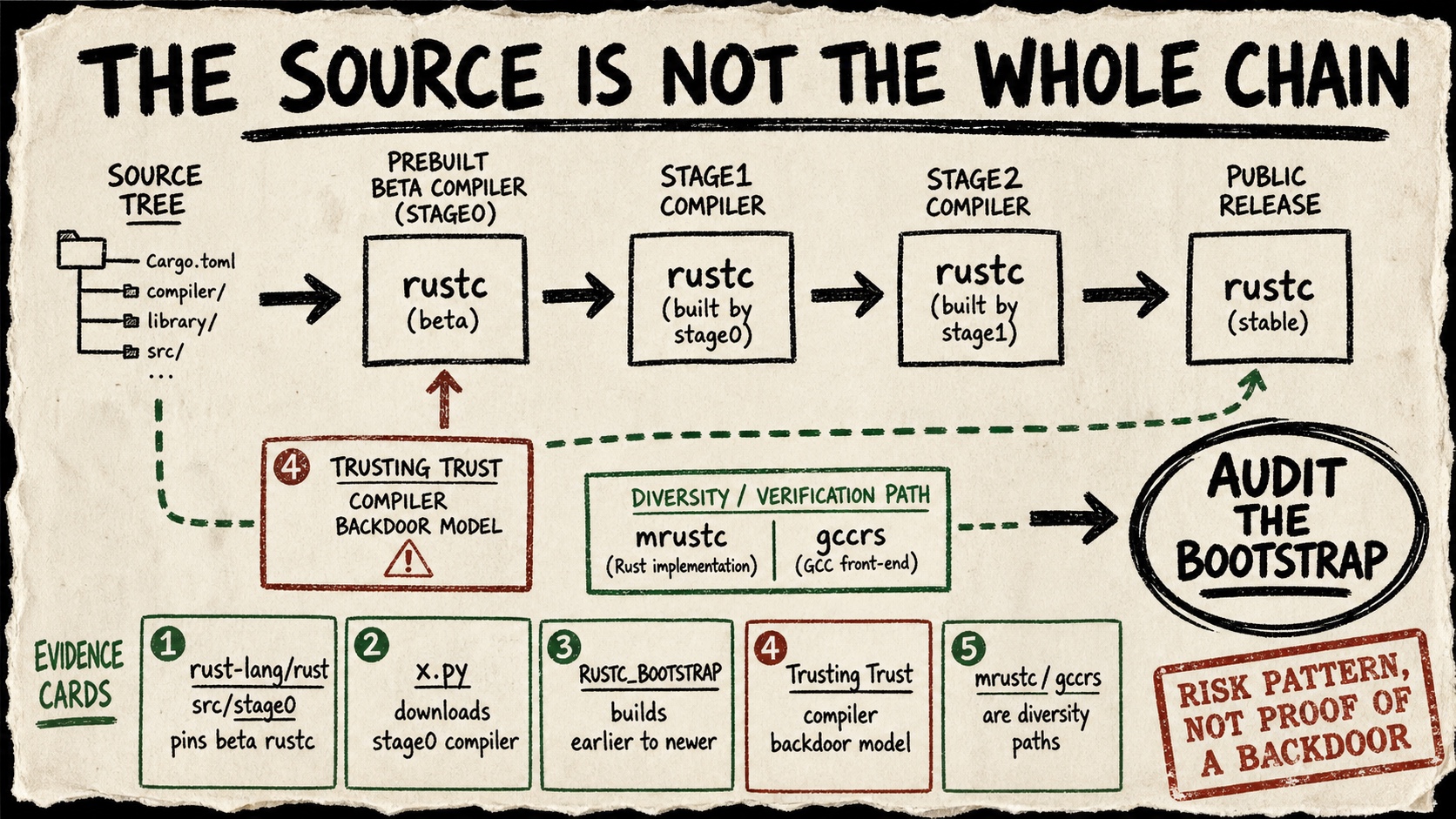
The uncomfortable part of compiler trust is that source code is not the whole object being trusted.
A clean source tree matters. Public hashes matter. Release process matters. But when the compiler is written in the language it compiles, the build begins before the current source can run. Something older has to compile the new compiler first.
That is the narrow claim worth investigating in the Rust debate. Not "Rust is backdoored." Not "AI assistants plus Rust imply compromise." The source-grounded claim is more precise: the official Rust compiler bootstrap path depends on a prebuilt earlier rustc, which is exactly the class of system Ken Thompson made famous in "Reflections on Trusting Trust".
The Rust docs say the quiet part clearly
The Rust Compiler Development Guide defines bootstrapping as using an older compiler to compile a newer version of itself. It then applies that directly to rustc: the build script downloads the current beta release of rustc and uses it to compile the new compiler.
The public repo shows the same thing in code. In rust-lang/rust/src/stage0, the bootstrap compiler metadata currently pins compiler_version=beta, compiler_date=2026-05-31, a compiler git commit hash, a channel manifest hash, and per-target SHA-256 checksums for downloaded rustc artifacts.
That file is not a scandal. It is an important receipt. Rust is not hiding that stage0 exists. The build chain says: fetch this known beta compiler, verify these artifacts, use that to produce the next compiler stage.
The bootstrap README fills in the mechanics. The entry script downloads stage0 compiler, Cargo, and standard-library binaries. The stage0 compiler builds the stage1 compiler and libraries. Then stage1 produces the stage2 compiler. The release binary readers install has a source trail, but it also has a compiler ancestry.
Why that is a Trusting Trust-shaped risk
Thompson's 1984 lecture matters because it separates source review from compiler behavior. The attack model is not "hide malicious code in the current source." It is "teach a compiler binary to emit malicious behavior while also reproducing the trick when it compiles the compiler again."
That is why the Rust bootstrap chain is a real security topic even if there is no evidence of a Rust backdoor. If a project can build modern compiler N only by first trusting compiler N-1, source review of compiler N is necessary but not sufficient to answer every supply-chain question.
The Rust project has more transparency than the caricature allows. The stage0 file names the bootstrap artifacts. The build docs explain the stages. The bump-stage0 tool says Rust's train model builds nightly from beta, beta from stable, and stable from the previous stable release. The RUSTC_BOOTSTRAP documentation explains why an earlier compiler needs permission to compile compiler and standard-library code that uses unstable features.
Those are good public signals. They also prove the trust boundary exists.
The word "only" needs discipline
The strongest version of the claim is true for the official modern rustc path: current rustc is built by starting from a slightly earlier rustc. That is how the Rust project documents and implements the normal bootstrap.
But "only" becomes misleading if it implies nobody is working on independent paths. mrustc is an alternative Rust compiler written in C++ whose stated purpose is bootstrapping rustc; its README says it can build working rustc and Cargo from release source tarballs and reports binary-equal validation for a recent chain. gccrs is a GCC Rust front end, but its own README still describes it as early and not usable yet for real Rust programs.
That means the practical ecosystem answer is mixed. Rust has serious diversity efforts, but the official compiler used by most developers is still rustc, and the normal build of rustc still begins with a previous rustc binary.
The defense is independent reproduction
David A. Wheeler's Diverse Double-Compiling work is the useful next reference because it does not wave away Thompson's model. It asks how to test whether source and executable correspond by rebuilding through a different trusted path and comparing results.
For Rust, the question to watch is not whether one tweet can prove intent. It cannot. The question is whether the community can make compiler ancestry inspectable enough that trust does not collapse into "download the blessed binary and hope."
The most meaningful future evidence would look boring: documented stage0 updates, reproducible compiler artifacts, independent rebuilds, mrustc-style bootstrap checks against newer releases, gccrs progress toward real Rust programs, and distribution-level build systems that can explain their seed compiler chain.
AI changes the pressure, not the theorem
The AI-assistant part of the original concern is a different risk surface. AI coding tools can increase code volume and make review harder. That matters for crates, applications, tests, and tooling. But it does not prove anything about rustc's compiler ancestry.
The compiler story stands on its own. Rust's official bootstrap chain really does start from an earlier rustc. Trusting Trust explains why that shape deserves scrutiny. The repo shows Rust makes that chain visible with pinned metadata and checksums. The ecosystem shows independent compiler work exists, but it is not yet equivalent to the dominant rustc path.
So the headline is not that Rust is uniquely unsafe. The headline is that mature language ecosystems need to publish more than source. They need to publish enough of the build ancestry that a reader can audit where trust entered the room.