Pi is easiest to misread if you start with the package list.
There is a coding-agent CLI. There is an agent runtime. There is a multi-provider LLM API. There is a terminal UI package. Those facts qualify Pi for the agent beat, but they do not explain why the project matters.
The better starting point is people. Public package metadata names Mario Zechner as author. The repository history shows Zechner as the dominant commit author, with Armin Ronacher and a long contributor list visible in the recent release trail. The repo's contribution guide says AI-assisted code is acceptable only when the person submitting it understands the change. Its `AGENTS.md` assumes multiple Pi sessions may be working in the same checkout and tells them how not to damage each other's files.
That is the useful frame for this companion profile. Pi is not just a tool that uses agents. It is a project about what kind of tool a person should be able to keep changing while agents are already inside the workflow.
The origin story is a refusal
In a public November 30, 2025 post, Zechner explains the Pi rationale as a response to coding-agent tools becoming harder to inspect and harder to keep predictable. The post describes a desire for simple tools, exact context control, a documented session format, alternate UI surfaces, and direct multi-provider or self-hosted model control.
That public rationale maps cleanly onto the codebase. The root README calls Pi an agent-harness monorepo and names the core pieces: `pi-coding-agent` for the CLI, `pi-agent-core` for stateful tool execution and event streaming, `pi-ai` for provider abstraction, and `pi-tui` for the terminal interface.
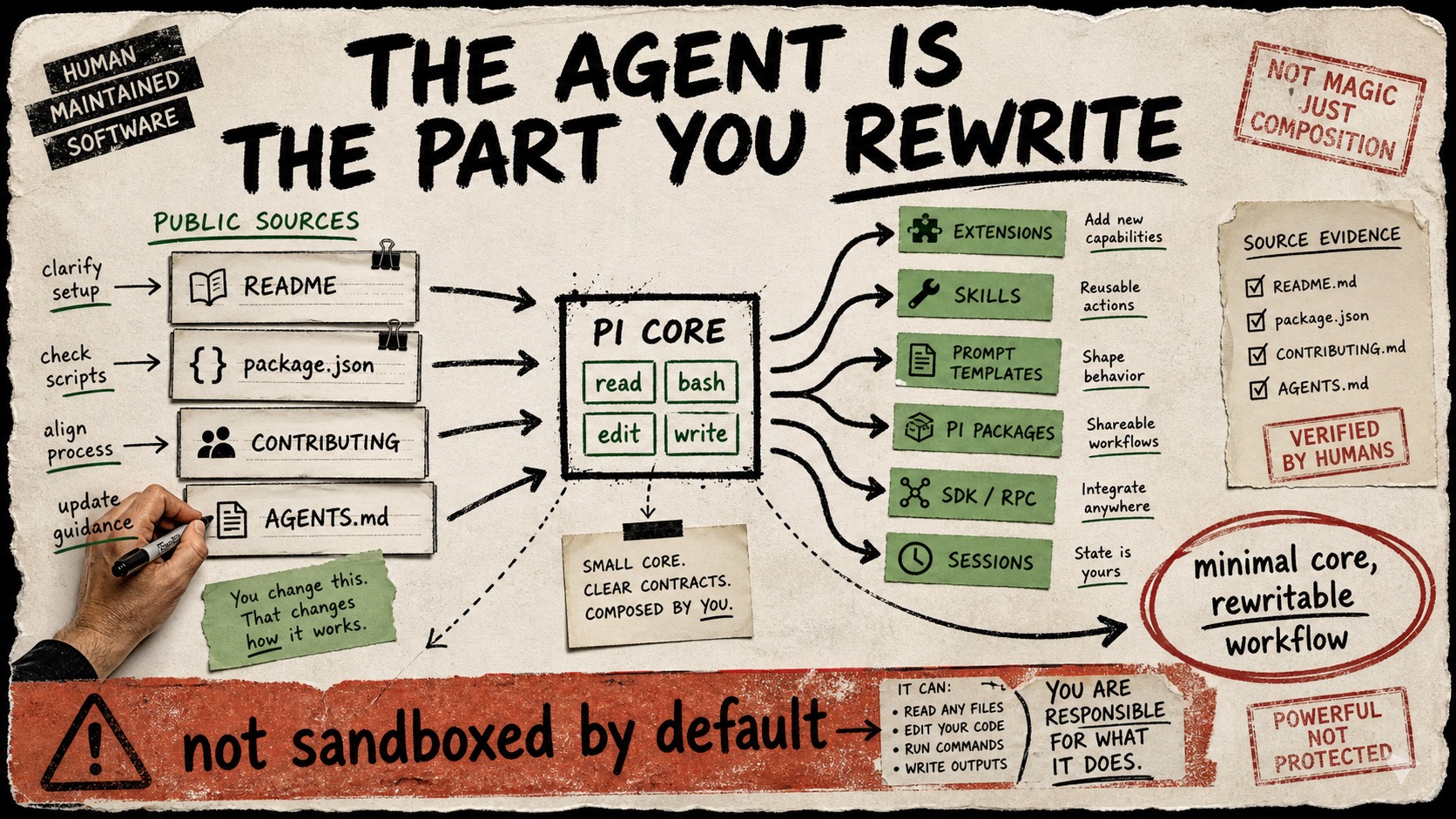
The product choice is not to hide that machinery. Pi's own docs tell users to adapt the harness through TypeScript extensions, skills, prompt templates, themes, and Pi packages. The point is not that the core has every workflow. The point is that the workflow can move out of the core.
The default agent is deliberately small
The coding-agent README says the default model gets four tools: `read`, `write`, `edit`, and `bash`. The source backs that up. `packages/coding-agent/src/core/tools/index.ts` defines a wider built-in set, including `grep`, `find`, and `ls`, but the default coding tool factory returns the four-tool set. The same file defines a read-only tool group for review-style work.
That choice is the first visible difference from agent products that keep adding named modes and product-owned helpers. Pi can do more, but it does not make every extra workflow a built-in promise.
The agent-core package is still a real runtime. Its README documents event flow, tool execution, configurable parallel or sequential tool calls, `beforeToolCall` and `afterToolCall` hooks, state, session IDs, steering messages, and follow-up queues. The source implementation shows the `Agent` class owning current state, listeners, queued messages, transport, session ID, tool execution mode, and hook callbacks.
So the grounded claim is narrow: Pi's core is minimal, not absent. It has enough runtime machinery to run a coding agent, then opens the surrounding shape to user code.
Extensibility is the product surface
Pi's docs are unusually explicit about what it chooses not to bake in. No built-in MCP. No built-in subagents. No built-in plan mode. No built-in todos. No permission popups. No background bash.
That list can sound like missing features until you read the other half of the documentation. Extensions can register custom tools, commands, keyboard shortcuts, event handlers, and UI components. Skills can be invoked on demand. Prompt templates can become reusable slash commands. Pi packages can bundle extensions, skills, prompts, and themes for npm or git distribution. RPC mode and the SDK let other applications embed or drive the runtime.
This is why the right comparison is not simply "Pi has fewer features." Pi is trying to move features to the layer where the user can inspect and replace them. Want a plan mode? Make it a file or an extension. Want subagents? Spawn Pi instances, write an extension, or install a package. Want MCP? The docs point toward CLI tools with READMEs or an MCP wrapper, not a built-in protocol dependency.
That is a real product stance. It is also a maintenance stance. A smaller core lets maintainers reject features that would lock everyone into one workflow, while still leaving room for users to build their own.
The repo has rules for people and agents
The public collaboration documents are part of the story. `CONTRIBUTING.md` opens with a blunt standard: contributors must understand their code. It says using AI is fine, but submitting agent output without understanding it is not. It also explains the issue and PR gate: new contributors are auto-closed by default, maintainers review worthwhile items, and low-signal or automated traffic may never get a reply.
That is not a soft community note. It is a maintainer-load policy for an AI-heavy development environment.
`AGENTS.md` goes further. It tells agents how to work in the repo: keep answers concise, avoid fluff, run the right checks, respect dependency security, stage only files changed in the current session, never use broad destructive git commands, and assume multiple Pi sessions may be modifying different files in the same checkout.
For this article, that matters because Pi is not only software for agent work. It is also software being maintained in the presence of agent work. The docs are evidence that the maintainers have already had to design for parallel human/agent development, not as a future theory but as everyday repo policy.
Trust is real, but it is not sandboxing
Pi's latest release trail makes the trust story sharper. The v0.79.0 changelog highlights project trust for local inputs. The coding-agent README explains the behavior: on interactive startup, Pi asks before trusting a project folder that contains project-local inputs. Trusting a project allows Pi to read local instructions, load `.pi` settings and resources, install missing project packages, and execute project extensions. Non-interactive modes ignore those project-local inputs unless the run is approved.
The source backs up the boundary. `trust-manager.ts` detects trust-relevant inputs such as `.pi`, `AGENTS.md`, `CLAUDE.md`, and `.agents/skills`, then persists decisions in a trust store. `resource-loader.ts` runs a pre-trust extension pass before project-local settings and resources are allowed into the final load path.
But this is not a permission system for commands, files, network, or credentials. Pi's root README says it does not include a built-in permission system for restricting filesystem, process, network, or credential access. The containerization guide opens from the same premise: Pi runs with all permissions by default, and users who need stronger control should isolate the whole process or route tool execution into an isolated environment.
The guide names three patterns. OpenShell runs the whole process in a policy-controlled sandbox. Gondolin keeps Pi and provider auth on the host while routing built-in tools and user shell commands into a local Linux micro-VM. Plain Docker runs the whole Pi process in a local container.
That gives the article its safety sentence: Pi externalizes the hard isolation boundary. Project trust controls whether project-local code and instructions are loaded. Sandboxing still belongs to the environment you run Pi inside.
The timeline explains the shape
The public history starts on August 9, 2025 with a monorepo setup commit by Mario Zechner. By November 25, the coding-agent changelog records an initial public release with an interactive TUI, sessions, file tools, model switching, provider support, message queueing, and HTML export.
Three days later, RPC mode appears, along with a refactor toward multiple frontends sharing agent logic. On November 30, Zechner publishes the public rationale for building an opinionated and minimal coding agent. In December, the changelog adds custom tools, then a subagent orchestration example and Agent Skills standard compliance.
The 2026 trail keeps making the same shape more operational. April brings session cloning, extension working-state controls, TypeBox validation for extension and SDK integrations, terminating tool results, and safer session-replacement behavior. May moves the packages into the `earendil-works` scope and continues hardening sessions, packages, and self-update behavior. June adds containerization docs, a Gondolin micro-VM example, temporary extension cache hardening, unsafe git package path checks, and finally project trust.
The pattern is not "more features in the core." It is "make the extension surface safer and more explicit while keeping the core small enough to understand."
What to watch next
Pi's strongest contribution to the agent story is not that everyone should want its exact defaults. It is that the source makes a category argument visible. Coding agents are not only model calls and tool lists. They are also maintainer policies, package boundaries, trust prompts, session files, extension APIs, and execution environments.
The open question is whether this model scales without becoming what it resists. As more people write extensions, packages, skills, and integration surfaces, Pi's minimal core will need stronger review paths, clearer trust affordances, and better ways to help users understand which code is running where.
That tension is why Pi belongs on the watchlist. It is a coding agent, yes. More specifically, it is an experiment in keeping the agent harness small enough that people can still see it, change it, and argue with it.
For readers following our June 7 runtime-onboarding story, Pi is the one-project version of that arc. Setup is not only a first-run screen. In Pi, setup is the whole philosophy: decide what to trust, decide what to install, decide what to leave outside the core, and decide which environment is allowed to hold the agent's hands.