Daily Edition Sources +4

The Hermes Search Patch That Removed Setup

A June 10 Hermes Agent patch by Matt Harris made web search work without a key; a follow-up by Teknium shows the maintenance question hiding inside that convenience.

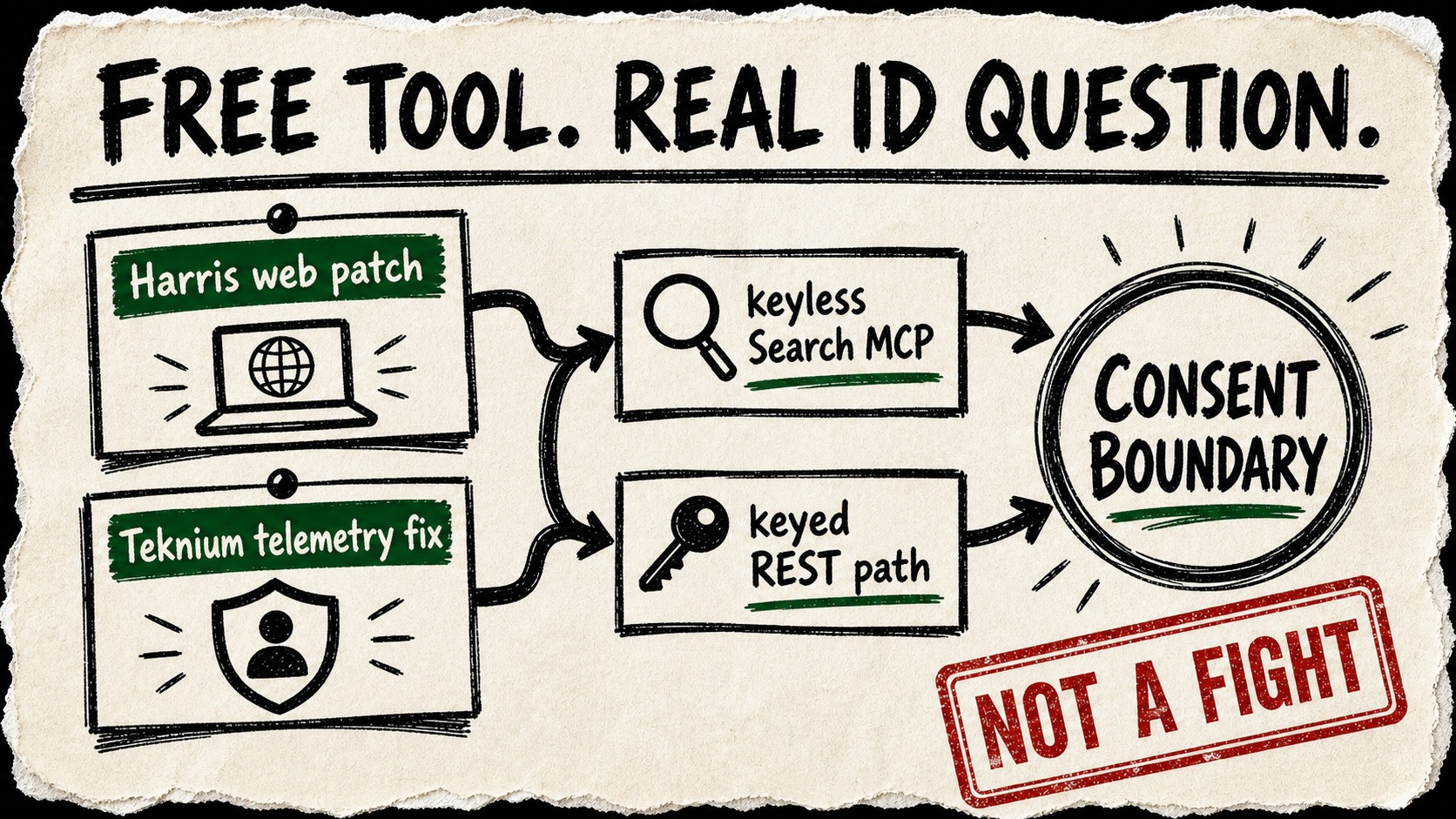
Diagram-style zine poster showing a contributor patch and maintainer fix feeding into keyless MCP and keyed REST paths, with a circled consent boundary.
Diagram Punkzero setup still needs an identity boundary.
repo NousResearch/hermes-agent evidence
4 source signals 1 repo 2 linked commits
Evidence: 2 linked commits / June 12, 2026 / Daily Edition
Open Edition Evidence below

The human story in Hermes Agent this week is not just that web search got another backend. It is that a contributor made search easier to use, then the project had to decide how much identity a free tool path should expose.

The convenience patch

Commit e0e25717, authored by Matt Harris and merged June 10, rewired Hermes' Parallel provider around two routes. Without PARALLEL_API_KEY, web_search and web_extract use Parallel's hosted Search MCP. With a key, the same provider uses Parallel v1 REST search and extract.

The patch is unusually explicit about user experience. It stops prompting users to configure web just because web.backend is unset, registers web tools with the free MCP as a backstop, and adds tests for anonymous headers, Streamable HTTP responses, web fetch ordering, keyed REST limits, and display labels.

The policy correction

The follow-up commit 0a5762c7, authored by Teknium, did not remove the feature. It changed the free MCP client identity from a Hermes-branded value to a generic mcp-web-client value, saying project policy forbids third-party usage attribution without explicit user opt-in.

That is a small code change with a large product lesson. Removing setup can create a new kind of default: a service sees traffic, a tool path has attribution, and a project has to decide whether that attribution belongs to the user, the tool vendor, or nobody by default.

Why it matters

The maintainer question is constructive and factual: when a hosted MCP makes agent tools work immediately, what should the client reveal before the user has chosen that provider? Harris' patch answers the ergonomics problem; Teknium's patch answers part of the consent problem.

Neither commit proves a finished web-search policy for every agent. Together, they show an agent runtime growing up in public: a contributor lowers the barrier to useful tools, and maintainers tighten the boundary so convenience does not quietly become attribution.

Evidence Trail

Receipts below the story

The article above is the public narrative. This section keeps the source trail, limits, and reporting notes on the same page.

Edition
DateJune 12, 2026
LaneDaily Edition
Confidence78%
Sources4
ReposNousResearch/hermes-agent

Reporter Notes

The companion is strongest as a maintenance story: contributor ergonomics work

met maintainer policy work. The feature and correction are both visible in

public commits.

Reporter Notes

This companion uses public professional activity only: two Hermes Agent commits

and public provider documentation. It credits visible contribution and

maintenance work without inferring private motivation.

Primary Evidence

extraction through a free hosted Search MCP when no PARALLEL_API_KEY is

set, and through Parallel v1 REST APIs when a key is present.

the path no longer names Hermes without opt-in attribution.

integration named in the Hermes source comments.

attribution context.

Evidence Limits

  • The commits do not prove private motivations or internal product planning.
  • The article does not claim Hermes' final long-term telemetry policy; it only

reports the policy reason stated in the follow-up commit.

  • The Parallel docs and terms are used only to identify the public hosted MCP

and attribution context; the Hermes commits are the evidence for Hermes'

implementation decisions.

Letters & Corrections

Send a note to the desk

Corrections, missing context, or a follow-up lead.