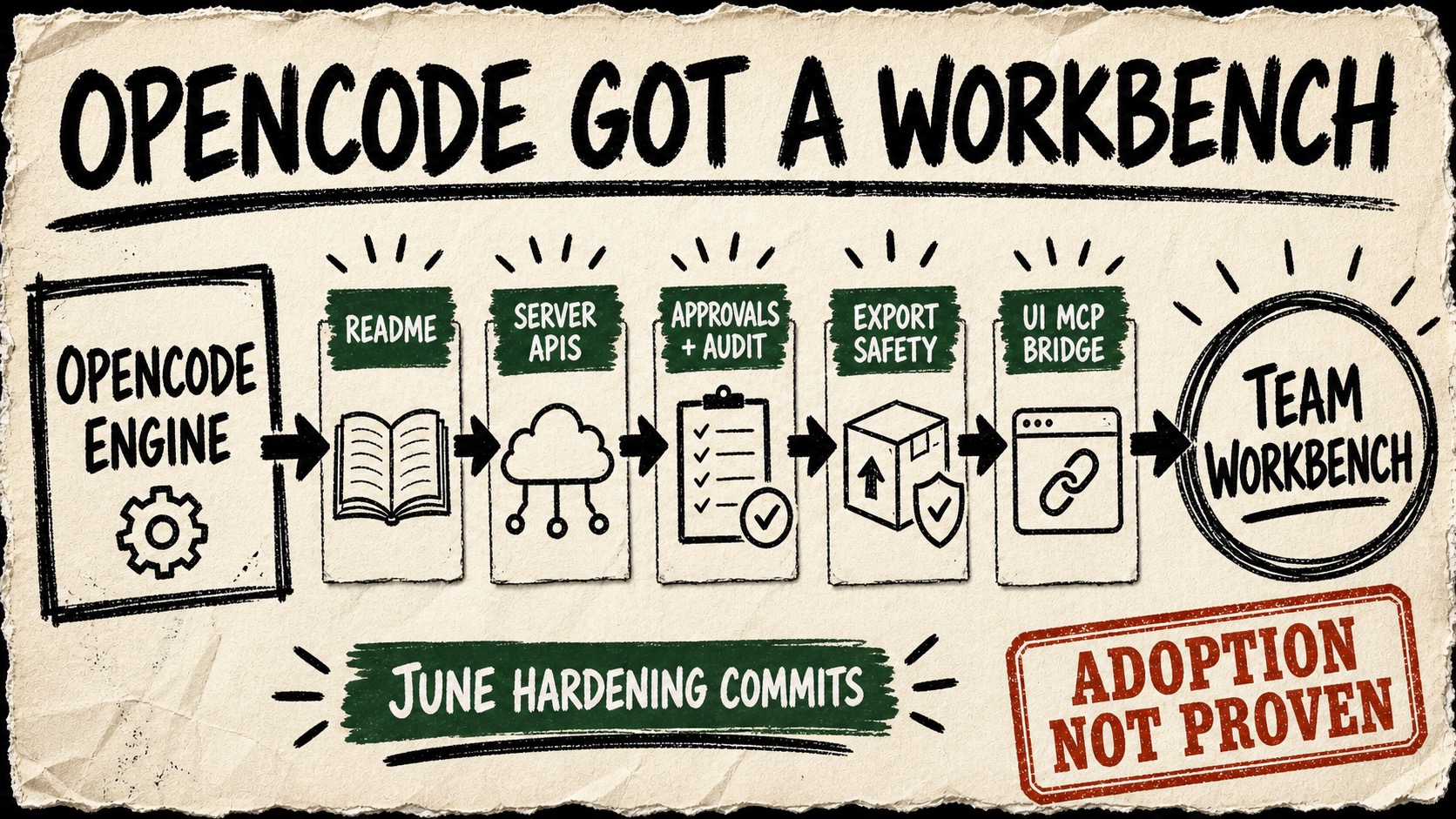
On June 16, different-ai/openwork merged documentation and fixes around hosted topology, database encryption, MCP JWT policy, organization ownership, and admin access, evidence that the OpenCode-based desktop app is becoming a team operations surface.
Facts
- The README frames OpenWork as a desktop app for local files, 50-plus LLMs, skills, plugins, MCP servers, and one-link setup sharing.
- The server package exposes endpoints for workspaces, events, skills, plugins, MCP, tokens, approvals, audit, import/export, and OpenCode proxying.
- The code includes manual approval requests, JSONL audit records, scoped owner/collaborator/viewer tokens, export secret scanning, and a bearer-protected UI MCP bridge.
Evidence
OpenWork differs by productizing the control plane around an existing agent engine. It wraps OpenCode with desktop, server, orchestrator, remote workspace, UI-control MCP, skills, plugins, and share/export mechanics.
Context
The consequence is practical: agent work is moving from one CLI session toward organizational machinery where teams decide who can install a skill, connect a worker, answer a permission prompt, export a setup, or inspect what happened.
Limits
The evidence shows architecture and hardening, not broad adoption. Windows support is framed as paid support, many cloud flows live under enterprise code, and the security commits show an active boundary under construction.