Daily Edition Sources +6

Agent Runtimes Are Learning When To Stop

Fresh OpenCode, Codex, OpenClaw, and Hermes Agent patches show agent tools turning long-running work into bounded, traceable runtime state.

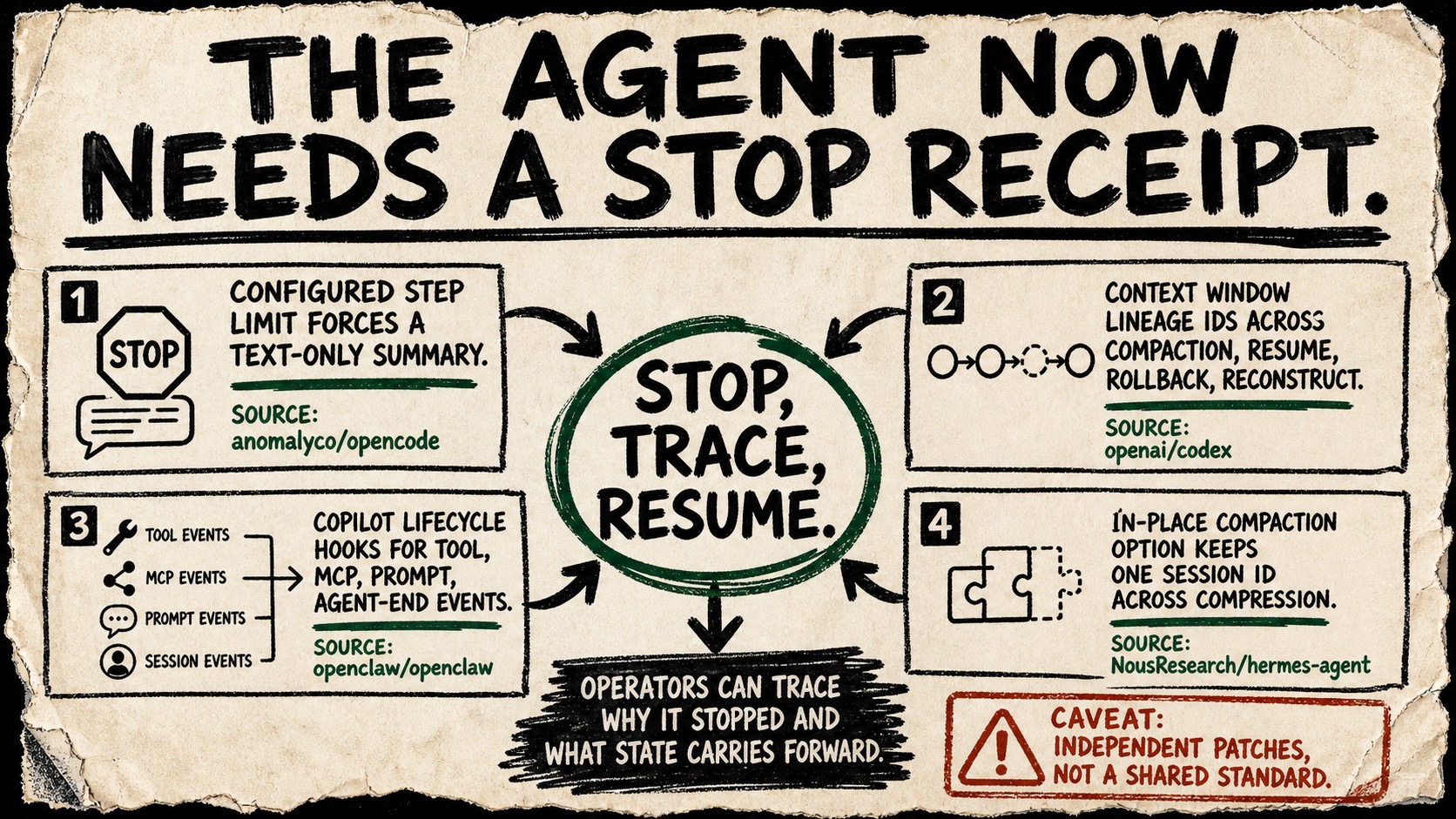
Diagram Punk poster showing OpenCode, Codex, OpenClaw, and Hermes evidence cards pointing toward a circled stop, trace, resume runtime contract.
Diagram Punklong-running agents now need stop receipts.
repos anomalyco/opencode + 3 more evidence
6 source signals 4 repos 4 linked commits
Evidence: 4 linked commits / June 21, 2026 / Daily Edition
Open Edition Evidence below

anomalyco/opencode merged Kit Langton's June 20 commit 4f1a9d7a, changing configured agent step limits so the final turn disables tools and asks for a text summary instead of failing as a runner error.

Facts

  • OpenCode moved the max-step prompt into core runner code and added tests that the final limited turn sends toolChoice as none with no tools available.
  • openai/codex commit d1209bdd added first, previous, and current context-window IDs that survive compaction, resume, and rollback.
  • openclaw/openclaw commit 03b022b8 routed Copilot prompt, tool, output, and agent-end events through standard harness lifecycle hooks.
  • NousResearch/hermes-agent commit 47fadc24 added an in-place compaction option that keeps one session ID across summarization.

Evidence

The receipts are runner tests, context-window state changes, lifecycle-hook wiring, and compaction code paths. Together they show stop, trace, and resume behavior becoming explicit runtime contracts.

Context

For agent builders and workspace operators, the practical question is no longer only whether the model can keep working. It is whether the system can say where the work is, why it stopped, and what state carries forward.

Limits

These are independent patches, not a shared standard. The evidence shows local engineering pressure around long-running agents; it does not prove that one common runtime model has arrived.

Evidence Trail

Receipts below the story

The article above is the public narrative. This section keeps the source trail, limits, and reporting notes on the same page.

Edition
DateJune 21, 2026
LaneDaily Edition
Confidence87%
Sources6
Reposanomalyco/opencode, openai/codex, openclaw/openclaw, NousResearch/hermes-agent

Reporter Notes

The strongest shared pattern is not "more controls" in the abstract. It is that agent systems are making the end of a run and the continuity between runs inspectable:

  • OpenCode makes a configured step limit ask for a summary with tools disabled.
  • Codex exposes lineage identifiers for context windows across compaction, resume, and rollback.
  • OpenClaw sends Copilot runtime events through harness hooks.
  • Hermes offers an in-place compaction path that keeps one session ID.

The under-covered source audit named OpenCode. That repo produced the lead's freshest concrete fact and the people companion, so the coverage gate is satisfied without forcing an unrelated source into the story.

The nearest repetition risk is June 14's recovery-path article and June 19's terminal control panel article. The new material is the stop-state contract: what happens when the runtime reaches a boundary, not simply what the user can see or click.

Primary Evidence

Evidence Limits

  • These sources do not show a shared standard or coordinated design across projects.
  • The article does not claim the patches are released to every end user.
  • The Codex and OpenClaw evidence is implementation-level; the Hermes and OpenCode evidence shows options and tests, not universal default behavior across all deployments.
Letters & Corrections

Send a note to the desk

Corrections, missing context, or a follow-up lead.