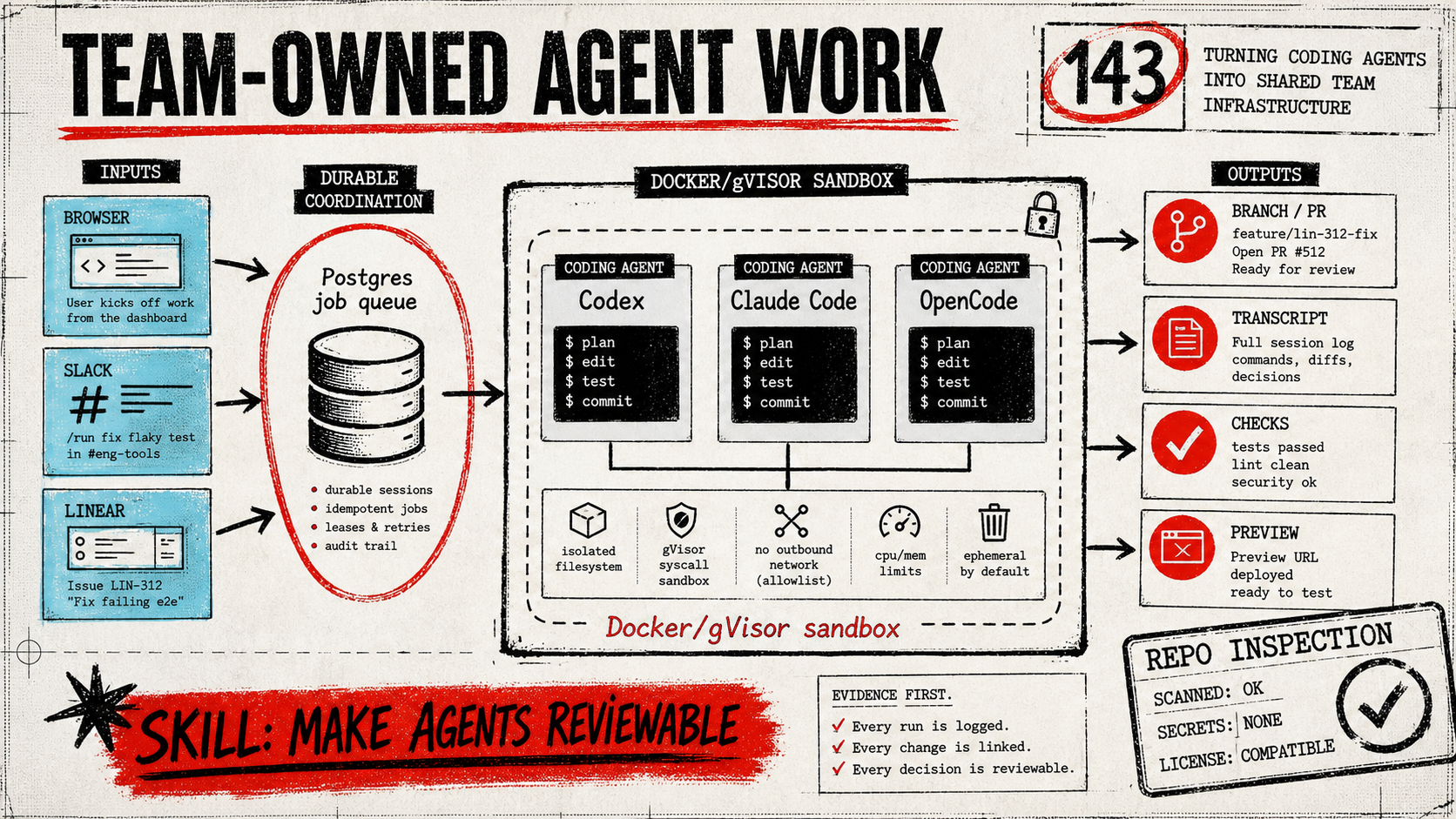
Assembled open-sourced 143 this week after a Hacker News post described the internal system it built for running coding agents as a team. The public post names Codex, Claude Code, OpenCode, gVisor sandboxes, GitHub, Linear, Sentry, Slack, PagerDuty, and self-hosting as part of the system.
The GitHub repo backs up the claim with more than a launch page. Its design overview describes organizations, sessions, agent tabs, automations, previews, branches, PRs, a Postgres job queue, worker-owned sandboxes, and a GitHub-native review path.
The Skill
The transferable skill is architectural restraint: 143 treats the coding agent as one process inside a durable workflow, not as the workflow itself. Browser, Slack, Linear, and Sentry inputs become sessions; workers run agent sandboxes; outputs become branches, PRs, transcripts, checks, and previews that humans can inspect.
The Receipt
The repo's durable-session-executor design is the engineering-depth receipt. It splits short-lived worker dispatch from per-session executor containers, fences terminal writes with job leases, records heartbeats, handles drain and recovery, and avoids routine deploys killing long-running agent turns.
The Caveat
This does not prove 143 is mature for every team or that its hosted service fits every security model. What to watch: whether the public repo keeps turning its design docs into implemented, testable runtime boundaries rather than only product positioning.