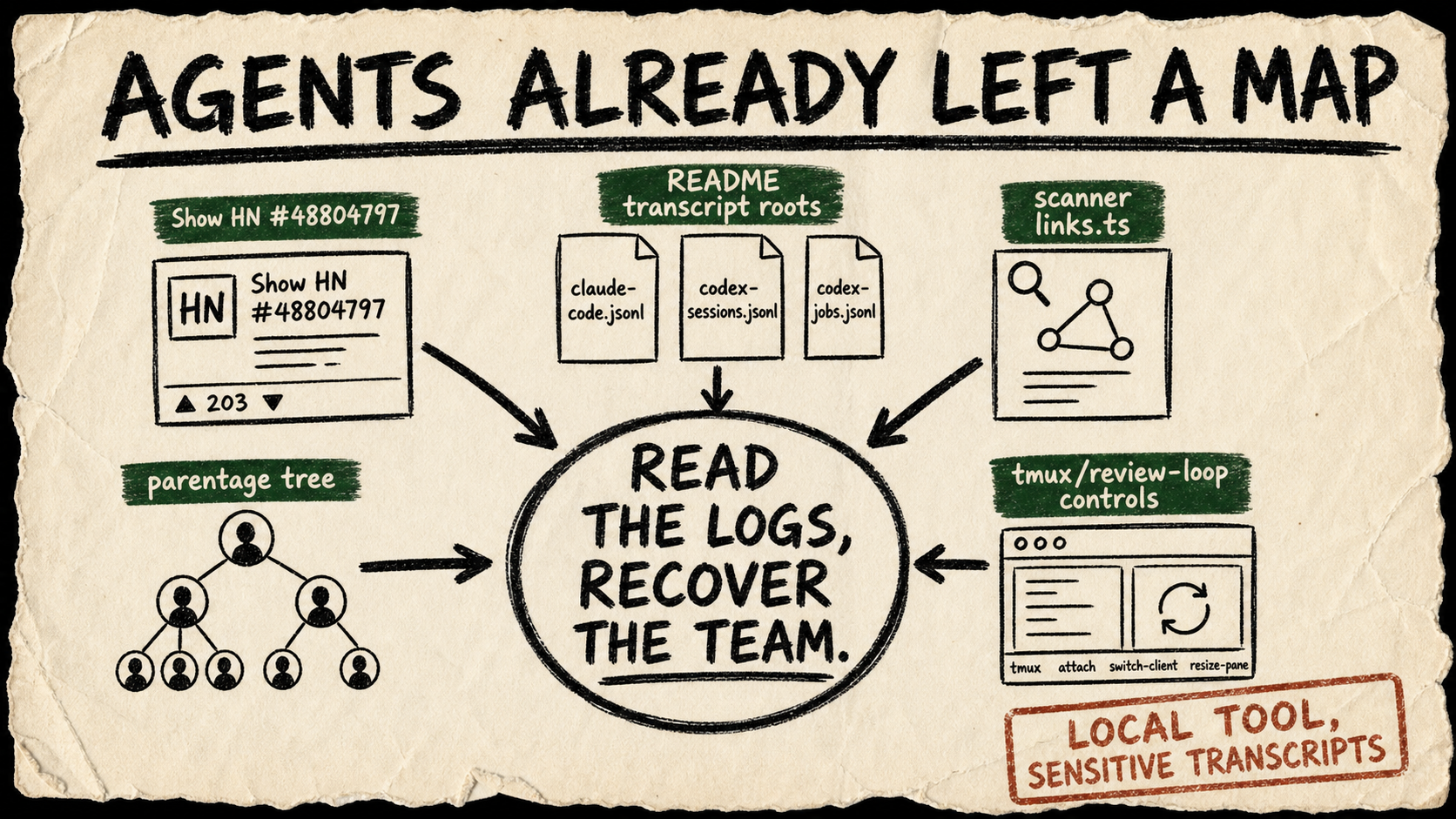
The public proof is direct: the July 6 Show HN post says the builder frequently runs parallel Claude Code and Codex agents, built the project with Claude Fable 5 and Codex, and points to the GitHub repo where the scanner, parentage tree, tmux controls, review loop, and token-gated Tailscale access are inspectable.
The Engineering Problem
The hard part is not showing a chat log. The repo has to discover transcripts under ~/.claude and ~/.codex, recover spawned subagents and background tasks, keep scans fast, reject paths outside whitelisted roots, and still let the operator jump back into the right tmux pane.
The Repo Receipt
The README names the transcript roots and the parentage tree. ARCHITECTURE.md describes a scanner pipeline from discover to links, a path allowlist for log reads, and a token proxy for remote access. src/lib/scanner/links.ts implements lineage recovery, compaction chains, background-task command lookup, and cross-session fallback scans.
The Building Skill
The transferable skill is to build observability from durable artifacts the tools already write. Instead of asking agents to report their status perfectly, Live Log Viewer treats transcripts, process state, and tmux panes as the source of truth, then layers UI and control on top.
Limits
This is a local single-user tool, and the README warns that remote access can expose sensitive transcripts and command endpoints. What to watch: whether the parentage model survives messy real sessions and whether contributors add safer read-only modes for review-only use.