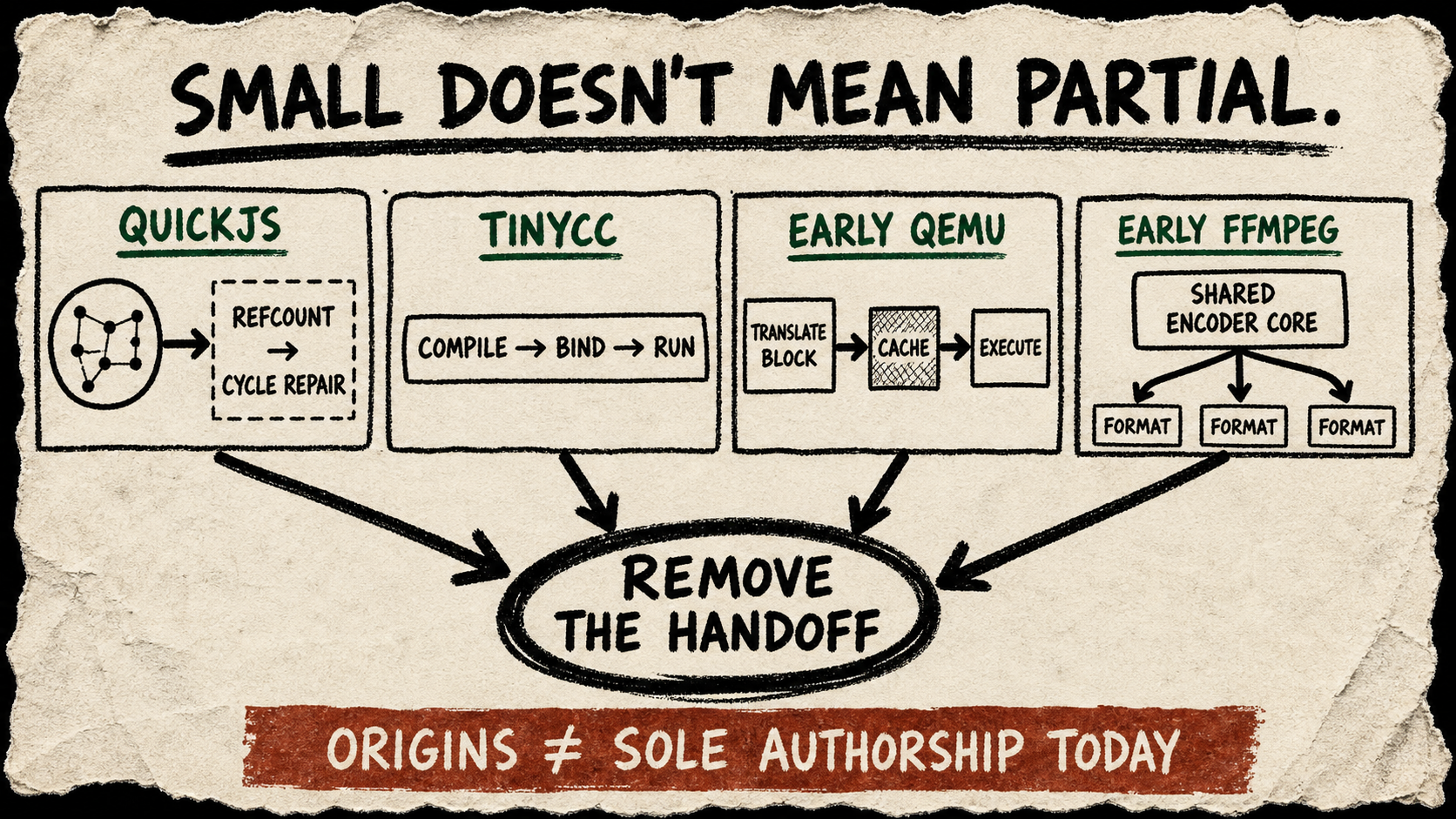
“Small” is the adjective usually attached to Fabrice Bellard's software. It is true but incomplete. Across four public source trails, the more transferable pattern is what disappears: a separate garbage-collection pause on the ordinary path, a compiler subprocess, instruction-by-instruction translation, or a fresh encoder for every video format. Compact code is the result. The design move is to remove a handoff.
QuickJS keeps the common memory path ordinary
The current QuickJS documentation describes reference counting with a separate cycle-removal pass. The June 2026 source makes that split concrete: ordinary values are duplicated and freed through small reference-count operations, while the exceptional cycle path runs decrement, scan, and cycle-free phases explicitly. A runtime does not have to charge every value operation for its hardest ownership case. It can make the usual lifecycle deterministic and isolate repair.
The same project turns JavaScript into an embeddable unit rather than a service one must talk to. Its compiler, qjsc, can emit C containing bytecode and a small entry point; the runtime exposes a C API and is organized as a few C files without an external dependency. This is current collaborative work—the official page credits Bellard and Charlie Gordon unless otherwise noted—not evidence that one author owns every present line.
TinyCC removes the compile-to-run trip
TinyCC's 2001 public history begins with a Makefile, a task list, and a roughly 920-line tcc.c. The more revealing artifact arrives in Bellard's May 2002 “added libtcc” commit. Its compact public API creates a compiler state, compiles a C string, binds a symbol supplied by the host program, and runs the generated main in process. The accompanying test compiles Fibonacci code, injects a host add function, and calls tcc_run.
That is more useful than the old size and speed boasts around TinyCC. A pipeline that used to require source files, a compiler command, object files, a linker, an executable, and a second process becomes a callable capability. The transferable skill is not merely golfing the compiler. It is exposing the compiler's useful interior as an API. Bellard's own project page also says he no longer works on TCC; today's repository is a community-maintained system, not a preserved solo artifact.
Early QEMU pays for translation by the block
The first weeks of QEMU's public history show a boundary being moved in steps. The February 2003 import includes executable loading, syscall translation, signals, and structure conversion. A new x86 CPU core follows; then the translator starts consuming several guest instructions at once. Bellard's March 6 translation-cache commit maps a simulated program counter to a generated host-code pointer. The execution loop looks up a block, translates on a miss, caches it, and invokes the host block directly.
The handoff between guest machine and host machine still exists, but it is no longer paid one instruction at a time. Work is batched until a jump and reused under a stable identity. Modern QEMU has since accumulated a vast community history and many architectures; this early sequence supports a claim about its originating mechanism, not ownership of the present project.
Early FFmpeg shares the engine and moves formats to the edge
Bellard's December 2000 initial FFmpeg revision is already a small system rather than a codec trick: 38 files and roughly 13,200 lines across a command-line tool, server, and codec library. Its README says MPEG-1, H.263, and RealVideo-compatible streams share one encoder core and differ chiefly in coding tables. The initial codec header gives that common mechanism a narrow interface—initialize, encode, close—while programs sit above it.
That early source does not justify assigning today's FFmpeg to Bellard; the current project is an extensive community framework. It does show the abstraction that made community growth possible: keep compression mechanics in a shared kernel and push format policy toward the edge.
The four gems are not proof that every system should be tiny or written by one person. They suggest a better question for runtime and tooling builders: where is the same expensive boundary being crossed again and again? Make the normal ownership path cheap. Turn a pipeline into an API. Translate a reusable block instead of an instruction. Share a mechanism and isolate policy. Small does not mean partial when the vertical slice is complete.