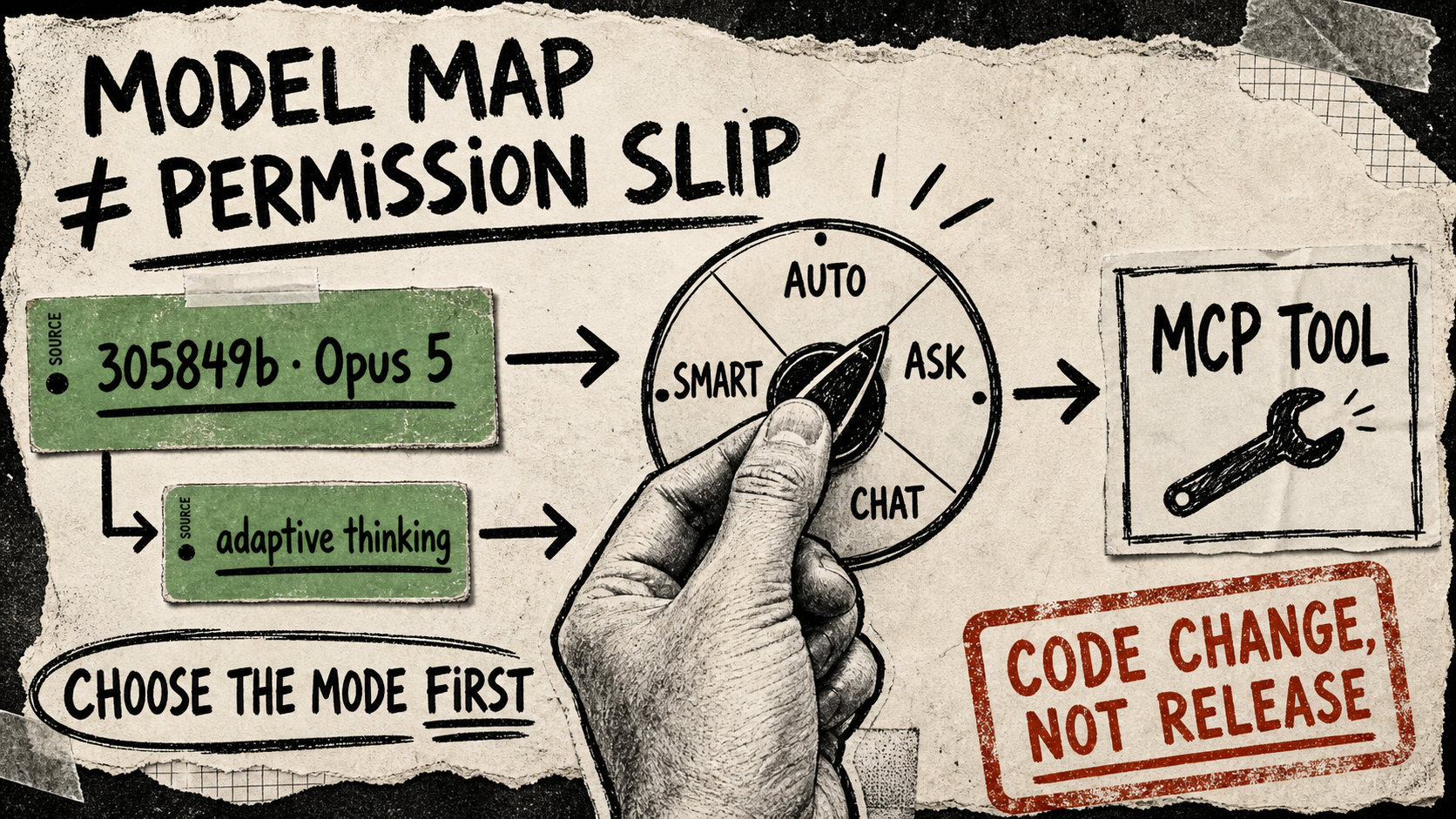
A model picker is not a permission screen. On July 27, aaif-goose/goose added Claude Opus 5 to its public provider map. The commit does the unglamorous work that makes a model name usable in a runtime: it adds provider identities, teaches the Anthropic request formatter to use adaptive thinking, and tests that the model resolves. For someone running an agent on a real machine, the next question is not merely whether that mapping exists. It is what authority will travel with it.
The choice starts before the first tool call
For aaif-goose/goose, the public permission-mode guide makes the choice unusually plain. It offers Autonomous, Manual Approval, Smart Approval, and Chat Only, and documents Autonomous as the default. That means compatibility and control are separate surfaces: the model mapping determines what request shape Goose can form; the mode determines whether tools and file changes can proceed without a person stopping the run.
The relationship matters because Goose is not a remote model catalogue. Its extension documentation describes MCP connections to applications and tools, and warns that autonomous operation with the Developer extension can execute commands and modify files without approval. The practical public situation is therefore a familiar one: an operator has found a new model route and must choose the control boundary before that model receives a local capability.
Make the mode part of the model test
That is a small change in habit with a large payoff. In a non-sensitive workspace, pick the intended mode, add one known extension, and write down which tool calls need confirmation, which are allowed, and how an unfamiliar tool is handled. Repeat the same bounded task after changing the model. The exercise cannot certify safety, but it can reveal when a compatibility upgrade has quietly changed a person’s understanding of who holds the key.
The cited sources prove source changes and documented intent, not a release, a working provider account, an end-to-end tool call, or production reliability. They also say nothing about how any individual team has configured Goose. The next useful receipt would be a public release and an end-to-end test that sends the newly mapped provider through a local extension under each permission mode. Until then, the right question before starting a session is precise: not just “can Goose run this model?” but “which mode will run it?”