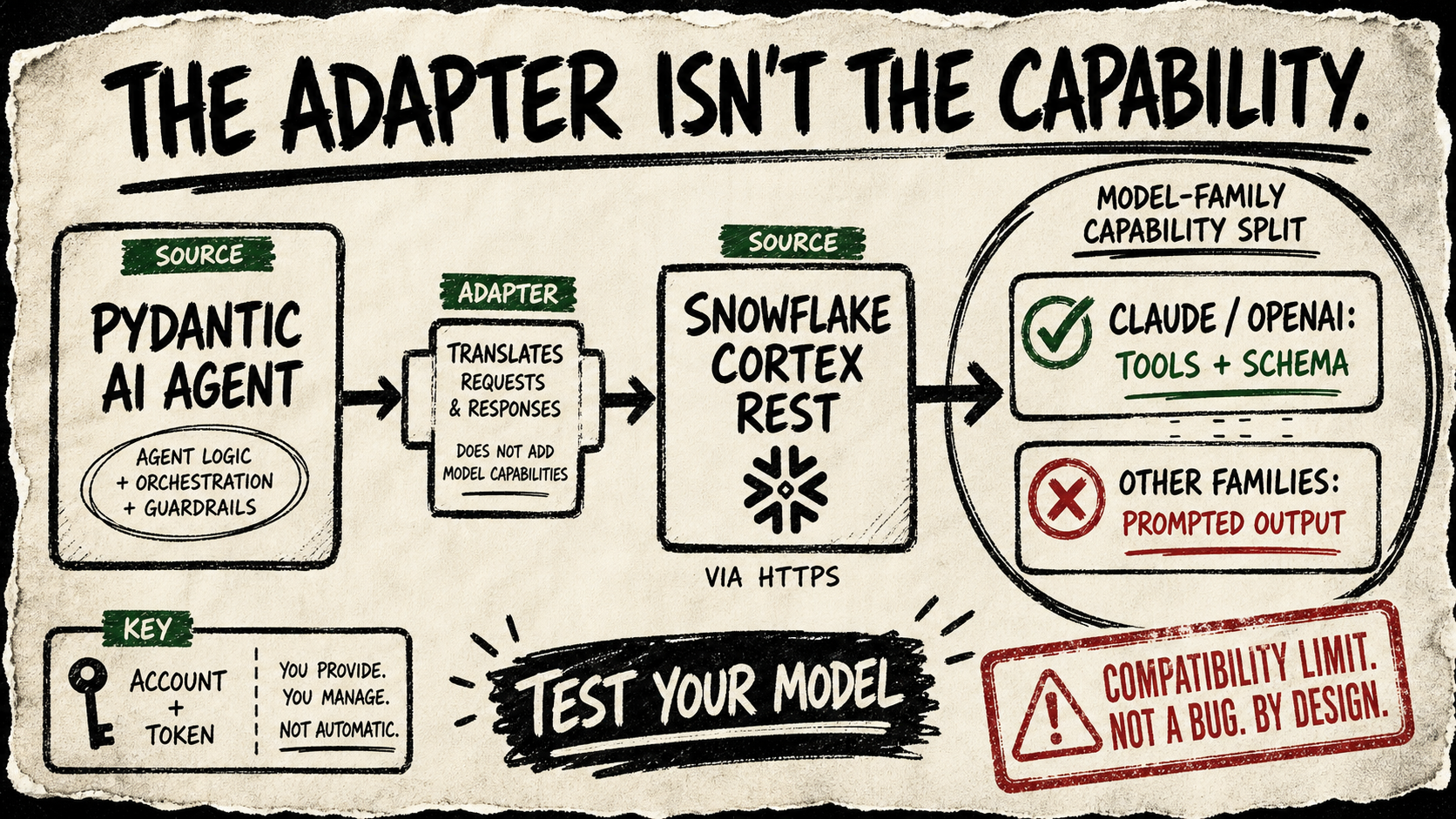
API discovery: Snowflake Cortex REST is the public provider surface; Pydantic AI’s new SnowflakeModel and SnowflakeProvider wrap it in the same agent interface used for other model backends. The practical hook is an account-bounded data-quality assistant: turn a proposed warehouse metric definition into a structured review brief without designing a fresh model adapter first.
Try it
Use a disposable Snowflake project and a least-privilege credential to make an agent produce a schema-checked “metric readiness” brief: intended definition, missing dimensions, access assumptions, and questions for the data owner. Pydantic AI’s documentation shows the account-and-token setup and the direct model form. The important design constraint comes from the same source: tool calling and native structured output are documented for OpenAI and Claude families; other Cortex families fall back to prompted output.
Copy-paste agent instruction
In a new disposable Python project, add pydantic-ai with its Snowflake extra. Do not request, print, commit, or transmit any real token. Using only a test Snowflake account and a least-privilege credential supplied through local environment variables, create a small Pydantic AI agent for `snowflake:claude-sonnet-4-6` that returns a structured MetricReadinessBrief with definition, missing_dimensions, access_assumptions, and owner_questions. Before running it, show which selected model family supports native structured output and tool calling; if it does not, stop and explain the prompted-output fallback. Run only a harmless synthetic example, then remove the local test credential.Test caveat
This is a source-and-test discovery, not a live account result. The documented path needs a Snowflake account identifier plus a programmatic access token, OAuth token, or key-pair JWT and an appropriate Cortex role. Entitlement, billing, model availability, data policy, and performance are account-specific; test only against synthetic or approved data, and verify the capability profile of the exact model you choose.