Most agent tooling tells a model what functions exist. Qwen Code has now made a different argument: the tool description should also tell the model when a workflow is warranted, when a pipeline beats a global barrier, and why a subagent answer needs a verifier. Its merged public pull request carries a Claude Opus 5 co-author trailer and reached main with 109 reported checks. That is public evidence of coding-agent assistance on this change, not a claim that every judgment in the patch was made autonomously.
The repo evidence
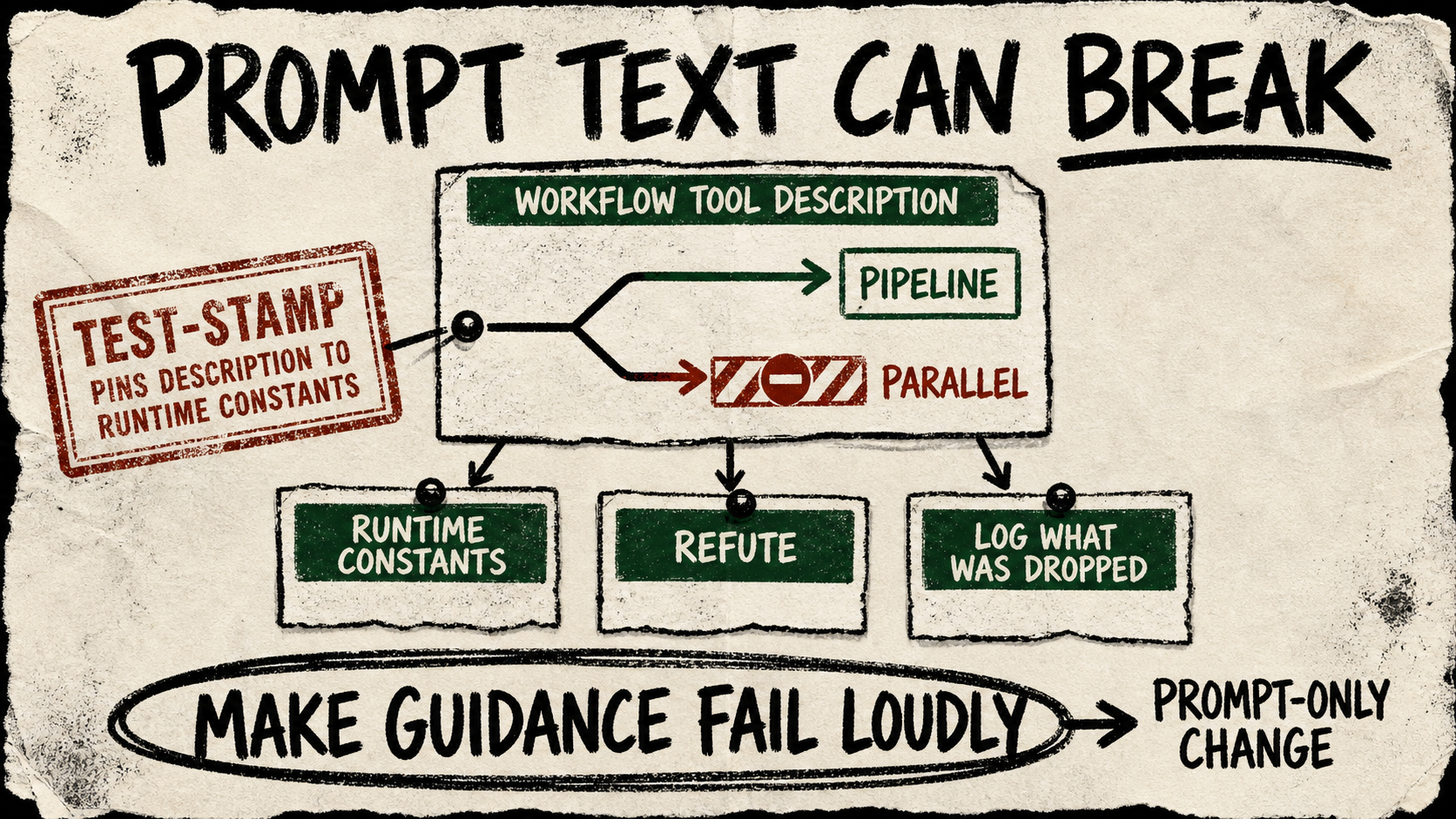
The inspected commit moves the Workflow tool’s model-visible text into WORKFLOW_TOOL_DESCRIPTION. It preserves runtime facts—concurrency, agent caps, resume behavior, sandbox boundaries—and adds a decision layer: scout before fanning out, prefer pipeline() when items can move independently, reserve a barrier for genuine cross-item work, and ask independent agents to refute important findings.
The engineering depth is in the anti-drift work. The description interpolates the agent cap and two environment-variable names from exported runtime constants instead of spelling them in prose twice. New tests anchor the policy sections, the cap, the one-level nesting limit, the saved-workflow location, and the mirrored script parameter description. A future refactor that quietly removes the instruction a model depends on should make the suite red.
Turn guidance into a contract
The transferable skill is simple to state and hard to practice: treat agent-facing prose as behavior-bearing code. First identify the sentences that would change an agent’s plan—choice rules, limits, failure handling, and honesty requirements. Then bind each to a source of truth or a focused test. Here, a raised runtime cap updates the model-visible description through the same constant; a deleted policy section trips a named expectation. That is stronger than a style review of a prompt and narrower than pretending a test can prove every model response.
The limit
The Qwen Code pull request records a small internal evaluation in which policy-bearing descriptions produced better-shaped workflow scripts, but it is not a general benchmark of model quality or production outcomes. The code change is prompt text only: it does not add a scheduler, a sandbox control, or a new runtime guarantee. The next useful signal is whether public task-level tests show the policy survives real repository work without encouraging unnecessary orchestration.