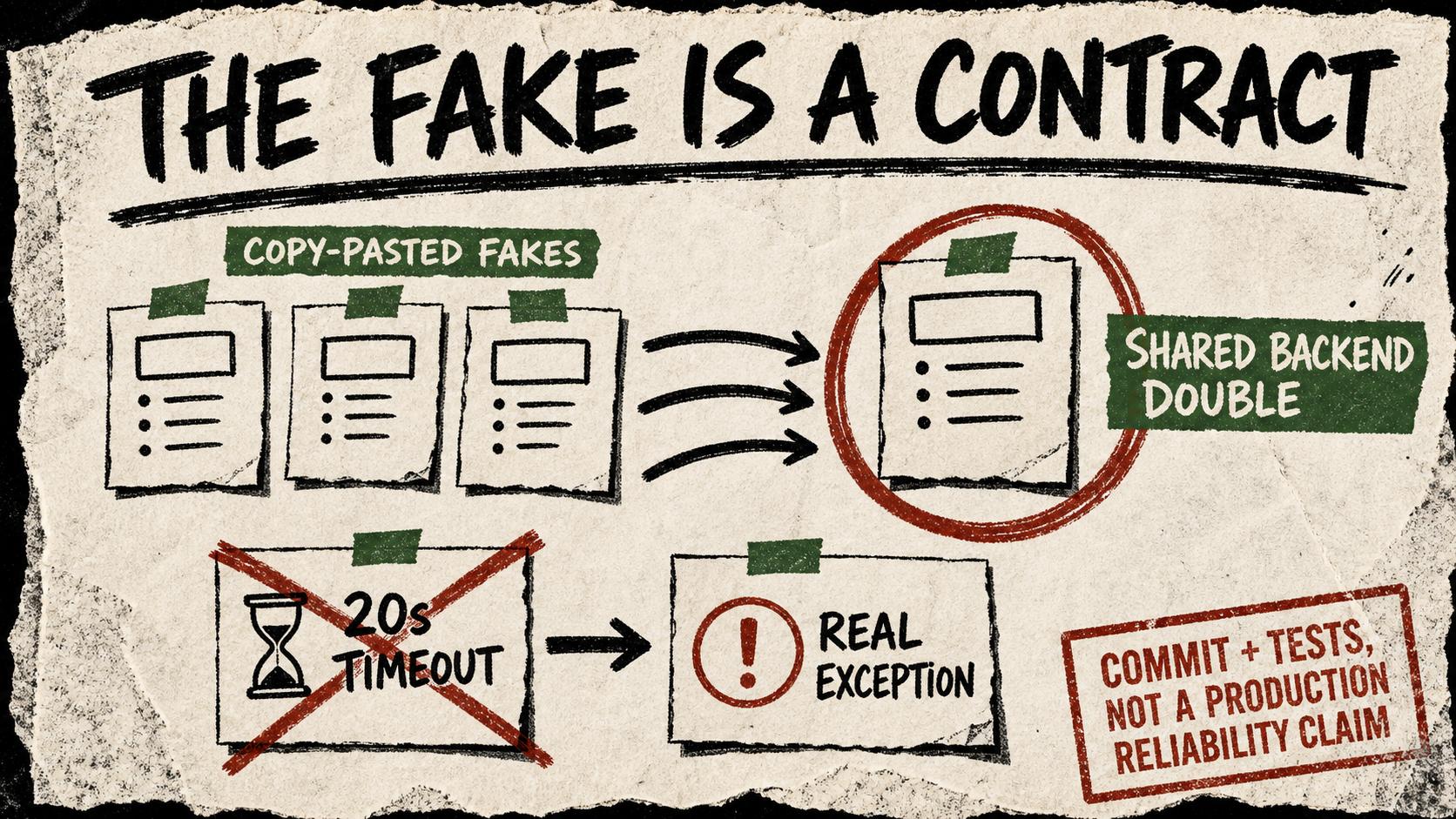
When a test double omits a production attribute, the visible failure is often the least useful part of the story. In Unsloth’s CI-repair commit, an unguarded backend read left multiple hand-written fakes behind. Some tests surfaced an attribute error directly; others waited twenty seconds for an async frame that would never arrive. The commit carries a public Co-authored-by: Claude Opus 5 trailer, evidence of coding-agent involvement—but not a claim about who authored each line.
The repo evidence
The engineering answer is small enough to reuse and broad enough to matter. A new shared FakeLlamaCppBackend defines the common production-facing attributes once, including context_length. Scenario-specific tests can still override behavior, but they no longer each invent the shape of a loaded backend. That shifts the next drift from a scattered aftershock into one explicit contract update.
The companion frame-wait helper makes the second repair more revealing. It waits on both the event and the task driving the request, checks the task first, and rethrows a real exception even when a frame event happened too. A timeout remains possible—but only when the request is genuinely still parked rather than when the assertion machinery has swallowed the cause.
The transferable skill
For builders using agents to repair a test suite, ask the agent to map every fake to the production reads it stands in for before it edits the failing assertion. Centralize the shared surface, then add a canary that passes the sparsest valid fake through the real route. In asynchronous tests, inspect and surface the driver task’s exception before declaring an event wait a timeout. Those two constraints turn a persuasive patch into a test that can accuse the next change at the right boundary.
The limit
The public code and tests show a focused repair, not a universal CI cure or a production reliability result. The agent attribution is deliberately limited to the commit trailer. The next useful receipt would be a follow-up failure caught by the shared canary—or evidence that a new backend read must be represented somewhere other than this fake’s common surface.