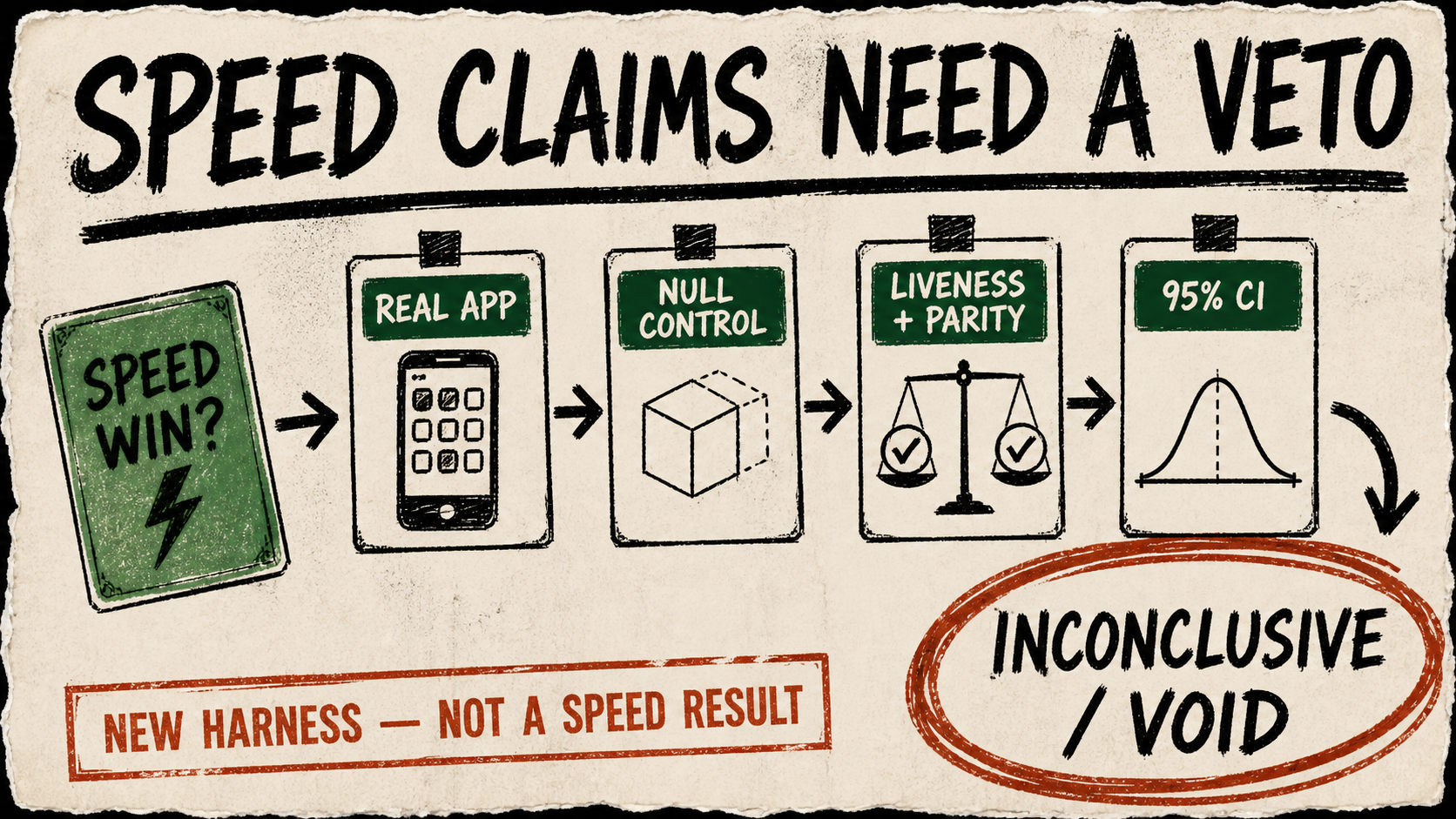
Most software performance stories begin with a number. Unsloth’s latest Studio work begins with the conditions under which it will refuse to print one. Its new StudioBench commit adds a real-app benchmark for its Studio interface, but the more consequential addition is a set of ways for an apparent win to be declared inconclusive—or void—before it becomes a claim.
That is a response to a specific embarrassment in the commit’s own account: the previous harness used a fixture that skipped the chat-adapter and autoscroll paths under investigation. It could produce a neat result while missing the mechanisms it was supposed to measure. The replacement drives a production Studio install through a controlled stream and scripted interactions, rather than treating a convenient local stand-in as the product.
The win has to survive its controls
The accompanying performance protocol makes the burden unusually explicit. A proposed change is compared with a same-build null control, checked to make sure the scripted actions actually ran, tested for sign consistency and stability, and compared for UI parity. A fast screening run can point to a direction; it is not allowed to supply a magnitude. The point is not ceremony. A dropped action can make a noisy run look cleaner than it was, and a timing improvement that copies only a fraction of a conversation is a regression in disguise.
An inconclusive win is not a smaller win
The source code makes a deliberately asymmetric call. In the A/B scorer, an apparent improvement whose 95% interval still includes no effect is kept out of the headline. An unresolved regression remains in the report, because removing it would make the result rosier. That is the useful pattern here: build the instrument so the cost of uncertainty is a missing boast, not a quietly optimistic number.
Unsloth has not published a new user-facing speed result in this change, and it would be wrong to manufacture one from the harness. The next signal worth watching is a completed comparison that carries its null control, liveness record, parity check, and raw enough evidence for another reviewer to see what the benchmark chose not to call.