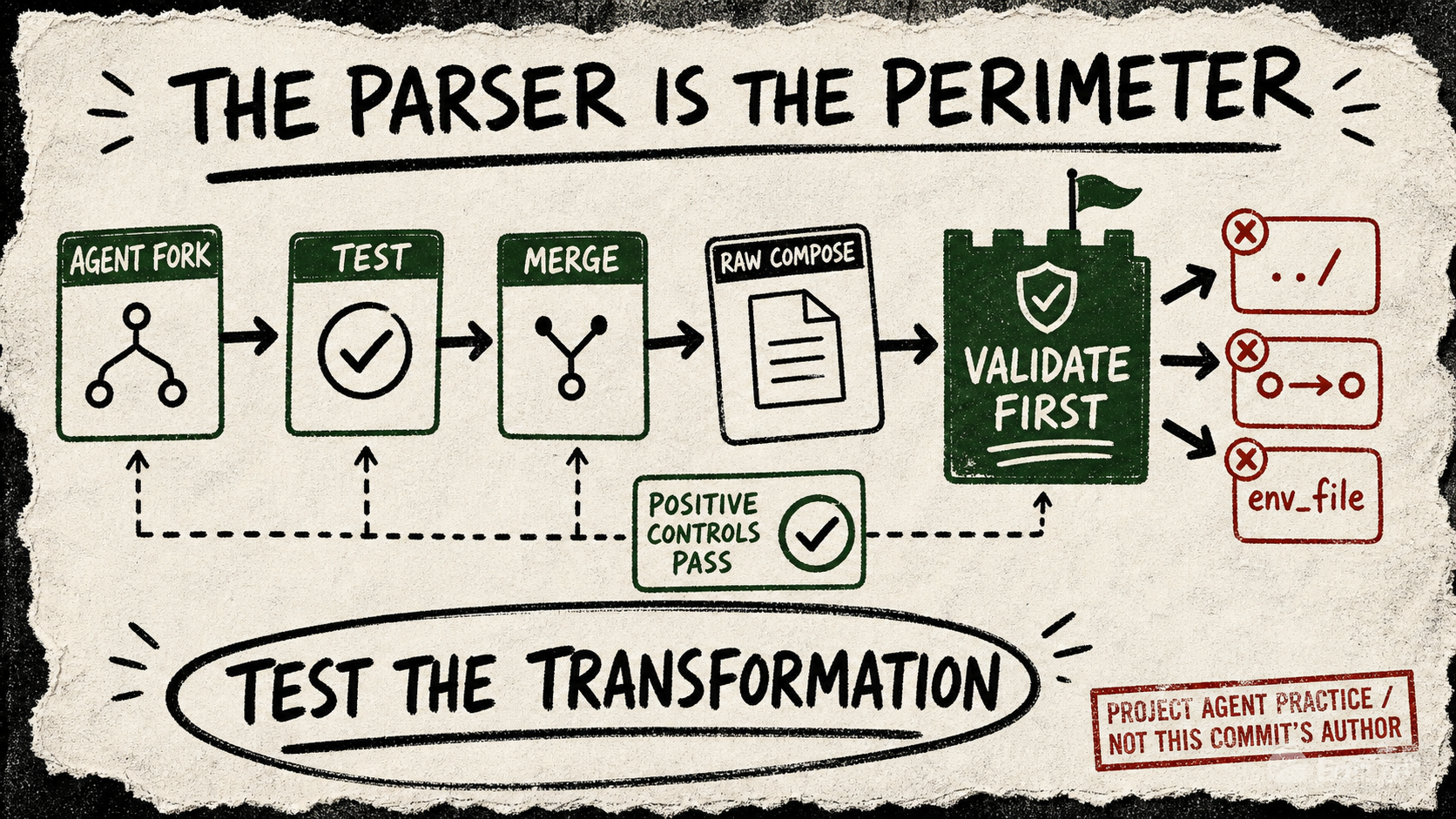
Headlong’s public README describes an agent working in its own fork of the project and says more than 50 of that agent’s commits have been pulled back into main. That is useful public proof of coding-agent-assisted project practice. It is not proof that an agent wrote today’s broker hardening, so the engineering deserves to stand on its own.
The repo evidence
The inspected broker source is not a thin wrapper around a Docker command. It extracts path-bearing fields from a Compose model, resolves candidate paths against a contained root, distinguishes known non-path references from local contexts, and deliberately runs an uninterpolated render first for environment and label files. That sequence matters because the default renderer reads those files and replaces their path fields with values.
The matching containment fixture drives the real policy function through a sibling-prefix path, a .. climb, symlinks, volume devices, secret/config files, extra contexts, build SSH, local caches and raw environment files. It also preserves ordinary inside-the-workdir cases. That combination—bypass cases plus positive controls—is engineering evidence, not a promise made by a README.
The transferable skill
Transferable building skill: test the transformation, not just the input. When an agent can author configuration for a privileged service, list every transformation between its request and the authority it reaches: parser, interpolation, path resolution, defaulting, renderer and error reporting. Put the invariant before the first step that can consume or reinterpret untrusted data. Then make each suspected bypass execute against that same guard, while keeping a clean ordinary configuration as a positive control. A string check at the first API boundary would not have caught a path that vanishes after the parser opens it.
The limit
The public evidence shows an agent-assisted project and a substantial source-and-test change; it does not attribute this pull request to a coding agent, prove a release contains it, or certify every deployment. The next useful inspection is whether the eventual release notes and future broker tests keep the raw-render ordering intact when Docker Compose adds another way to name a host file.