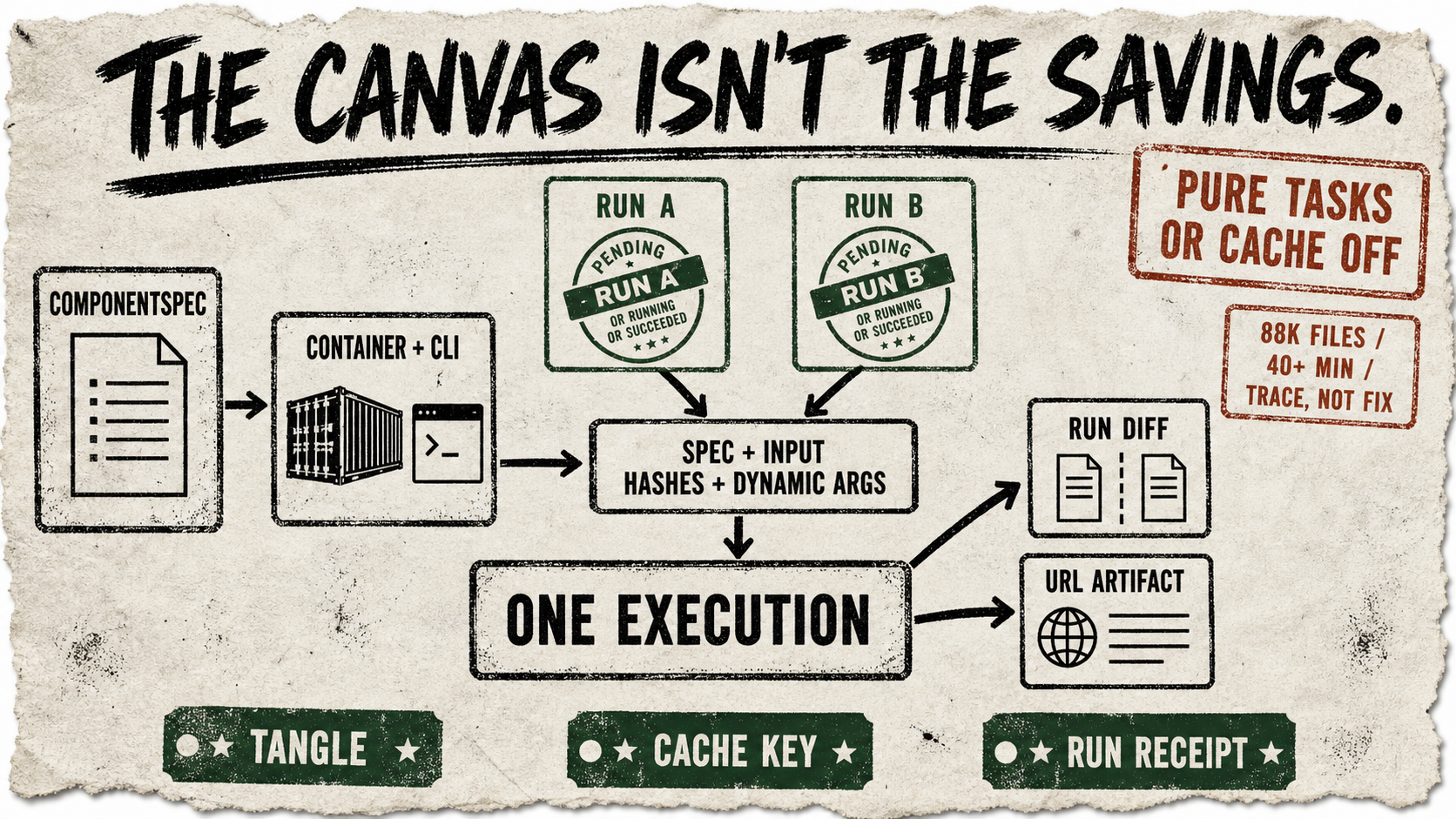
On September 1, Tangle’s public front end learned to turn a pipeline’s URL output into a link. The merged URL Artifact Previews change recognizes a declared URL, URI or link artifact, and also notices when a plain text value is one complete web address. It opens only HTTP or HTTPS values, rejects javascript:, data:, file:, gs: and other schemes, caps the value’s length, and tests the refusal paths.
That is a small interface improvement with a useful premise underneath it: the output of a machine-learning step is not disposable console exhaust. It is an addressable object in an experiment record. Tangle wants a person to open it, compare it, clone the run that produced it, or let another pipeline reuse the work.
The same source now exposes a harder reader of that record. Tangle’s master branch contains an AI Sidekick that can search components, inspect a pipeline, add or delete tasks and ports, connect edges, change arguments, validate the graph, and submit a run after an explicit request. A draft pull request says the assistant is ready to be enabled for everyone. It is not enabled for everyone yet: the current public flag remains off by default, and the proposal is still open.
More revealingly, a September 1 stack of open patches describes what happens when an assistant can see a nested pipeline without reliably knowing which graph owns the thing it is editing. A deletion can report success while changing nothing. A name intended for a subgraph can hit a same-named task at the top level. A connection can cross a graph boundary that the pipeline format cannot represent. The proposed repair is not a better prompt. It is a typed, location-aware mutation contract that can resolve one owner graph—or refuse the operation.
That tension changes the obvious Tangle story. The project is not simply making ML “no code.” Its consequential work is turning arbitrary container programs, data artifacts and execution history into a graph precise enough for people to reuse and for an agent to edit without guessing.
The boxes are declarations; the work is still real code
Tangle arrived in public under Shopify’s name on December 5, 2025. In the company’s launch report, creator Alexey Volkov says it began as Cloud Pipeline Studio, a tool he built before joining Shopify, then became infrastructure for Search & Discovery and other teams. Shopify reports more than a year of compute time saved and thousands of redundant hours avoided each month. Those are first-party operating claims, not independent benchmark results, but the open source shows the mechanism they are describing.
A Tangle component is a YAML specification around a command-line program in a container. It names inputs and outputs, records metadata, selects an image, and describes how values or file paths reach the program’s arguments. A configured component becomes a task; a task invocation becomes an execution; connected tasks become a graph; the root graph is the pipeline. Python can hand a CSV to Rust, which can hand a model artifact to JavaScript, because Tangle’s real integration boundary is the command line and the filesystem rather than one in-memory language runtime.
The canvas edits that declaration. The backend still has to move artifacts through storage, launch containers locally or remotely, collect logs, and decide when downstream tasks can start. Its API server and independent orchestrator communicate through the database; launchers translate the same graph into local Docker or Podman, Kubernetes, Google Cloud, or Hugging Face Jobs according to the deployment.
This is why “visual” and “no infrastructure” should not be confused. A reader can open the hosted canvas and build without registration. Running there requires a Hugging Face account, repository and job permissions, and a Pro subscription. Running locally requires the Tangle repositories, uv, and Docker or Podman. The graph lowers the cost of assembling and reading the workflow. It does not make the containers, credentials, storage or compute disappear.
The cache key makes “don’t rerun it” concrete
Tangle’s strongest idea lives below the canvas. In the current backend, the container-execution cache key is calculated from the container specification, dynamic arguments and the hashes of input artifacts. The structure is serialized with sorted keys and hashed into an execution identity. This is more specific than saying two tasks have similar ancestors in a DAG: Tangle asks whether the work and the bytes entering it are the same.
Unless a task sets P0D to disable reuse, the orchestrator can look for a matching execution that is pending, running or already succeeded. The reuse path links the new run’s execution node to that existing container execution. If it has finished, the output artifact records are attached. If it is still running, several experiments can wait on the same piece of compute rather than launch duplicates.
“Global” therefore needs a boundary. On a shared team backend, the same work can serve pipelines and colleagues that use its database. On Tangle’s public multi-tenant Hugging Face service, each user has a separate database and artifact repository; strangers do not receive one universal cache. An organization’s single-tenant deployment can offer an organization-wide cache. The useful unit is the tenant or backend, not the whole internet.
Content equality also is not semantic correctness. Tangle’s own caching guide tells component authors to behave like pure functions. A component that reads a changing website, clock, queue or external database without declaring that state can return a stale “match.” Authors must add a nonce or date input, set a maximum staleness, or disable caching. Tangle’s type names are optional metadata rather than centrally enforced runtime validation, so the consuming program still owns the final decision about whether an artifact means what its label says.
The Sidekick turns the graph into an agent tool surface
The beta assistant makes those old abstractions newly important. Its editor dispatcher routes a request among general help, component search, pipeline architecture and repair. A separate debug assistant is deliberately read-only. The architecture and repair agents can call a public ComponentSpec Object Model tool set: rename a pipeline or task, add and delete tasks or inputs and outputs, set arguments, make or unpack subgraphs, connect edges, validate, and submit.
The model does not mutate the browser’s state by emitting a loose block of YAML. It runs in a Web Worker, crosses a Comlink bridge, and asks the main thread to apply typed operations to the live MobX graph. Tool calls are grouped into editor undo steps. That is sound interaction design: a machine edit should land through the same model the visual editor understands, remain reversible, and produce a validation result a person can inspect.
It is also real authority. The assistant is configured with a bring-your-own OpenAI-compatible provider. The public client is permitted to run in the browser, and the provider key is stored in localStorage. The source warns plainly that JavaScript on the same origin can read it and recommends scoped, rotated credentials. Self-hosters should take that literally: an agent that can submit container work and a key available to the application origin belong in the threat model, not in an onboarding footnote.
A nested graph is where confident language meets an exact address
The open subgraph work is a compact case study in agent safety. PR #2655 says the assistant currently receives a subgraph’s name and ports but not its internal tasks unless another tool supplies them. It can reason about the outside shape while guessing about the inside. The proposed get_subgraph_state operation would let it fetch nested contents recursively and on demand.
PR #2683 names the mutation failure more bluntly. Operations intended for nested entities were routed to the top-level graph. That can become a no-op, an accidental edit to a same-named top-level task, an invalid cross-boundary connection, or a deletion that says it succeeded when it did not. The patch routes each operation to the graph that owns the target and makes validation location-aware.
The rest of the still-open stack tries to complete the contract. PR #2684 adds task and port creation inside subgraphs plus explicit wiring across their boundary. PR #2685 centralizes recursive resolution. PR #2687 gives mutations a typed target and a refusal path, with focused tests. A request such as “connect this output to that input” must resolve two names, two ports and one legal ownership relationship. If it cannot, success is the wrong answer.
None of those patches was merged at the reporting cutoff. Their pull-request descriptions are evidence of a known design problem and proposed repairs, not proof that current users have encountered every failure or that the fixes work in production. That distinction is also why the draft flag-removal proposal is newsworthy: the public source is negotiating the boundary before turning the assistant from an opt-in beta into an expected part of the editor.
Tangle is building the receipts an assistant will need
The agent work is arriving alongside better ways to inspect what changed. An August 19 run-comparison engine aligns tasks and marks them added, removed, changed or unchanged. A changed task can mean a different component version, arguments, annotations or cache setting; an identical task whose execution outcome differs is still surfaced. The merged stack grew into structured, graph, metadata, artifact and log comparisons plus a comparison route.
Conditional execution followed on August 24. URL artifacts became links on September 1. Together, those changes shift the front end from a place that draws a pipeline into a place that can explain what two experiments did differently and let a reader follow the result out of the graph. That is the evidence surface an AI editor needs: not only a command that says “done,” but a before-and-after graph, an execution outcome, and artifacts a human can open.
The newest URL work shows the trust details hiding inside that convenience. A pipeline controls the artifact value, so the UI does not turn any URI-shaped string into a click. It accepts only a complete HTTP(S) address and opens it with new-tab isolation. That prevents obvious script and local-file schemes from becoming active links. It does not make the destination trustworthy; an external artifact remains an external site the operator must choose to visit.
The cache can save a day and still block on 88,000 files
A system built around artifact identity must calculate and store artifact facts. On August 17, the backend merged a tracing change after a large directory exposed the cost. The commit describes roughly 88,000 per-merchant files whose get_info() walk took more than 40 minutes on the single orchestrator thread, blocking other executions. Byte size was not the predictive dimension; file count was.
The patch adds a child trace span around that output-artifact inspection. It explicitly says “no behavior change.” This is valuable candor and useful observability. It is not the fix. The case cuts against both easy readings of Tangle: the cache is neither vapor nor magic. It can literally make two runs share one execution, and it still has to walk, hash and record outputs before downstream work can trust them.
Hosted deployment adds other boundaries. Hugging Face jobs store each user’s artifacts in a private dataset repository while Tangle currently keeps run metadata in its own persistent storage. Every artifact must be downloaded and uploaded through repository operations, adding overhead. Old or minimal containers may not support the required Python and uv tooling. Cross-cloud work brings its own credential distribution. A visual graph makes these transfers legible; it cannot repeal them.
The next release test is whether the assistant can refuse
The public Hugging Face Space was last modified in July and its Dockerfile follows a stable branch, so it should not be used as proof that September master changes or open pull requests are live. The backend and front-end repositories also do not publish GitHub Releases that map every master feature to a supported product version. The next useful receipts are therefore concrete: merge the nested-graph ownership stack, keep its location-aware tests, decide whether to remove the assistant flag, update a stable build, and show an end-to-end run whose diff and artifacts match the requested edit.
The backend has its own next signal: move from timing the large-artifact hot path to preventing one metadata walk from freezing unrelated executions. The provider settings need deployment guidance that treats a browser-held key as a scoped capability. Component authors need examples that make cache breakers and untrusted external reads visible in the graph rather than relying on tribal memory.
Tangle’s canvas is easy to understand because it makes a pipeline look like boxes and arrows. Its deeper contribution is less photogenic: a component has a version, an input has a hash, an execution has an identity, a run keeps its evidence, and a mutation should have one exact address. That structure is what makes old computation reusable. It is also what gives an AI assistant a chance to act safely. The decisive test will not be whether the Sidekick can confidently redraw a pipeline. It will be whether it knows when the requested graph does not exist—and leaves a truthful receipt instead of pretending the edit worked.