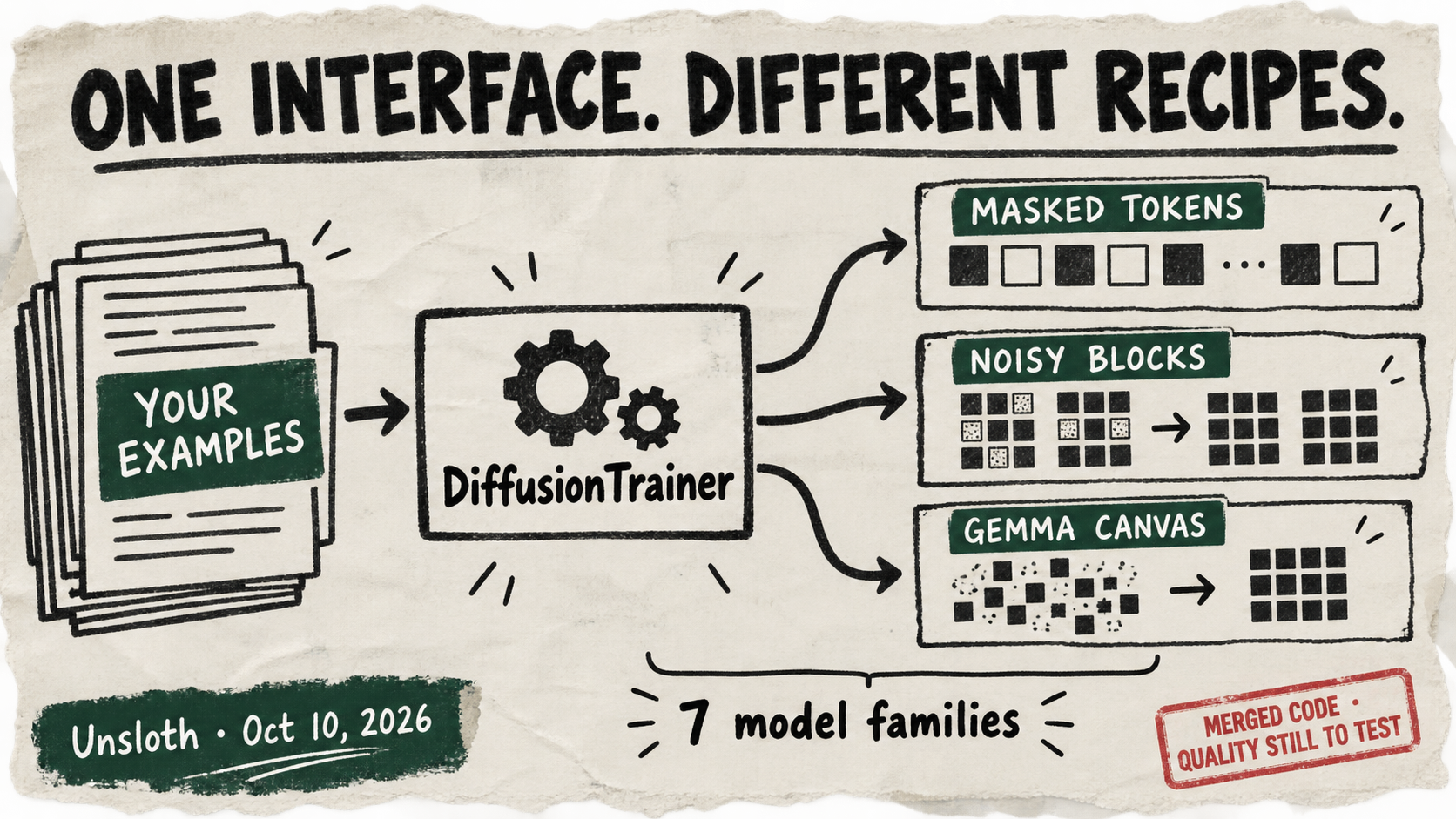
Unsloth has merged a common fine-tuning interface for seven families of text-diffusion models in unslothai/unsloth. The October 10 change adds DiffusionTrainer, which accepts familiar training examples but selects a learning recipe appropriate to the model. Its profiles cover DiffusionGemma, LLaDA, LLaDA-MoE, Dream, Nemotron-Labs-Diffusion, LLaDA2 and SDAR.
That gives researchers trying to customize these alternatives a shared place to begin. Instead of rebuilding the dataset and training plumbing around each project's example, they can use a common interface for prompt-and-answer or chat data. Underneath it, the models still learn in different ways. Making those differences explicit is the useful part of the integration.
The boundary is merged source. The latest inspected Desktop beta, published October 8, predates the change; we have not verified inclusion in a published Python package. This is a development to evaluate, not a claim that every existing installation now offers the trainer.
A familiar dataset, a different lesson
A conventional language model is usually trained to predict the next token from preceding text. Text-diffusion models instead learn to recover text from a corrupted version, with important variations in what is hidden, what remains visible and how the error is calculated. That is why changing the model name in an ordinary training script is insufficient.
Unsloth's new trainer reuses the dataset handling of Hugging Face TRL's supervised fine-tuning machinery. It delegates the actual learning objective to a model profile. The shared interface standardizes how an experiment is assembled; it does not flatten the models into one algorithm.
For the masked-token families, the recipe hides selected answer tokens and trains the model to recover them. Dream needs a different alignment of predictions. The block-based recipes also control which clean blocks a noisy block can see, so later answers do not leak into an earlier training step.
DiffusionGemma has another arrangement: a context-reading encoder and a response canvas containing randomly replaced tokens. Its objective combines canvas reconstruction with an encoder learning term and optional self-conditioning, where an earlier prediction helps a subsequent pass.
The data consequences are concrete. The trainer disables packing unrelated examples into one sequence, because bidirectional attention could let them see one another. Gemma's canvas objective selects the last contiguous supervised response span. A chat dataset can therefore fit the input format without every assistant turn becoming an equivalent training target across all families. Researchers need to inspect which answer their chosen recipe actually teaches.
The canvas that never arrived
A small integration error explains why this work is more useful than a longer supported-model list. In a July 27 report, a user traced Unsloth's DiffusionGemma Sudoku notebook and asked where its corrupted training canvas went. The notebook supplied an argument named canvas_ids; the model expected decoder_input_ids. The intended partially corrupted solution was being discarded.
The new objective passes the canvas through the expected argument. A regression test checks that changing this input changes the model's output. A companion notebook correction, also merged October 10, replaces the custom training loop with the shared trainer and aligns other parts of its recipe.
The author reports a small held-out Sudoku comparison favoring the replacement over the old loop. It changed several training details together and used one seed, so it does not isolate the effect of the argument fix or establish a general quality improvement. The stronger source-visible finding is that the intended training input now reaches the right part of the model.
Customization existed; the common machinery is new
Google's June 10 developer guide already offered a JAX fine-tuning recipe for DiffusionGemma. Unsloth added its own loading and LoRA support on June 11. LoRA trains small adapter weights rather than updating every model parameter. October's change consolidates and broadens that work; it does not make diffusion customization possible for the first time.
Nor does it establish a new speed advantage. Google's launch claim concerned faster generation on dedicated GPUs, especially at low concurrency. Training is a different workload. Unsloth's inspected loader explicitly keeps this path separate from its usual autoregressive kernel and compilation optimizations.
We inspected the implementation, earlier loader, notebook correction and test definitions. We did not train the models or execute the suite. Some comparisons require an external reference file or supplied tiny checkpoints; their presence in the repository is not an independently reproduced result.
The practical gain is a less bespoke starting point for asking which diffusion model can learn a particular task. The next useful demonstration is a pinned, released setup that preserves the intended training targets and improves a genuinely held-out task, with memory and training cost recorded. A common interface makes that comparison easier to construct. The result still has to be earned separately by each recipe.