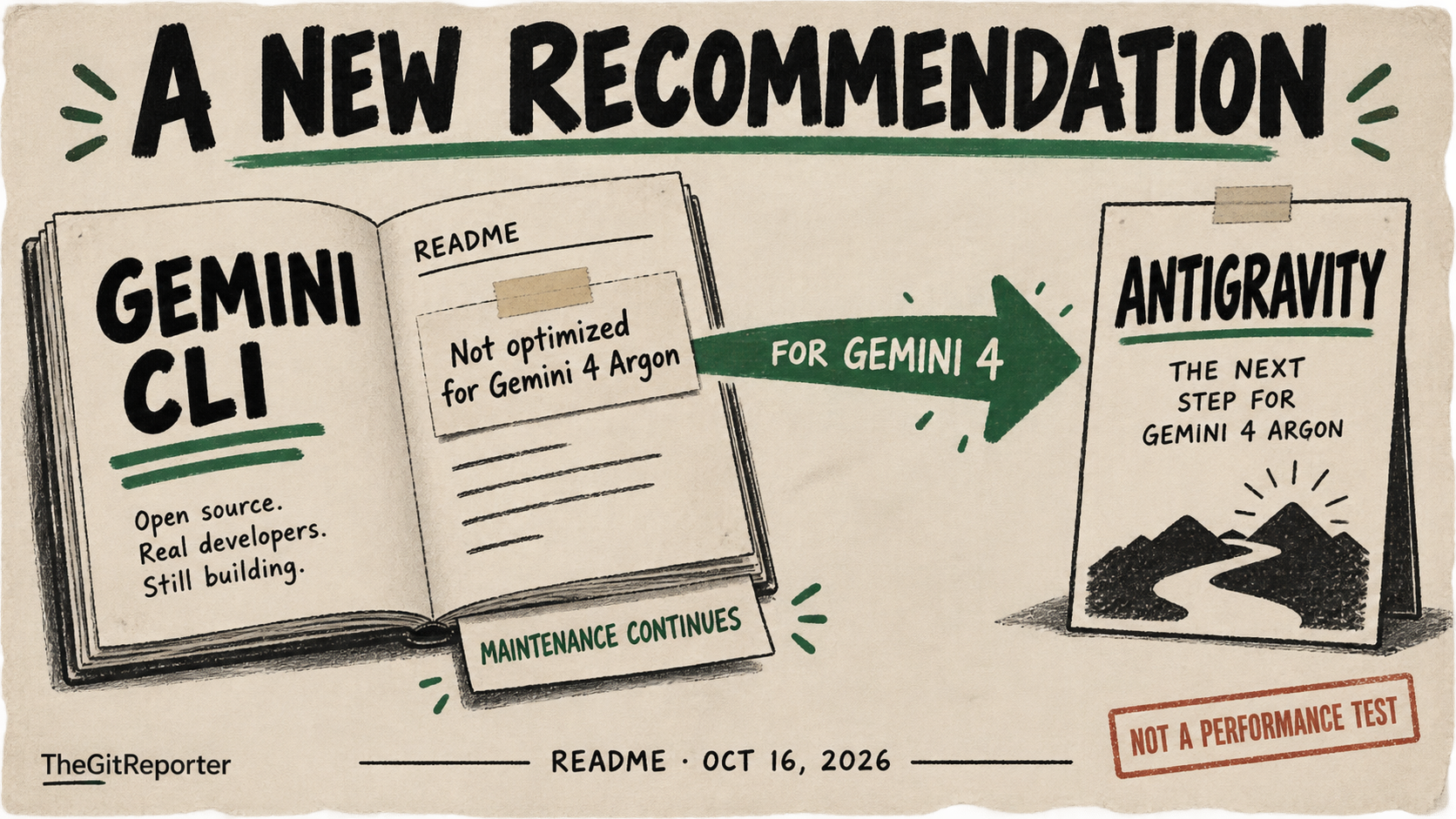
Google has added a new recommendation to the google-gemini/gemini-cli README. An October 16 README change says the terminal agent has not been optimized for Gemini 4 Argon and directs people who want to use that model to Antigravity. A second change that morning repeats the recommendation and strips out several older promotional claims.
This is a public product recommendation, not a demonstrated technical lockout. Google’s May transition announcement promised continued access to the latest Gemini models for enterprise customers. Today’s warning concerns optimization. Those statements can coexist, and the README supplies no task results showing how much performance or behavior differs.
The distinction matters to anyone who kept Gemini CLI for its source code, existing scripts or familiar integrations. The repository still receives implementation fixes. Its own introduction now tells readers seeking the latest Gemini experience to choose another product.
The old deadline and the new warning
The first banner also reminds unpaid and Google One users of the June 18 transition. That deadline is historical. In its May 19 announcement, Google said free users and Google AI Pro and Ultra subscribers would stop receiving service through Gemini CLI on that date. It separately preserved enterprise access and availability through paid API keys.
For those remaining routes, Google committed to ongoing model and other updates. It described Antigravity as the destination for its unified agent platform, with a shared harness underneath terminal and desktop interfaces. The company also acknowledged that feature parity would be incomplete at the start.
October’s new sentence makes that direction explicit at the moment a reader encounters Gemini CLI. The follow-up edit removes the old “Why Gemini CLI?” section, including its free-tier pitch, and drops the OAuth benefits list that advertised automatic model updates. It adds recommendations near the introduction and getting-started instructions. These are documentation changes; deleting a feature from a promotional list does not delete its implementation.
The public review connects the two moments. Taylor Mullen approved the new banner; he also coauthored the May announcement. That is a visible continuation of Google’s stated direction. It does not explain which internal engineering decisions lie behind the optimization warning.
The repository keeps doing useful work
Gemini CLI’s same reporting window contains concrete counterevidence to a story of abandonment. An October 15 Git change disables interactive credential and SSH prompts in the environment used for automated Git operations. It addresses commands waiting for input that an automated process cannot sensibly provide.
Another patch hardens skill-file parsing, including descriptions that otherwise collide with YAML syntax. A settings change resolves configuration placeholders after loading environment files. Each includes test changes that can be inspected alongside the implementation. We read those changes; we did not run their test suites.
That work has practical value for existing users, even as Google points new-model users elsewhere. Maintenance and preferred product direction are separate signals. Following only release activity would miss the new recommendation; following only the banner would miss the continuing repairs.
Our June 4 report described the underlying split: Gemini CLI exposes the agent’s implementation, while Antigravity offers several interfaces to a shared engine. The Antigravity CLI tree inspected today still publishes its README, changelog and examples rather than that engine’s source. Its 1.3.6 changelog describes new model availability and runtime repairs, but release notes do not provide the same inspection opportunity as implementation diffs.
What a migration decision still needs
Google has clarified where it wants Gemini 4 users to go. It has not published, in these changes, a definition or measurement of the optimization gap. The warning therefore cannot tell an enterprise operator whether a particular script, tool integration or approval flow requires migration.
A useful comparison starts with the work already being done: the same task, an explicitly chosen model and account route, and the permissions and tools it needs. Check whether the intended result survives interruption and whether an automated run finishes without interactive intervention. The source-visibility difference belongs in that decision alongside task behavior.
The next consequential evidence would be a concrete explanation of the Gemini 4 integration difference, or a reproducible comparison showing which workflows it changes. Until then, the new fact is clear enough: Gemini CLI remains an active open-source project whose own README now recommends Antigravity for Google’s latest model generation.