A coding agent has several parts. The model proposes what to do. Tools read files, run commands or contact other services. The harness manages the conversation and the loop between them. Vercel’s durable-harness adds a recovery layer around that machinery: storage remembers the session, and a queue arranges for another process to continue it.
Introduced in Vercel’s October 19 announcement, the open-source package supplies integrations for Pi, OpenCode, Claude Code and Codex. The attraction is practical: an application builder can keep an existing harness while making its work survive a function timeout or process crash. The browser connection can disappear without becoming the end of the assignment.
The underlying idea is larger than keeping a machine awake. Continuity becomes a record another machine can read. Inspecting the implementation also reveals two choices a builder still has to make: how uncertain actions are handled, and which parts of the system actually move when the storage backend changes.
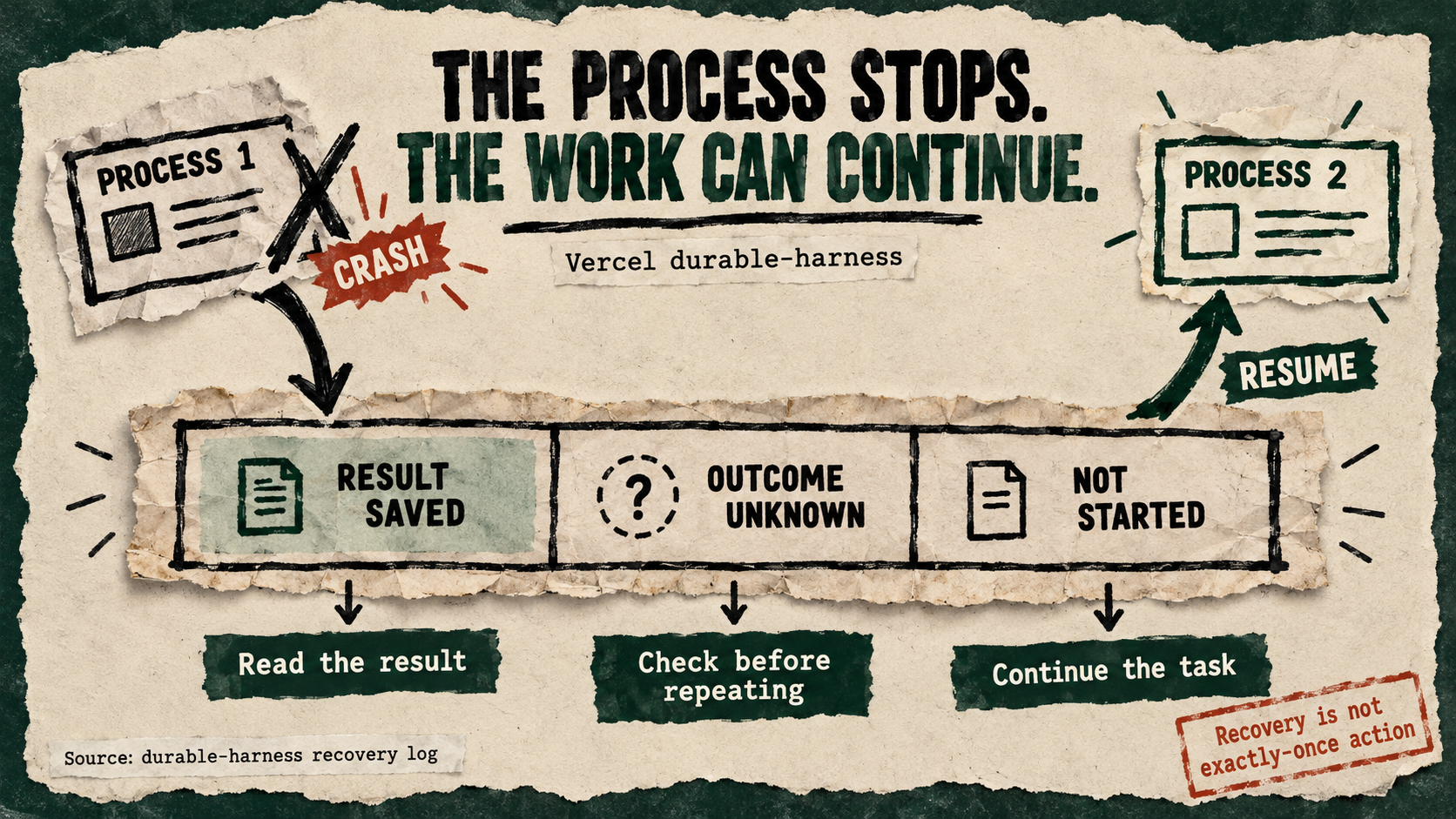
A stopped process leaves three kinds of work.
Consider an agent that has prepared a review and started posting a comment on a pull request. Its process stops before the tool reports back. The comment might exist already. Starting the whole job again would discard useful work; blindly repeating the last action could post it twice.
The kernel’s recovery test captures that distinction. It creates a completed model step and an unfinished tool call, then opens the same storage through a new runtime. The test expects the recorded model step to retain a single attempt and the interrupted tool to be reported as uncertain. It uses a scripted harness, not a live model.
Follow one interrupted comment.
The saved log stays in place while the process changes. Select a moment to see what the next process can know.
The model result is saved. The comment tool has started, but its outcome has not reached the log.
The completed model result is stored. Recovery can reuse that recorded work.
The tool started, but no result is saved. With replay set to never, recovery reports uncertainty instead of automatically repeating this call.
The resumed model is instructed to check the pull request before repeating an action that may already have happened.
Schematic, not a recorded run. After recovery, the known result remains available, the comment’s outcome still needs checking, and the task can continue. Based on the recovery note and tool-call identity. The illustration does not establish that a model will make the correct next decision.
For process-based harnesses, the recovery code constructs a message from the log: which calls completed, which failed and which may have taken effect. It tells the model to inspect actual state before repeating uncertain actions. This is an explicit handoff of unfinished work.
The tool author chooses a replay policy. Under safe, repetition is permitted; Pi retries automatically, while the other three integrations tell the model it may repeat the call. Under never, the interrupted call is not automatically rerun. That protection belongs to the logged call’s identity. It does not prevent a later, newly requested call from attempting the same business operation.
That is why a comment, payment or deployment still needs its own way to identify duplicates or check results. Recovery supplies the missing context for that decision. It cannot infer what an external service did merely because the local process stopped.
Two workspaces make different promises.
The workspace implementation makes the storage boundary concrete. By default, a small virtual workspace keeps its files in the session log. Its changes commit alongside the tool result. A Vercel Sandbox instead supplies a real execution environment with a persistent Drive; an interrupted command can leave partial changes there.
- Virtual workspace: files and result travel together.
- Useful for small, bounded tasks. Its simulated shell cannot install packages, start real processes or reach the network. A crash before the commit leaves the durable file changes unapplied.
- Sandbox Drive: the working directory persists.
- Useful for real project commands. The next process inherits files that may reflect a partly completed action, so recovery must account for what the command already changed.
The repository includes a particularly revealing test: kill a child process after a document or virtual-file edit but before its outcome is recorded, then recover in a different process. The safe-write cases expect one committed revision. The never-replay case expects an interrupted result and no committed document edit. We inspected these tests without executing them; their atomic document behavior should not be extended to arbitrary external APIs or shell commands.
There is a similar boundary for model work. Preserving a recorded answer can avoid recomputing it. A response cut off during generation may have to be generated—and billed—again, as the process-harness implementation explicitly notes. Durability preserves committed progress; it does not make interruption free.
The log can move without the whole stack moving.
The backend abstraction is called a World. It supplies storage, queueing and streams. The selection code chooses Vercel’s backend on Vercel, local files elsewhere, or a configured alternative such as Postgres. For a local or custom backend, it registers the queue consumer, starts the backend and arranges recovery of sessions left unfinished.
This lets builders separate the choice of agent from the choice of where its continuity lives. It is a useful opening for applications that want an existing agent’s behavior without inventing another session-recovery system.
| Part | What the package separates |
|---|---|
| Harness | Adapters integrate existing agent loops with the durable session machinery. |
| Session backend | The World can use Vercel, local files or a configured backend such as Postgres. |
| Execution workspace | The public Claude Code and Codex adapters still require Vercel Sandbox. |
| Model access | Model credentials and service dependencies remain separate from the session database. |
The Sandbox restriction is enforced in the Codex adapter and documented for both Claude Code and Codex on self-hosted servers. Moving the log to your own Postgres database does not bring those execution environments in-house. The Postgres World also remains a reference implementation: its documentation assigns route protection and other production responsibilities to the operator.
For Vercel, this architecture makes its infrastructure useful to developers who choose several different harnesses. That is an inference from the integration design, not evidence that developers are migrating or that one hosting choice costs less.
Test the handoff at the awkward moment.
This follows a concrete thread in our October 18 reporting on Pi: a task can save its next step and hand the wait to a host alarm. Vercel’s contribution here is an integration layer across existing harnesses. It does not establish that Vercel invented durable execution, or that all those harnesses now recover in identical ways.
The inspected package is version 0.0.1-beta.6, with an Apache-2.0 license and a Node.js 22 minimum. For an application builder evaluating it, a useful trial is one disposable task with a read, a write and an external action whose result can be queried. Stop execution once after a saved result and once while the external action is unresolved. Then inspect the resumed session and the external system separately.
That trial should ask whether finished work survives, whether uncertain work is described accurately and whether the application reconciles the external action before trying again. It is a proposed evaluation, not a benchmark we ran. Production recovery time, operating cost and model behavior remain to be measured.
The promising capability is visible already: a coding agent’s assignment can outlive its current process, carrying both completed work and a precise account of what is still unknown. That gives builders a better foundation for unattended work—and a concrete contract to test before depending on it.