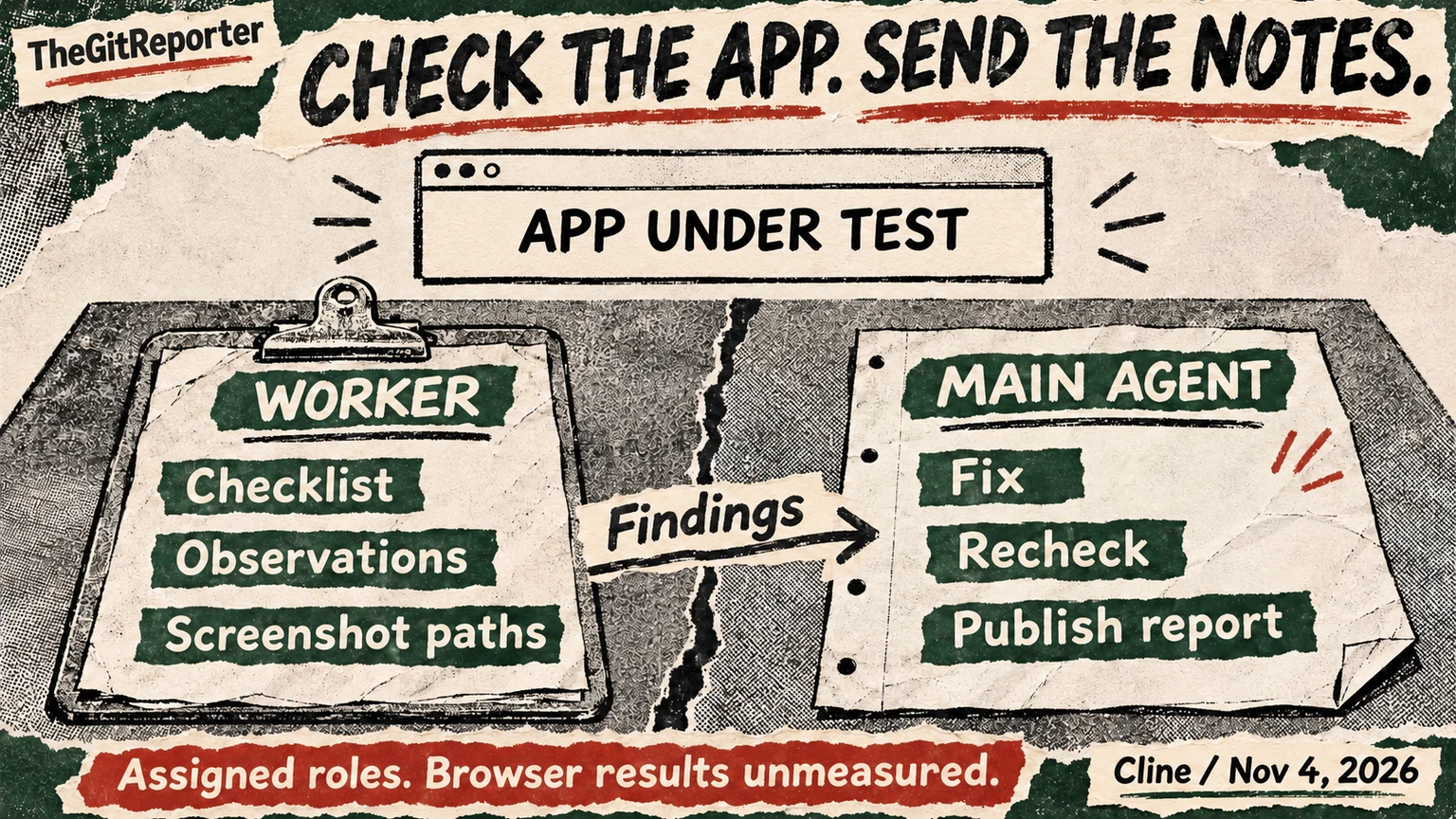
Cline, an agent that builds and changes software, is giving interface inspection its own worker. In the cline/cline change merged on November 4, the main agent can hand an ordered checklist to a subagent whose assigned job is to use the application, describe what happened and send back screenshot paths.
The change puts a useful pause between making a screen and explaining whether it works. The worker is instructed to observe; the main agent remains responsible for repairs and the report shown to the user. This is a new assignment within the existing agent system, with browser results still unmeasured.
Read the division of work
One app. Two assignments.
The main agent supplies the checklist. The worker sends findings back. Both belong to the same Cline workflow.
New specialist
Inspect the interface
Receives: the app, access details, steps and expected outcomes.
Asked to return: observations, passed / failed / blocked status, and fresh screenshot paths for passed or failed checks.
What makes this an assignment?
The worker prompt says to observe the real UI, leave source edits to the main agent and report missing prerequisites as blocked. The tool validates the incoming checklist, then returns the delegate’s result. These behavioral instructions are not a new result validator or a separate read-only sandbox.
Read the worker contractMain agent
Fix and report
Keeps: implementation, repairs and requests for a fresh check.
Assembles: findings from workers, published screenshots and the existing visual report.
When is a path evidence the reader can open?
A local screenshot path still needs publication through the host’s artifact tools. The report stores a screenshot reference; its schema checks the reference’s shape and presence, not whether the image exists or proves the observation.
Read the publication boundaryWhat comes back: findings and local paths. The final report stays with the main agent.
Source explanation, not a recording of a Cline run. Worker calls are sequential because they may share a browser.
The report came first
Cline had already built the presentation layer. Its October 30 carousel defines ordered checks, observations and screenshot evidence. On November 2, an optional reporting tool gave the agent a way to assemble those results. Passed and failed checks already required a screenshot object; blocked checks could omit one.
November 4 adds a specialist to produce observations for that system. The new ux_verifier uses the host’s existing agent-spawning machinery. The cloud computer-use instructions ask the main agent to delegate visual checks when this tool is available, then request a fresh check after fixing a failure. Manual verification remains the fallback.
For someone commissioning an app, the valuable distinction is between the work that changed the interface and the observations offered afterward. A clipped button can become a specific reported finding with an image to inspect. A missing browser can remain an explicit blocker. Those are intended uses of the workflow, not results demonstrated by this merge.
A focused job inside the same system
The worker is told not to edit the application or install missing computer-use dependencies. It receives the main agent’s checklist rather than inventing an independent acceptance standard. Its instructions ask for a fresh screenshot for each passed or failed check and for every supplied check to be accounted for.
That wording matters: the implementation validates the assignment’s input, including unique checklist IDs, then passes through the worker’s result. It does not add a judge that compares each screenshot with the expected behavior. The earlier report tool also does not verify artifact availability. A structured report makes observations easier to inspect; its structure cannot certify them.
The engineering does make the division of work explicit. Delegation retains the spawning tool’s approval and disable restrictions. Worker identity travels through Cline’s Hub connection so a child finishing does not consume the main agent’s completion event. Sequential execution acknowledges that the workers may be operating the same browser, rather than separate test machines.
What would make the gain visible?
The pull request reports controlled model inputs and no live provider or browser verification run. We inspected the code, historical contracts and test definitions; we did not run the feature against an application. A containing November 4 nightly tag establishes tagged source, not working availability across Cline’s installed clients. Hosts still need enabled delegation, browser tools and the explicitly registered publication/reporting tools.
The next useful demonstration is ordinary and demanding: give the worker an app with a known defect, inspect its observation, fix the defect, request a fresh check and open the resulting screenshot from the final report. That would connect Cline’s new division of labor to something the person receiving the app can actually judge.