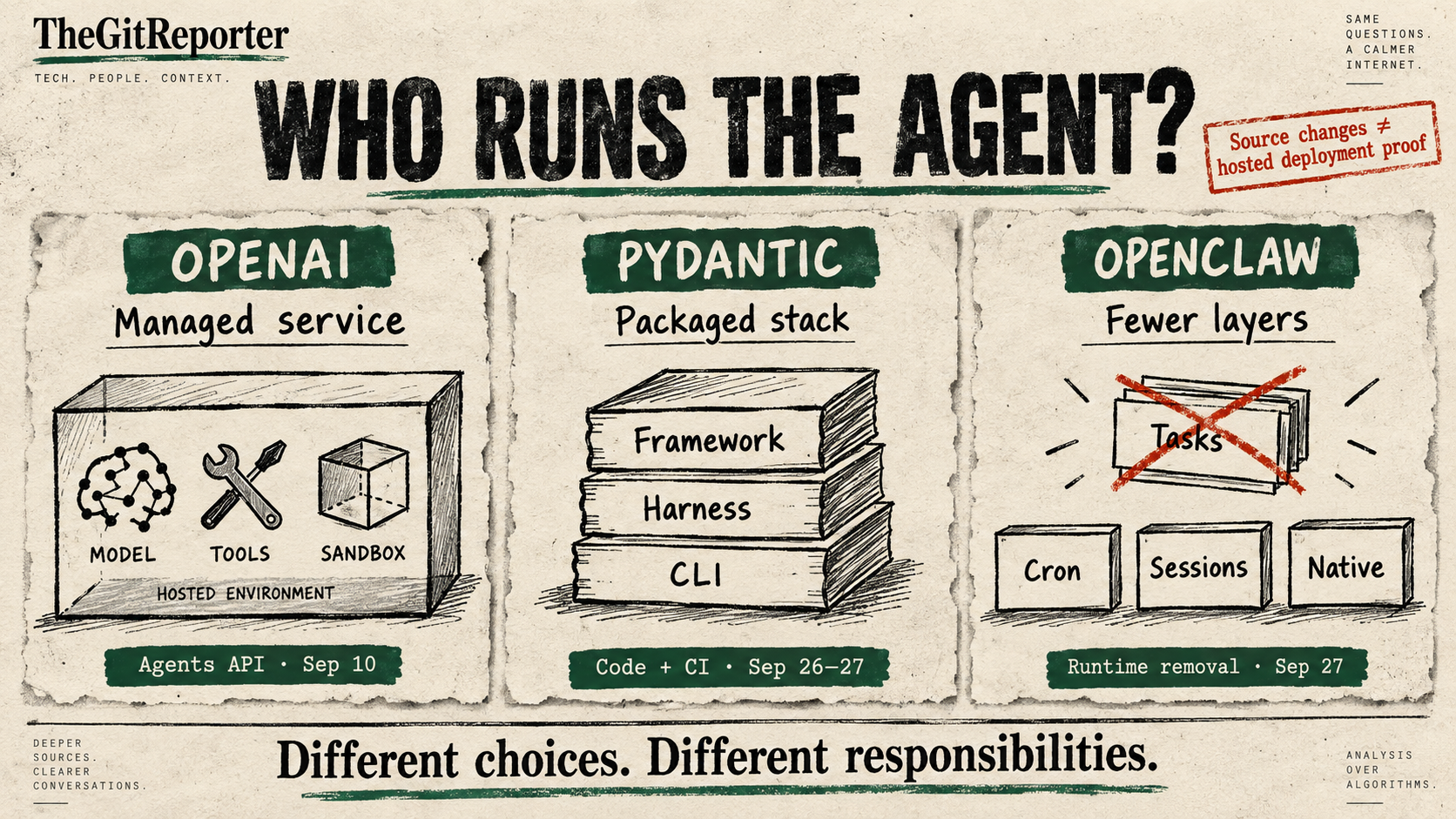
Who Supplies the Agent? OpenAI Hosts It, Pydantic Assembles It
Pydantic’s weekend changes tie a framework, a coding harness and a terminal client to one release process. Set beside OpenAI’s managed Agents API, they reveal a choice that model rankings miss: which parts of the agent your team still has to run.
More From This Edition
All editions ›OpenClaw Retires the Ledger That Watched Its Other Ledgers
Builder Work: The Example Config Was Taking Real Requests
API Discovery: Ask OpenWork Who Needs to Sign In
Recent Editions
Full history ›You Sent the Correction. Has the Agent Read It?
QM now places a mid-run correction where the agent runtime receives it. That small change separates a delivery problem from an agent that had the information and still went wrong.
Unsloth’s Sandbox Is Back. A Working Tool Still Does Not Prove Isolation.
The replacement for Studio’s reverted sandbox has landed, followed by a Windows Preview. Its promise is conditional: establish what boundary actually ran, and distinguish an unavailable host from a launch that must be refused.
Goose Gets Small Enough to Bundle. Its Old Recipes May Not Fit.
A lean agent build answers Buzz’s packaging problem. The review draws a harder line around which existing configurations it will carry.
Qwen Code Draws a New Sandbox Boundary. Saving the Policy Still Has a Gap.
Linux tool confinement now leaves the agent’s model connection on the host. The public review shows why the settings file that selects that boundary deserves just as much scrutiny.
How AI Agents Work
The long-form map behind the daily paper: context, tools, loops, memory, delegation, safety, interface, and trust.