Daily Edition Sources +4

The OpenClaw Patch That Made Reapproval Visible

Jason (Json)'s June 13 OpenClaw patch turns pending node reapproval from hidden gateway state into CLI guidance an operator can act on.

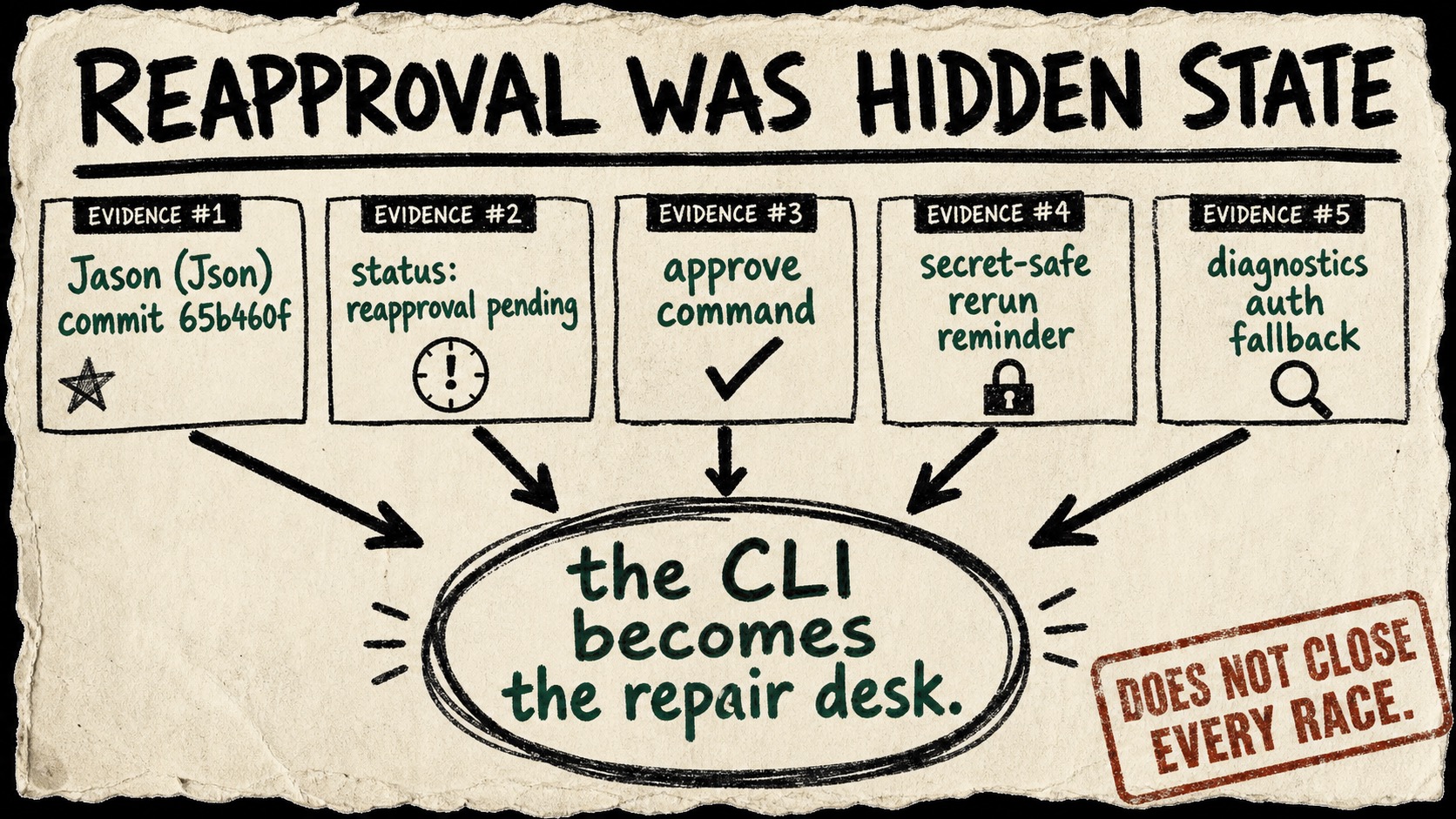
Rough marker poster with five OpenClaw reapproval evidence cards feeding into a circle that says the CLI becomes the repair desk.
Diagram Punkhidden reapproval state becomes an operator repair desk.
repo openclaw/openclaw evidence
4 source signals 1 repo commit 65b460f
Evidence: commit 65b460f / June 14, 2026 / Daily Edition
Open Edition Evidence below

The human story in openclaw/openclaw commit 65b460f is a maintenance problem made visible. Jason (Json), with Peter Steinberger as co-author, shipped a patch that teaches the nodes CLI to say when approval or reapproval is pending and which command should resolve it.

The operator clue

The new status path formats approval pending and reapproval pending, prints an openclaw nodes approve command when a pending request exists, and reminds users to reuse explicit --url or --token options without echoing the secret values. The describe path adds pending request, caps, permissions, and commands beside the effective node state.

The review shape

The commit message reads like a review checklist: scope pending diagnostics, reuse stored auth, preserve selected diagnostics credentials, recover from stale diagnostics auth, isolate privileged diagnostics auth, and serialize cleanup races. The test diff backs that up with cases for pending first approval, pending reapproval, fallback auth paths, local backend shared auth, older gateways, stale request IDs, and terminal escape sanitization.

Why this contribution matters

Node approval is a trust boundary, but the daily pain is usually operational: a user sees a disconnected or limited node and does not know whether to pair, approve, reapprove, reconnect, or rerun with the same gateway flags. This patch moves that state into the tool where an operator is already looking.

The fair follow-up

The useful public question for the contributors is whether reapproval guidance should stay CLI-first or become a shared diagnostic surface across OpenClaw's gateway and app interfaces. The article credits the repair without claiming the patch closes every node authorization race.

Evidence Trail

Receipts below the story

The article above is the public narrative. This section keeps the source trail, limits, and reporting notes on the same page.

Edition
DateJune 14, 2026
LaneDaily Edition
Confidence78%
Sources4
Reposopenclaw/openclaw

Reporter Notes

The patch is valuable because it shifts authorization state into the user-facing

boundary" abstraction. The commit message and tests show a contributor doing

the careful part: deciding when to use privileged diagnostics, when to fall

back, and how to tell an operator what to do without leaking secrets.

Reporter Notes

This companion is written as a people/contributor story. The public evidence is

the commit trail and source diff showing a contributor turning pending

reapproval state into operator-facing diagnostics.

Primary Evidence

changed, and the maintenance arc around pending diagnostics and reconnect

races.

formatting, pending caps/perms/commands, and connection-reminder wording.

local backend shared auth, pairing scopes, and read-only fallback.

secret-safe rerun guidance, fallback auth, stale requests, older gateways,

and terminal escape sanitization.

Evidence Limits

  • The evidence does not prove private OpenClaw roadmap priorities or internal

review discussion.

  • The article does not claim the patch eliminates every node authorization race.
  • Public git author metadata identifies professional contribution activity only;

the article avoids private identity claims.

  • The article does not claim this CLI surface is already available in every

OpenClaw app interface.

Letters & Corrections

Send a note to the desk

Corrections, missing context, or a follow-up lead.