Daily Edition Sources +4

Agent Sessions Are Getting Recovery Paths

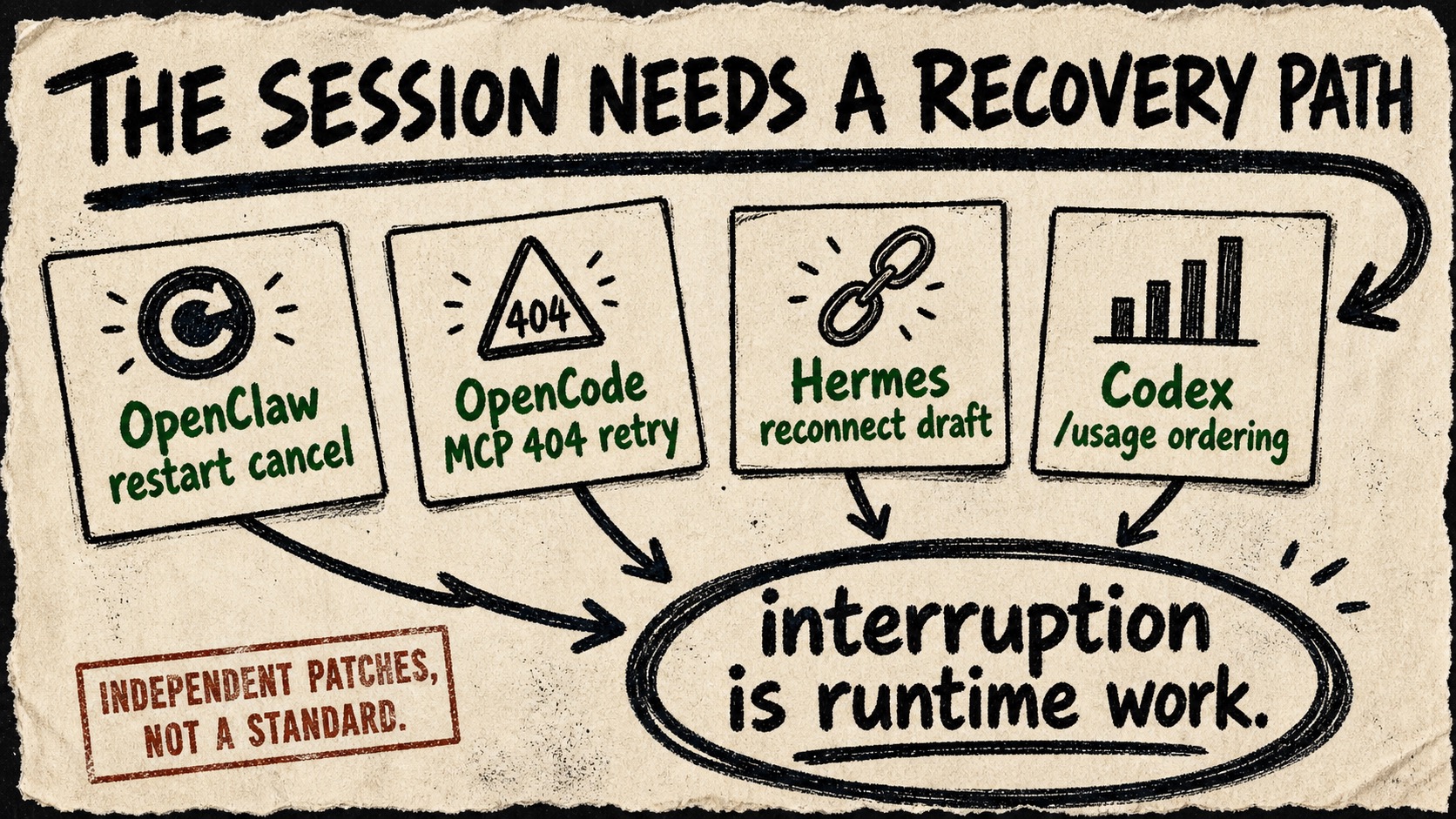
Fresh OpenClaw, OpenCode, Hermes Agent, and Codex patches show agent tools treating interruption and recovery as runtime work, not edge-case cleanup.

Rough marker poster showing OpenClaw, OpenCode, Hermes, and Codex evidence cards feeding into a circled line that says interruption is runtime work.
Diagram Punkinterruption becomes runtime work.
repos openclaw/openclaw + 3 more evidence
4 source signals 4 repos 4 linked commits
Evidence: 4 linked commits / June 14, 2026 / Daily Edition
Open Edition Evidence below

openclaw/openclaw merged commit d20fdf3b on June 13, marking restart shutdowns as cancelled agent-run lifecycle events and keeping late completions from taking ownership after a restart begins.

Facts

  • OpenCode added a test fixture and SDK patch so an expired MCP HTTP session can reinitialize and retry once after a 404.
  • Hermes Agent kept the desktop composer editable during reconnect while blocking submit and queue-drain actions until the gateway returns.
  • Codex relanded a /usage command with async account-usage fetches, rollback cleanup, and delayed history insertion around active streams and hooks.

Evidence

The receipts are OpenClaw commit d20fdf3b, OpenCode commit c7dee9c, Hermes Agent commit 8cf9d86, and Codex commit c884536.

Context

This continues Saturday's context-boundary story, but the operator problem has shifted from what enters a run to what survives when a run is interrupted, reconnected, retried, or measured.

Limits

These are independent patches, not one recovery standard. Watch whether restart ownership, MCP session replacement, reconnect drafting, and usage visibility become explicit user promises instead of internal hardening work.

Evidence Trail

Receipts below the story

The article above is the public narrative. This section keeps the source trail, limits, and reporting notes on the same page.

Edition
DateJune 14, 2026
LaneDaily Edition
Confidence78%
Sources4
Reposopenclaw/openclaw, anomalyco/opencode, NousResearch/hermes-agent, openai/codex

Reporter Notes

The strongest single fact is OpenClaw's restart ownership patch because it

turns a shutdown/restart edge into a lifecycle outcome and guards against late

completion. OpenCode gives the clearest transport recovery example. Hermes

shows user work preserved while the backend is unavailable. Codex adds an

operational visibility card whose placement has to respect rollback, streaming,

and hook ordering.

Reporter Notes

This article groups independent patches around one operator problem: long-running

agent sessions now need explicit recovery behavior when restarts, expired MCP

sessions, reconnecting desktops, rollback, hooks, or usage checks interrupt the

normal flow.

Primary Evidence

lifecycle generation through delivery and cleanup, and tests restart

cancellation against late completion.

request can reinitialize from an expired session ID to a replacement session

after a 404.

submit and queued prompt drain until the gateway returns.

pending usage cards, and delayed insertion around live stream and hook

ordering.

Evidence Limits

  • These are independent changes, not a coordinated standard.
  • The evidence does not prove all interrupted agent work can be resumed.
  • Some changes are user-facing, while others are internal lifecycle or transport

hardening.

  • The article treats Codex usage visibility as part of operational recovery

context; it does not claim /usage itself restores a failed run.

Letters & Corrections

Send a note to the desk

Corrections, missing context, or a follow-up lead.