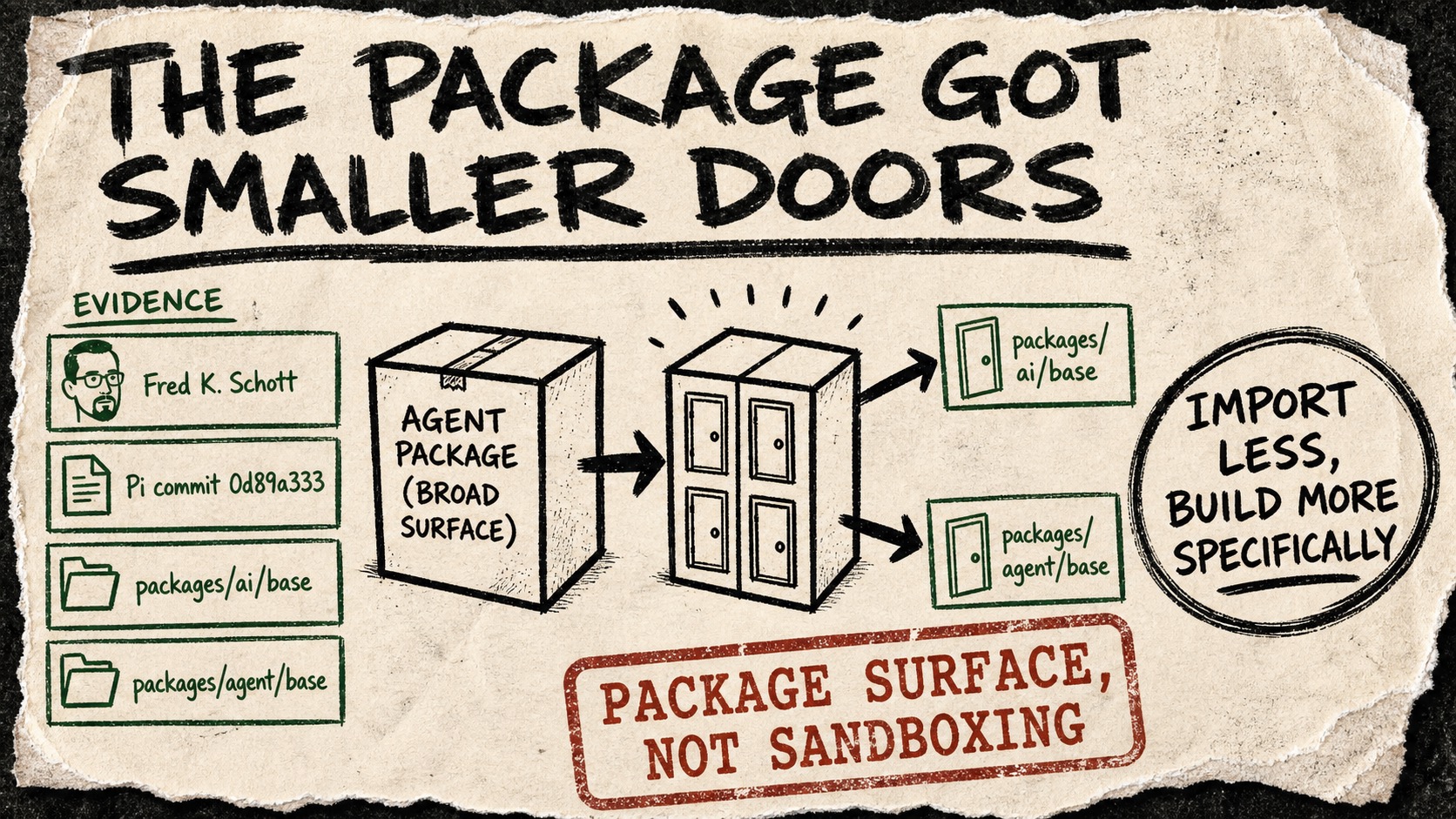
Fred K. Schott's June 19 commit 0d89a333 is a packaging story with a human maintenance arc: a contributor took a broad agent monorepo surface and gave downstream builders smaller doors into it.
The Public Trail
The patch adds ./base exports to @earendil-works/pi-ai and @earendil-works/pi-agent, creates matching base.ts files, rewires imports across agent harness code, and adds tests for the new base entrypoint behavior.
That is not a flashy feature launch. It is contributor work that makes a package easier to embed carefully: import the core types, registry pieces, session machinery, or provider-specific modules without accepting every default path as the top-level package contract.
Why This Contribution Matters
Pi has already been covered as a minimal, rewritable coding-agent harness. This patch moves the same philosophy into package boundaries. A small agent product is more convincing when its public imports also let builders choose a smaller surface.
The evidence is strongest at the packaging and source level: package metadata, new base entrypoint files, provider exports, and tests. It does not prove smaller runtime permissions or sandboxing, which Pi documents as a separate boundary.
The Conversation To Open
The constructive follow-up for Schott and the Pi maintainers is whether the next pressure point is documentation: which imports should extension authors reach for first, and which broad imports should be treated as convenience rather than default architecture?