
Why git log | head is not merely git log
Crush commit 96728b15 adds containsCommandChaining to inspect shell metacharacters before granting the bash tool's safe-read-only shortcut. A plain git log may qualify; git log piped into head does not, because the pipe moves the request into shell composition.
The bash contract can accept both command strings. Authorization is decided later: the runtime checks the concrete command, session, working path, and permission state before execution. A schema says what can be proposed. It does not say what may happen.
What changed since the first Atlas draft
OpenAPI specs become a model-visible tool surface with credentials and unsupported operations kept outside reach.
anomalyco/opencode Shoubhit Dash Made OpenCode Read MCP ResourcesMCP resources add another concrete surface where tool discovery and reviewability matter.
anomalyco/opencode, openclaw/openclaw, NousResearch/hermes-agent, openai/codex Agent Tools Are Getting Credential BoundariesCredential handling keeps reminding readers that tool access is not just schema availability.
What actually happens
-
Propose call
name plus arguments
-
Validate
schema and registration
-
Check policy
grants and limits
-
Operator decision
only when required
-
Authorize
policy + any consent
-
Bound executor
selected principal
-
Environment effect
commit or reject
-
Record receipt
result + evidence
One call crosses separate control planes
The tool contract contains the model-visible name, description, input schema, and expected result shape. It constrains how a proposal is expressed, but it does not establish whether credentials exist, whether the current principal may act, or whether the requested arguments are safe.
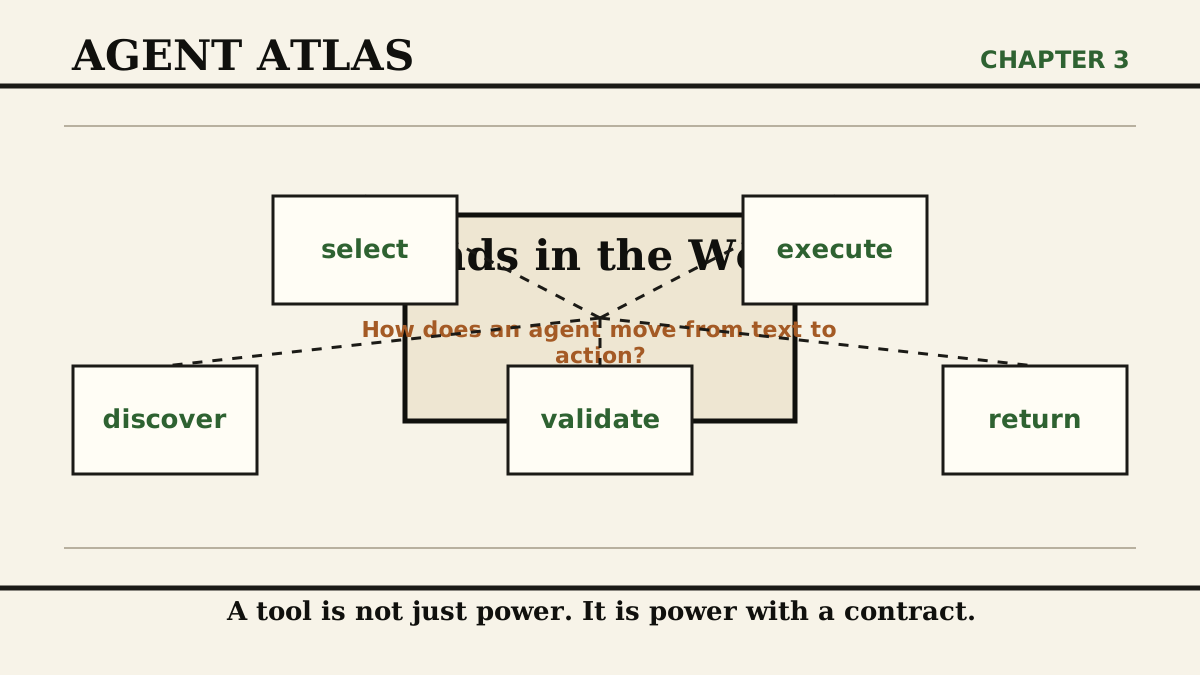
Registration, authorization, and execution answer different questions. Registration asks whether the tool enters the plan. Authorization asks whether this invocation may proceed. Execution determines which process, server, operating-system user, network identity, or external credential performs the side effect.
Availability is negotiated at runtime
Codex commit e0435afb registers RequestUserInputHandler only when resolved configuration permits it. Tests verify that disabling the setting removes the tool from both visible and registered sets.
Availability still does not mean readiness or authority. Hermes moves MCP discovery into a background helper with a bounded first-snapshot wait and keeps read-only scans away from synchronous token refresh. A tool menu is a live runtime contract, not a static feature list.
Policy must run before side effects
Codex commit 5c20513a makes ordinary local function tools participate in default PreToolUse and PostToolUse hooks. PreToolUse can block a call or rewrite its input before the handler runs. Runtime-control operations explicitly opt out of selected generic behavior.
Policy state must remain coherent under concurrency. Crush commit 6b312bee moves skip state to an atomic boolean and protects session auto-approval with a mutex. A correct schema cannot compensate for a racing permission service.
Receipts observe outcomes without owning tools
Codex commit c69cde35 adds ToolLifecycleContributor. It observes accepted starts and typed finishes with turn ID, call ID, tool name, invocation source, and outcomes including completed, blocked, failed, and aborted.
Those receipts help attribute activity, but they do not prove that authorization was appropriate, returned data was correct, or an external effect can be reversed. Observation, policy, and execution are separate responsibilities.
Where the contract breaks
Contract-authorization collapse
A registered schema is treated as permission to perform every valid invocation.
Stale availability
Discovery advertises a tool whose credentials, server, or provider are not ready.
Receipt without effect integrity
A normal handler return is recorded as success despite partial or incorrect effects.
What the product must prove
- Identify the specification source, registration gate, policy hook, approval path, executor principal, result sanitizer, and audit sink for one tool.
- Run identical arguments under different permission and sandbox states; record which layer changes the decision.
- Compare lifecycle outcomes with the external side effect and available compensation mechanism.