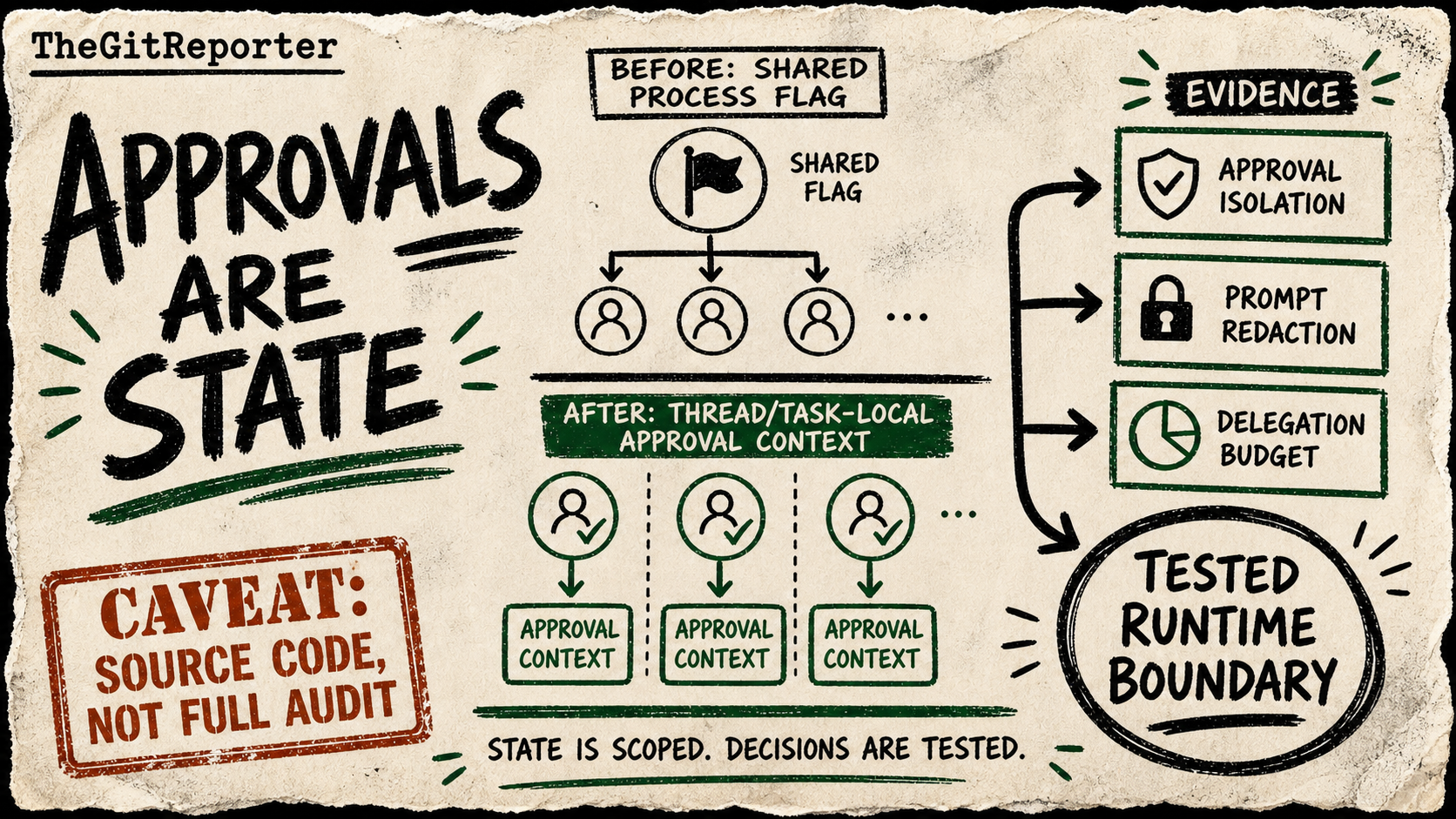
NousResearch's Hermes Agent changed its ACP approval path on June 30, replacing a process-wide interactive flag with a context variable after a commit said concurrent sessions could drop a second run onto an auto-approve path.
Because commit 62b9fb662 changed approval state isolation, agent operators should watch whether permission prompts become tested runtime boundaries across every concurrent session they let an agent run.
Facts
- Commit
62b9fb662moves interactive approval checks through a context variable and adds approval-isolation tests. - Commit
4a7a6fd40redacts secrets before dangerous-command prompts are shown to users or gateway notifiers. - Commit
35a0803a3caps subagent summaries against the parent context headroom and adds a regression test for the delegation budget.
Evidence
The public sources are Hermes commits for ACP approval isolation, user-facing secret redaction, shell heredoc and homograph scanner hardening, and subagent summary budgeting. Together they show a project tightening the surfaces where an agent asks, displays, and returns work.
Context
For operators, the important movement is not one more warning string. It is approval state, prompt display, and delegation output moving into explicit code paths with tests. That makes future regressions easier to name and harder to hide inside a long-running agent session.
Limits
The commits do not prove a complete security audit, a release, or real-world incident frequency. What to watch next: whether Hermes documents these approval boundaries for ACP users and keeps adding tests around notifier, batch, and remote execution paths.