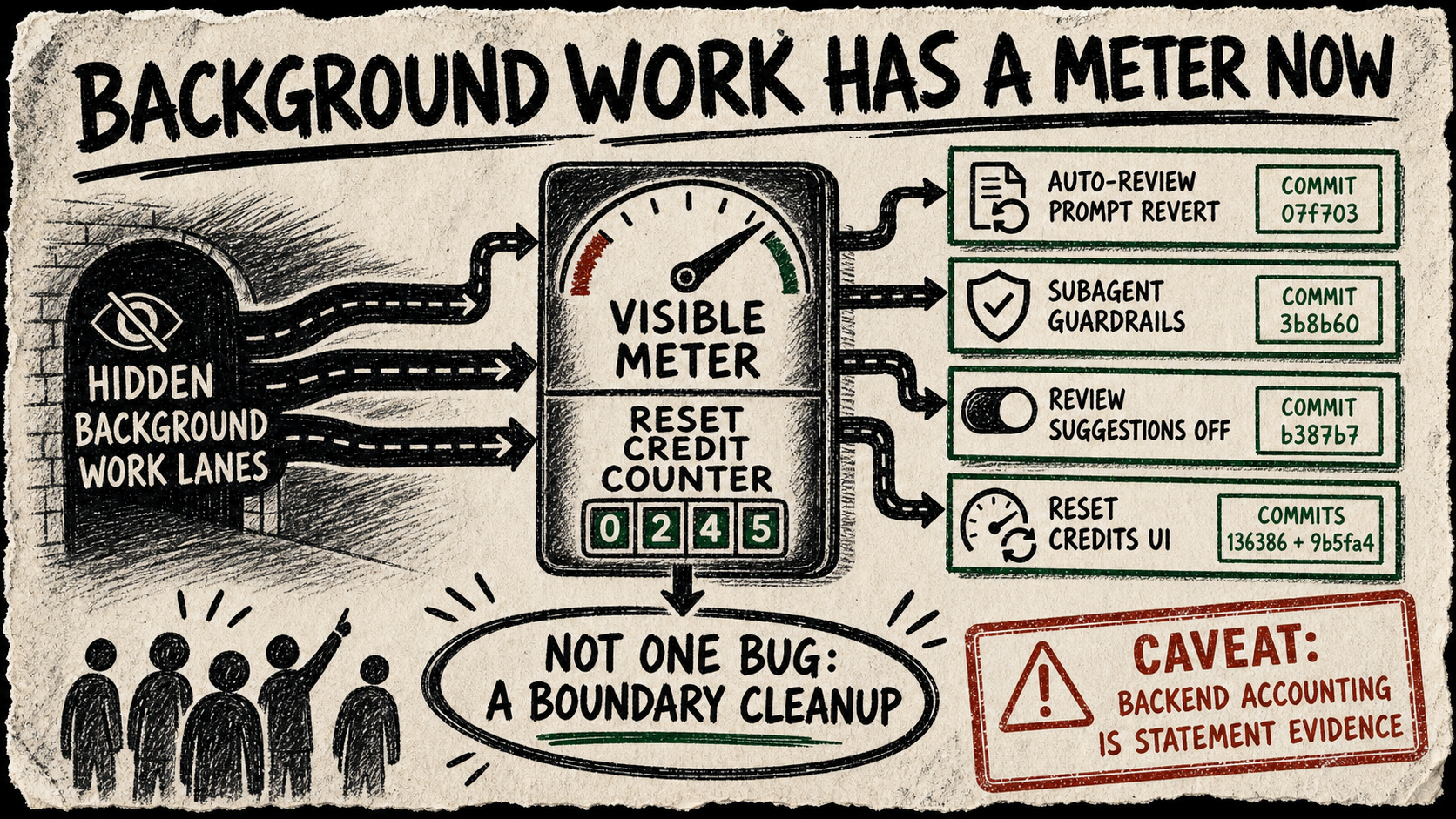
The important sentence in the Codex usage-limit update was not the apology. It was the shape of the failure: there was not one central bug. A few smaller systems had started spending work on the user's behalf, and the product's usage displays made some of that work look like normal GPT-5.4 turns.
The public statement said Codex limits would be fully reset again within the hour, with one additional reset credited into users' banks for the next 24 hours. It also said OpenAI found compounded causes: a more proactive auto-review path, another change that triggered more subagent work, background suggestions that could duplicate or retry too often after failures, and usage graphs that displayed auto-review, failed requests, or rate-limited requests in misleading ways.
The open-source evidence does not prove every backend accounting claim. It does prove a serious client and runtime correction around the exact surfaces named in the statement. In the public openai/codex repo, the receipts cluster around four user-visible boundaries: what auto-review is allowed to ask for, when subagents are allowed to run, which suggestions are allowed inside review flows, and whether a user can see and redeem reset credits as concrete account objects.
The Public Claim Set
The source claim is the public X post at x.com/thsottiaux/status/2071740419030053227. The post says the team reset usage limits while rolling out hotfixes across the CLI, desktop app, and usage backend. It also names the major user-facing promise: future usage data should be clearer and actual consumption should be lower.
That promise has two different evidence standards. The repo can show code that reduces or isolates unnecessary background work in the client/runtime. The repo cannot, by itself, show whether a backend usage graph now excludes failed turns, rate-limited turns, or relabels old auto-review activity. This article treats those as official-statement evidence unless a public code path backs them.
Auto-Review: The Proactive Prompt Was Rolled Back
The cleanest public receipt is the auto-review revert. Commit 07f7032383, titled Revert "Make auto-review on-request prompt more proactive"
, deletes the dedicated on_request_auto_review.md prompt template and removes the branch that selected that template when ApprovalsReviewer::AutoReview was active.
The reverted change, commit d9dace8a59, is unusually revealing because its own description explains why it existed. It made the on-request approval text more aggressive for auto-reviewed productivity runs, encouraging earlier escalation for likely sandbox blocks, network access, remote services, authentication, cloud or database access, and other out-of-sandbox needs.
That does not mean auto-review was malicious or broken. It means Codex had created a separate instruction surface that could ask the model to spend fewer turns proving the sandbox would fail and more quickly seek approval for the outside world. In ordinary work, that can be a productivity win. In usage accounting, it changes the boundary between work a user explicitly asked for and work the agent does in the background to keep itself moving.
The revert is therefore not just a wording cleanup. It is a product correction: auto-review remains identified as auto_review, but the special proactive escalation packet is gone from the public prompt assembly path.
Subagents: Depth No Longer Means Permission
The public subagent receipt is commit 3b8b60a583, titled Restore v1 delegation guidance
. The commit restores a sentence that should matter to anyone watching agent cost: requests for depth, thoroughness, research, investigation, or detailed codebase analysis do not count as permission to spawn subagents.
It also restores a decision frame for when to delegate and when to keep work local. The guidance tells the model to identify immediate blockers, preserve the main critical path, delegate bounded sidecar tasks only when they can run in parallel, and avoid urgent blocking work that the main rollout should do itself.
That maps closely to the user impact. A user asking for a deeper answer may expect one longer turn, not a family of child threads. If a prompt simplification removed the language that constrained delegation, the model could still obey the formal authorization rule while losing the practical guardrails that kept independent research from becoming extra background capacity.
Another public patch, 726b9d07d0, sharpens a subagent retry message when a requested reasoning effort is unsupported. That one does not prove excess usage. It does show the team fixing a failure edge where the model is told exactly how to retry spawn_agent rather than wandering through unsupported combinations.
Review Suggestions: A Background Door Was Shut
The tweet's background-suggestion claim is harder to prove end to end from the public repo, but the repository does show review-time suggestion suppression. Commit b387b7dabb, titled Disable tool suggestions during review
, adds a review test that starts with plugin suggestions available, submits a review, and asserts two things: the review request does not expose request_plugin_install, and review does not fetch /ps/plugins/suggested.
That is the kind of fix users rarely see but usage systems feel. Tool suggestions are not the answer the user asked to read. They are support work around the answer. If that support work is fetched, generated, retried, or injected during a review path, it can become invisible labor: useful when it is right, noisy when it is duplicated, and infuriating when it is counted like ordinary requested reasoning.
The same review/MCP neighborhood has additional public guardrails. Commit 29bfc614d3 restores MCP suppression for replayed reviews, and commit 1bbbad1bca blocks nested review while a replayed review is active. Those commits do not prove the usage backend fix, but they support the pattern named in the statement: review is a special execution lane, and background systems around it needed tighter gating.
Reset Credits Became Account Objects, Not Just Copy
The immediate relief in the post also has a public client-side trail. Commit 136386e1c3, Expose rate-limit reset credit details
, adds protocol and backend-client support for listing reset credits, consuming a specific credit by ID, and carrying fields such as available_count, id, reset_type, status, granted_at, and expires_at.
Commit 9b5fa439d, Show reset credits in redemption picker
, moves that account object into the terminal UI. It adds a reset-credit picker, sorts available credits by expiration, displays whether the reset applies to monthly or weekly-plus-five-hour windows, preserves idempotency, and handles stale selected credits by asking the user to refresh.
This is the difference between a support gesture and a recoverable product mechanism. A user who was told "we credited a reset into your bank" needed the product to know what that bank contained, when a credit expired, which credit was being redeemed, and what happened after redemption. The public code does not show the backend grant itself, but it does show the client and app-server contract that makes banked reset credits visible and redeemable.
The Usage Graph Is The Least Public Part
The post says auto-review was incorrectly appearing as GPT-5.4 usage, and failed or rate-limited requests were still shown as turns. The public repo gives context but not the full backend answer.
Codex already names automatic approval review as a separate preferred model path in public code: DEFAULT_APPROVAL_REVIEW_PREFERRED_MODEL is codex-auto-review in codex-rs/model-provider/src/provider.rs. Analytics code also carries a guardian_default_review_model_id. That supports the idea that auto-review is a distinct category inside the system.
But the graph relabeling itself appears to live behind the usage backend, not in the public repository. The same is true for the statement that only successful requests now count toward turn graphs and that rate-limited requests were displayed incorrectly but never charged. Those are important claims. They should be repeated as official claims, not inflated into public diff evidence.
Why Users Felt It So Fast
The common pattern is that Codex had become better at doing things adjacent to the user's explicit request. Auto-review could pursue approvals more proactively. Subagents could multiply work if the delegation boundary softened. Review flows could carry suggestion machinery. Reset credits and warning surfaces had to catch up to the real account state.
That is the hard part of agent products. The value proposition is that the agent does useful work you did not micromanage. The trust boundary is that the user still knows which work they asked for, which work the system performed to support it, and which meter each one touches.
The public Codex fixes look like a team moving that boundary back toward the user: less proactive auto-review prompting, clearer subagent authorization text, fewer review-time suggestion side paths, and a visible reset-credit account surface. The backend claims add the missing half: graphs should stop making failed, rate-limited, or auto-review work look like ordinary successful GPT-5.4 turns.
Evidence Ledger
- Auto-review became more proactive: proved by original commit d9dace8a59 and reverted by 07f7032383.
- Subagent work needed tighter limits: supported by 3b8b60a583, which restores explicit delegation guardrails, and 726b9d07d0, which clarifies retry behavior for unsupported reasoning effort.
- Background suggestions needed gating: supported by b387b7dabb and review/MCP suppression commits 29bfc614d3 and 1bbbad1bca.
- Immediate reset relief: client-side support is visible in 136386e1c3 and 9b5fa439d. The actual backend grant remains statement evidence.
- Usage reporting categories and graph counting: not fully public in the repo. Treat the relabeling and successful-request-only graph behavior as official usage-backend claims.
The Takeaway
The user impact is simple: when the product spends capacity in the background, the meter must say so with the same honesty as the model answer. The engineering impact is subtler. The fixes are not one dramatic algorithm change; they are a set of boundaries around agent helpfulness.
That is why this matters beyond one Codex outage cycle. Mature agent tools will not be judged only by how much autonomous work they can perform. They will be judged by whether they can explain which autonomous work happened, which part counted, which part failed, and how the user gets relief when the system did too much on their behalf.
What to watch next: whether Codex keeps turning hidden helper work into explicit product categories. Auto-review, subagents, suggestions, retries, and reset credits are not side details. They are the accounting layer for trust.