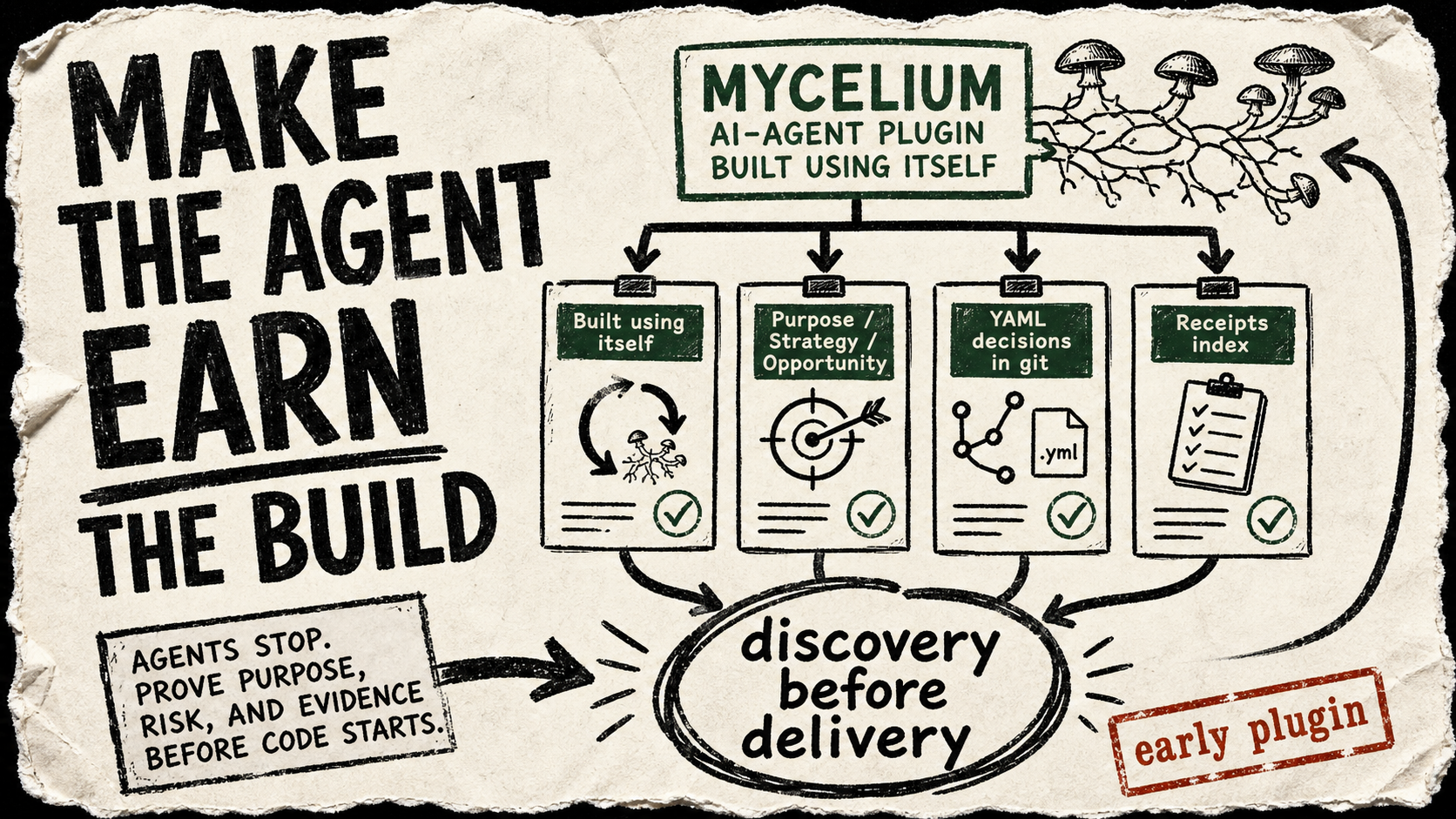
The scout source is a July 4 Show HN post for Mycelium, where the builder describes a coding-agent plugin that starts upstream of implementation and says the project is being dogfooded on itself. The repository README makes the proof sharper: "Built using itself" appears in the public project description, beside Claude Code install commands and a receipts index.
This is not a five-minute wrapper because the repo is mostly governance machinery, not a single prompt. Its docs define Purpose, Strategy, Opportunity, Solution, Delivery, and Market scales; its skills guide the agent through discovery and evidence checks; and its receipts record cases where the framework changed after user runs found weak assumptions.
The Craft
The building skill worth borrowing is to make the agent's pre-code discipline durable. Mycelium stores product decisions as plain YAML in the repo, requires evidence before advancing, and treats a failed check as a loop back to discovery rather than as a blocked build.
Repo Receipts
The README points to install paths, usage modes, skills, theory grounding, an AI system card, and a receipt index. One receipt says a recurring pattern across five instances became a standing self-check; another says a dead-link sweep missed prose/code-span path rot, leading to a second guard.
Reader Takeaway
Builders using coding agents can copy the shape even without the plugin: put the riskiest assumption in the repo, force the agent to name the smallest test, and preserve the decision record where future sessions can read it.
Caveat
The public evidence proves an early open-source framework and its self-reported dogfooding, not broad adoption or outcome quality. Constructive follow-up: publish one complete anonymized run from prompt to YAML decision to shipped or rejected build.