
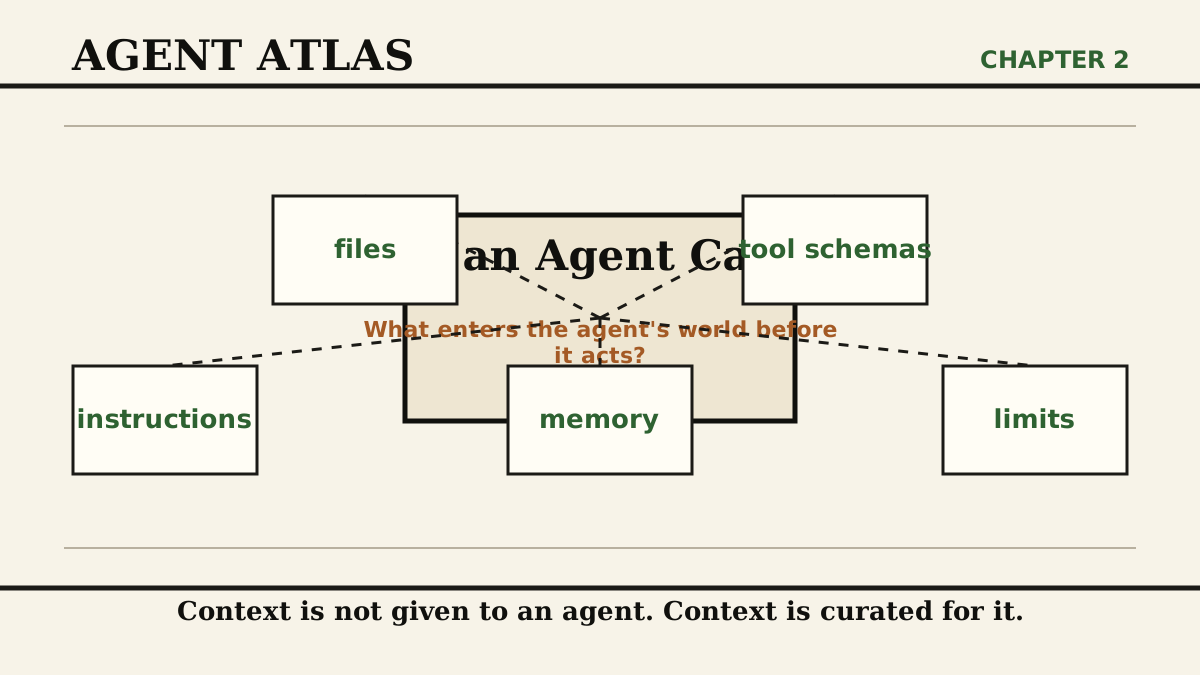
A turn receives facts the transcript never displays
Codex commit 768848ab adds experimental additionalContext to turn-start and steer calls. Clients can attach browser or automation state without converting it into visible user prompt text. Each entry is classified as untrusted or application and routed into hidden contextual message items with different roles.
The implementation includes truncation, deduplication, reset behavior, and tests. Those controls acknowledge a basic risk: hidden context can be useful, stale, duplicated, oversized, or hostile. A response may be consistent with the assembled request while appearing inexplicable from the visible conversation alone.
What changed since the first Atlas draft
Memory Bank makes saved context searchable, scoped, tested, and explicitly secret-aware.
alejandro-ao/tau Tau Keeps Branch Context For ContributorsBranch summaries show context moving between work episodes for humans and agents.
earendil-works/pi Mario Zechner Kept Pi Compaction VisibleCompaction visibility turns hidden prompt-budget work into inspectable state.
What actually happens
-
Visible thread
messages and displayed history
-
Hidden context
application and untrusted state
-
Memory and files
retrieval plus path rules
-
Context compiler
rank, budget, serialize
-
Model viewport
selected decision packets
-
Outside the view
missing, stale, or blocked
The viewport is assembled from unequal sources
Visible messages are only one layer. The request can also include application context, untrusted external material, project instructions, summaries, tool descriptions, permission state, and inherited thread history. These sources do not carry equal authority, visibility, freshness, or ownership.
A useful context pipeline needs explicit kinds and lifecycle rules. Codex distinguishes untrusted from application context, prevents blind replay through deduplication and reset behavior, and applies truncation. Without those distinctions, external state can masquerade as trusted instruction or survive after its relevance expires.
A file operation can discover new instructions
Gemini CLI PR 22082 adds discoverJitContext, which asks the context manager for GEMINI.md snippets associated with an accessed path. The discovered material is appended to tool output, allowing a file operation to supply local project rules at the moment the path becomes relevant.
The mechanism is wired into read, list, write, and edit tools. Context discovery failure does not block the underlying operation. That preserves tool reliability, but it creates a subtle failure mode: a write can succeed after the path-specific instructions that should have governed it failed to load.
Memory has addresses and ownership boundaries
OpenViking describes context through deterministic viking addresses with resource, user, agent, and session scopes. Its abstract, overview, and full-content layers let a runtime choose between compact orientation and deeper retrieval rather than treating every retained item as equivalent.
Codex commit aad59a09 draws a different boundary by moving generated memory rows and memory-job state into memories_1.sqlite while leaving durable thread metadata in the main state database. The separation identifies which records belong to a rebuildable memory pipeline and which records define the thread itself.
Provenance determines whether context can be audited
Lineage identifiers answer different questions: which thread supplied copied history, which thread performed the work, and which session grouped the activity. Without those distinctions, inherited context loses its origin.
Context quality is therefore not just a retrieval score. It is the ability to explain source, authority, freshness, selection, truncation, and placement for every packet that influenced a decision.
Where the contract breaks
Hidden context contradicts the visible thread
Application or external context affects the request without appearing as user-visible text.
Path-specific instructions fail open
JIT discovery can fail while the file operation succeeds.
Memory loses provenance
Stored facts and summaries outlive metadata explaining their source.
What the product must prove
- List every context item with source, kind, visibility, authority, timestamp, and truncation state.
- Link each filesystem operation to the path-specific instructions discovered or missed.
- Identify the active memory store, retrieval source, fork lineage, thread ID, and grouped session ID.