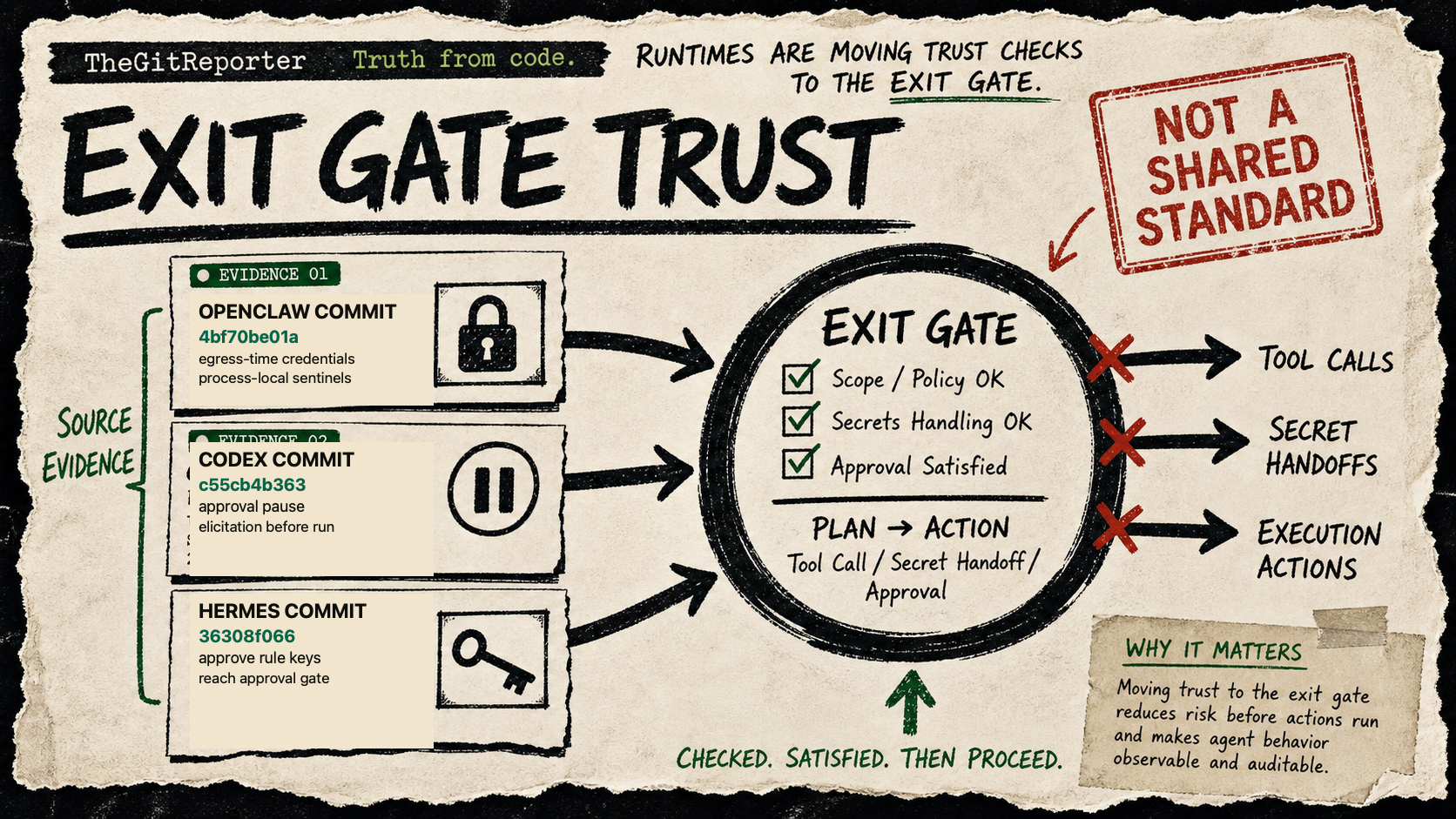
OpenClaw's July 8 commit added egress-time credential injection with process-local sentinels, while Codex made code-mode approvals pause for elicitation and Hermes passed approval rule keys into its plugin approval gate.
For agent operators, this changes the morning watch item: audit static config and the exit gate where a runtime turns a plan into an external request, a secret-bearing call, or an approval decision.
Facts
- OpenClaw changed provider secret handling across host, provider, sentinel, redaction, and transport tests.
- Codex changed code-mode approval flow so all approvals trigger an elicitation pause.
- Hermes changed plugin approval plumbing so approve rule keys reach the approval gate.
Evidence
The public receipts are OpenClaw commit 4bf70be01a, Codex commit c55cb4b363, and Hermes commit 36308f066. Together they move trust checks from broad policy language into code paths that decide what leaves the agent process.
Context
The beat movement is not "more security features." It is a narrower operator contract: secrets, approvals, and plugin rules are becoming runtime boundaries that should be tested where tools execute, not merely documented where users configure them.
Limits
These are independent commits, not a shared standard or a coordinated release. What to watch next is whether the projects expose these exit-gate checks in logs, user prompts, and failure messages that operators can review after the fact.