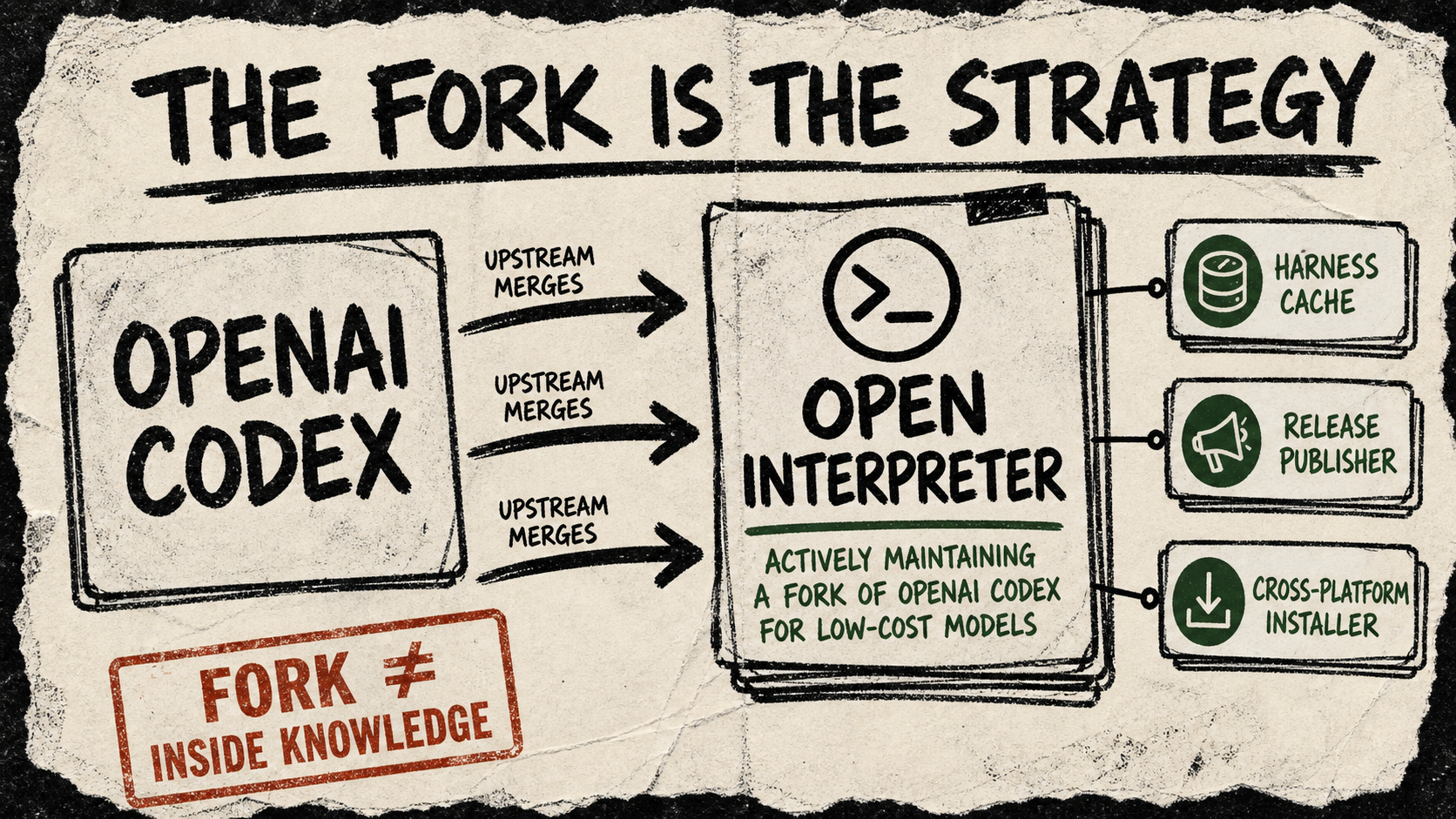
Open Interpreter began as a Python project in 2023. Its current repository now says something more specific: the Rust version is a fork of OpenAI's Codex, aimed at getting strong agent behavior from lower-cost models through selectable harnesses. The relaunch was made explicit in a July 13 “Open Interpreter is back” commit by the account that started the original project.
The visible mechanism matters more than a borrowed brand. The fork's history contains repeated merges of Codex upstream; one July 14 merge has an upstream Codex commit as a parent. Immediately around it, the maintainer added a release-publishing workflow, adapted a chat-harness cache key to upstream metadata, repaired remote-runtime docs, and documented a cross-platform uninstall path that preserves user state. That is what a maintained fork looks like: the upstream supplies a moving base, while the fork owns the choices that make the base usable for a different audience.
The advantage is speed—with a bill attached
A fork can inherit a large body of work: operating-system support, protocol plumbing, safety boundaries, and fixes that would be expensive to recreate. Open Interpreter's README turns that leverage toward a clear product bet: local state, provider switching, harness emulation, and lower-cost models. The July release work shows that the bet is not only a README claim; it includes release and installer machinery that has to survive on macOS, Linux, and Windows.
But upstream leverage is not the same as privileged knowledge. The same merge commits that make the fork fast create a recurring reconciliation job. A changed cache key, a conflicted merge, or an upstream release shift can force the fork to revise its own integration. The public record supports an active technical relationship between two repositories, not an employment relationship, private coordination, or a reason any contributor may have joined OpenAI.
What the lineage does—and does not—tell readers
The strongest public contributor signal here is sustained authorship and maintenance activity, not biography. The repository history attributes the recent fork-owned release, harness, documentation, and installer work to Killian Lucas; inherited Codex history includes many other authors and must not be recast as Open Interpreter team membership. The original Python project also continues separately as the community-maintained endolith/open-interpreter fork, so the two eras should not be compressed into one architecture story.
The next signal is concrete: whether the fork can keep absorbing upstream Codex changes while shipping distinct, testable low-cost-model and harness behavior. That is the advantage readers can actually inspect. Anything stronger would require public evidence that the current record does not provide.