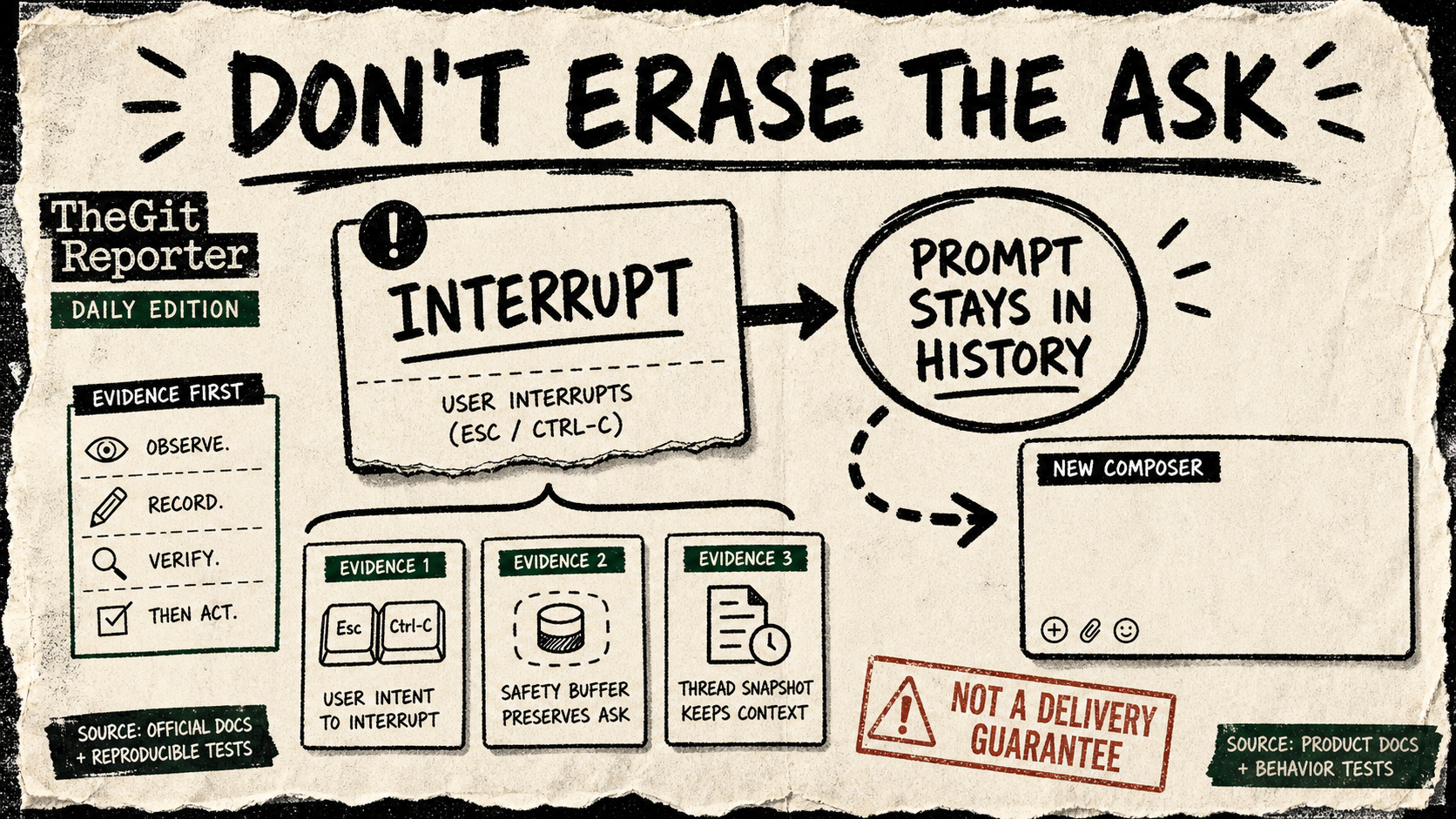
Interrupting a coding agent is a small act with large consequences. A person may have stopped it because the plan was wrong, the command looked risky, or a better instruction came to mind. On July 15, openai/codex changed its TUI so an output-free prompt interrupted with Esc or Ctrl-C remains in conversation history while the next composer opens blank.
That is deliberately different from putting the old request back into the editor and rolling the last turn away. The new tests cover both interruption keys, a failed safety-buffer retry, and restoring the matching buffered prompt when a thread snapshot is replayed. The interaction says: the attempt happened, but the next turn is a new decision.
Stopping is information, not cleanup
The change removes the cancelled-turn edit path and separates safety-buffering state so that a retry failure can still restore the right prompt after a thread switch. In a tool that can run commands and make changes, that makes interruption legible rather than pretending an abandoned request never existed.
This also sharpens the boundary from yesterday's Codex history work. The earlier commits made a durable record and a recoverable reading view; this one decides what an interrupted user request means inside that record. A session can show the stop without forcing the user to resume the same wording.
A better next question
This is not a guarantee that an interrupted operation has been cancelled everywhere, nor a promise about all Codex surfaces. It is a tested TUI behavior. The next useful signal is whether interruption status becomes equally explicit for work already delegated to a tool or subagent—where “I stopped asking” and “the work stopped” are not always the same event.