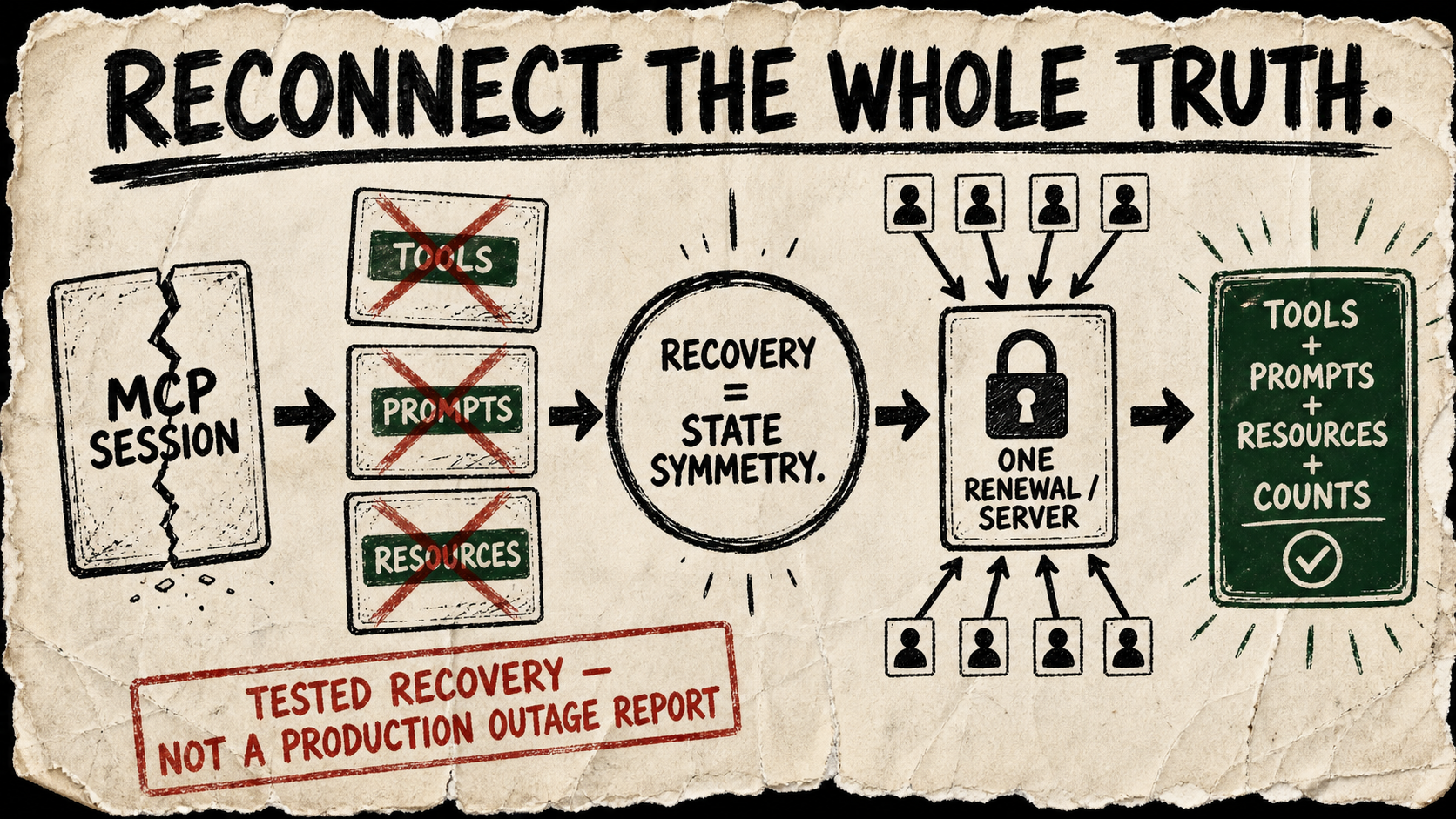
A public Crush commit ends with an unusually direct receipt: “Generated with Crush.” That proves a coding agent participated in the work, but the interesting evidence sits in the Go beneath it. The change repairs a dangerous kind of half-recovery in an MCP client: a session can reconnect while the agent’s registry still tells a different story about the tools, prompts, and resources it can use.
The repo evidence
In internal/agent/tools/mcp/init.go, Crush first makes initialization intentional. A coordinator created outside application startup no longer waits forever for a setup phase that will never begin. More importantly, a dead MCP session is no longer renewed by a crowd of callers. The code gives each server a renewal mutex, lets the first caller rebuild, then makes later callers re-check and reuse the healthy replacement.
The recovery path also clears every stale registry on failure—not only tools, but prompts and resources—and then re-lists all three on the new session before reporting fresh counts. The paired lifecycle tests exercise that symmetry. One test sets up eight callers against a dead session and requires exactly one replacement; another requires the renewed session’s tools, prompts, resources, and reported counts to agree.
The transferable building skill: recover the contract, not the socket
Builders can reuse a simple discipline here: name the state your system advertises, clear it together when the backing connection fails, and restore it together before declaring success. Treat the lock, registry, and status count as one recovery boundary. Then write the test that makes concurrent callers prove they received the same rebuilt state rather than merely a non-error return value.
The limit
The commit and tests establish an intended implementation, not a production incident or a measured reliability gain. Its “Generated with Crush” line is public coding-agent-use proof, not a complete record of who designed, reviewed, or authored each line. The next useful receipt would be a release note or a real server-recovery report showing whether this symmetry holds outside the in-memory test harness.