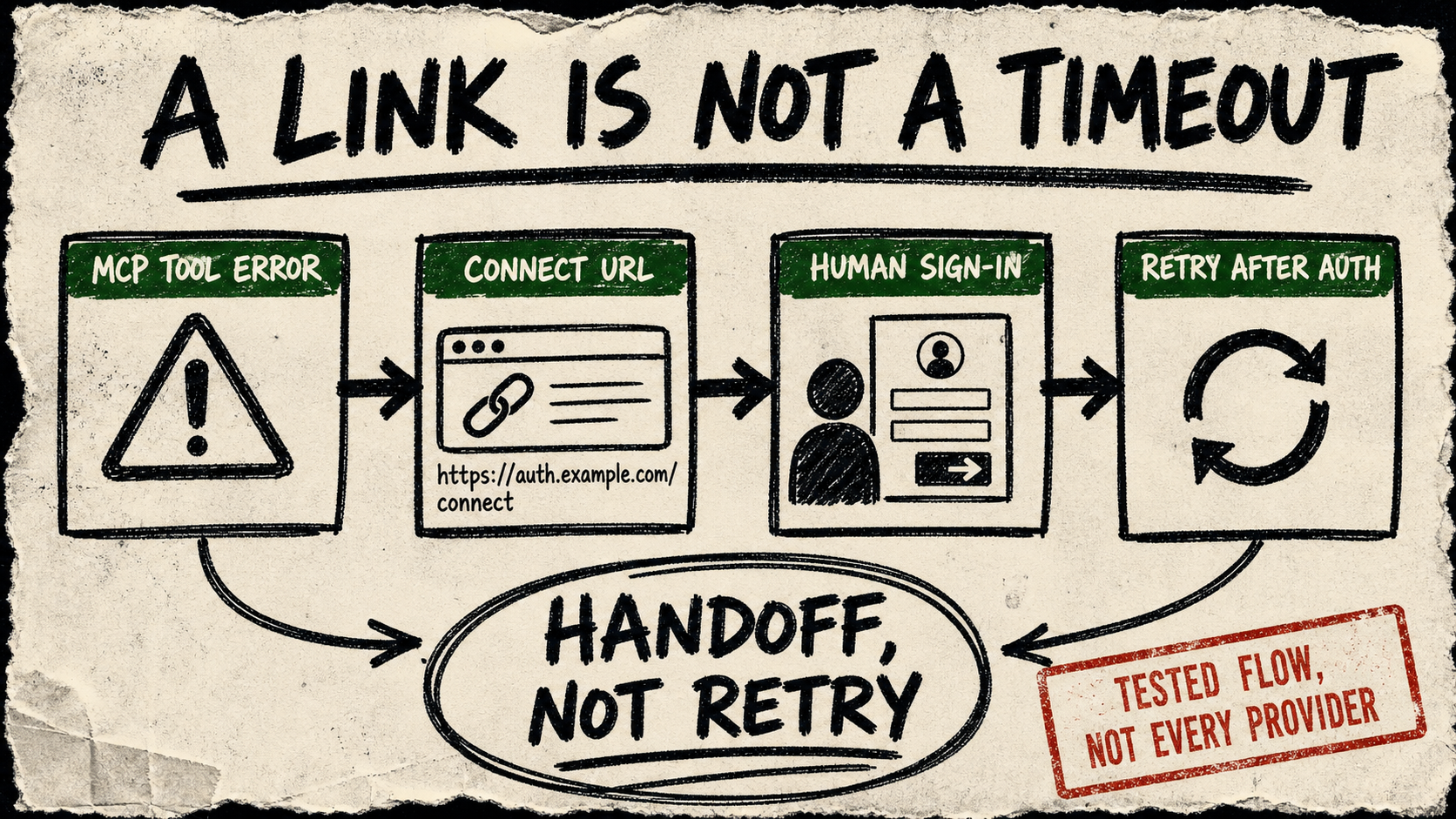
An agent asks a connected tool for something it cannot authorize itself. The honest next move is not another request; it is a handoff to the person who can sign in. In a July 20 different-ai/openwork commit, an end-to-end test gives a mock MCP tool a structured connection URL and checks that the agent can return a linked instruction: connect the account, then retry.
That sounds small until the different-ai/openwork tool is sitting between an agent and a service somebody else controls. A generic failure turns the moment into a bad loop: the agent keeps trying, the account holder has no clear action, and the provider sees another request instead of an authorization. A link does not grant the agent more power. It makes the missing human decision visible.
The important bit is what is allowed to travel
OpenWork's follow-up diagnostics change says a downstream provider authorization link should be relayed rather than masked as a timeout. The distinction matters: a timeout invites a retry; an authorization requirement names an action owner. The later provider-error patch tests that structured JSON-RPC authorization data can become a member-facing action, while a free-text URL, an unsafe scheme, or an oversized body does not automatically become a trusted instruction.
That restraint is the story's real mechanism. The product is not merely displaying more error text. It is deciding which machine-provided detail can cross into a human action, which detail stays untrusted evidence, and when the only honest message is that the provider needs attention.
A useful failure should stop the wrong retry
The public tests use a mock server and model, so they do not prove live compatibility with every MCP provider or the safety of any link outside this validation path. They do show a design worth copying: preserve a bounded, structured authorization handoff, label the human who can act, and do not turn arbitrary provider prose into a button. The next signal is whether this survives real provider variations without making a sign-in URL another route for unsafe content.