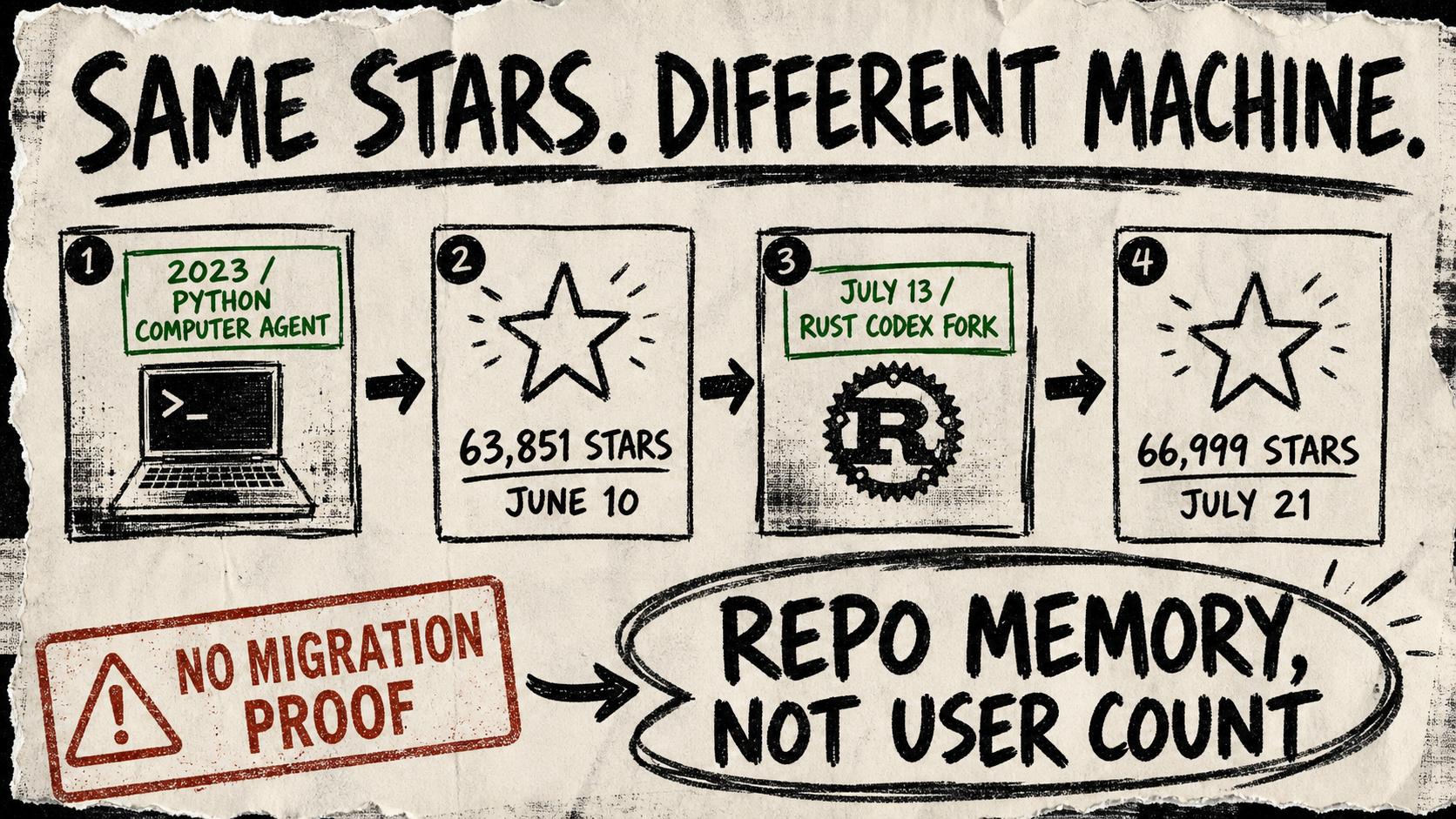
Open Interpreter released 0.0.34 on July 18. Three days later, the public openinterpreter/openinterpreter GitHub API reported 66,999 stars. The rounded figure is irresistible social proof. It is also a record of a repository whose product changed underneath it.
The project’s July 13 relaunch describes a Rust coding agent forked from OpenAI Codex, with model-specific harnesses for lower-cost and open models. The same repository began in 2023 as a Python program that let a language model run code on a person’s computer. The name and star counter crossed that architectural break together.
The first crowd starred a different machine
The August 2023 Show HN thread captures the original bargain: an open command-line assistant that could write and run local Python, JavaScript, and shell commands, normally asking before it acted. A later 2024 discussion preserves both enthusiasm for a model-agnostic desktop assistant and the harder question of what people repeatedly used it for. Those conversations were about the Python computer agent, not the current Rust harness.
A public June 10 repository snapshot recorded 63,851 stars and Python as the primary language. Compared with the July 21 API count, roughly 95% of today’s aggregate number was already attached to the repository before the relaunch. That is a comparison of counters, not people: stars can arrive and leave, and the snapshots do not identify who stayed. But it changes what the big number can honestly mean.
Lineage is not an org chart
The contributor list carries the same trap. OpenAI Codex authors sit high in the current history because the fork retains their commits. Tibo Sottiaux, a public Codex contributor, spelled that out: OpenAI names appear because history was preserved. That is useful provenance, not evidence of an Open Interpreter employment relationship, privileged access, or private coordination.
The new project has real work of its own to earn attention: its README and relaunch post make a compatibility bet around Codex interfaces and model-specific harnesses, and its July release gives prospective users a concrete package to inspect. The relaunch also points people who want the original product to the community-maintained Python continuation. That separation is clearer than pretending there was one uninterrupted product.
The graph has a caveat too
There is no honest live Star History curve to settle the transition. GitHub announced restrictions on public stargazer endpoints and views, and Star History said it could no longer make arbitrary third-party histories without repository access. A smooth chart would risk making two eras look like one adoption story anyway.
The next receipts should belong to the new agent alone: independent harness evaluations, release uptake, issue reports from real repositories, and fork-owned changes that still survive future Codex merges. The 67,000-star label is accurate. It answers how much attention this GitHub repository accumulated. It does not answer how many people trust the coding agent now inside it.