
A forgotten turn can still exist
Hermes implements undo by marking transcript rows inactive rather than deleting them. The rows remain available for audit but disappear from active prompts and search. Hermes then evicts cached agent state so the next message rebuilds from active-only history.
Forgetting therefore requires coordinated storage, query, and cache behavior. Codex draws another boundary by moving memory-owned tables and jobs into memories_1.sqlite while durable thread metadata remains elsewhere. Rewindable conversation state and rebuildable memory pipelines are not the same store.
What changed since the first Atlas draft
Team memory now has tests, schema checks, search behavior, and no-secrets guidance.
openclaw/openclaw OpenClaw Makes Session Threads A Maintainer ProblemPinned, archived, read-only, and screenshot-backed sessions split memory from mere recency.
openclaw/openclaw Fenglanhua Made OpenClaw Prove Its Memory MigrationMemory migration becomes credible when the patch includes proof and review evidence.
What actually happens
-
Turn context
selected, short-lived, high fidelity
-
Thread history
durable conversational record
-
Notes and memories
typed writes with provenance
-
Indexes and caches
derived and rebuildable
-
Archive and audit
long-lived, costly to correct
Name the store before calling it memory
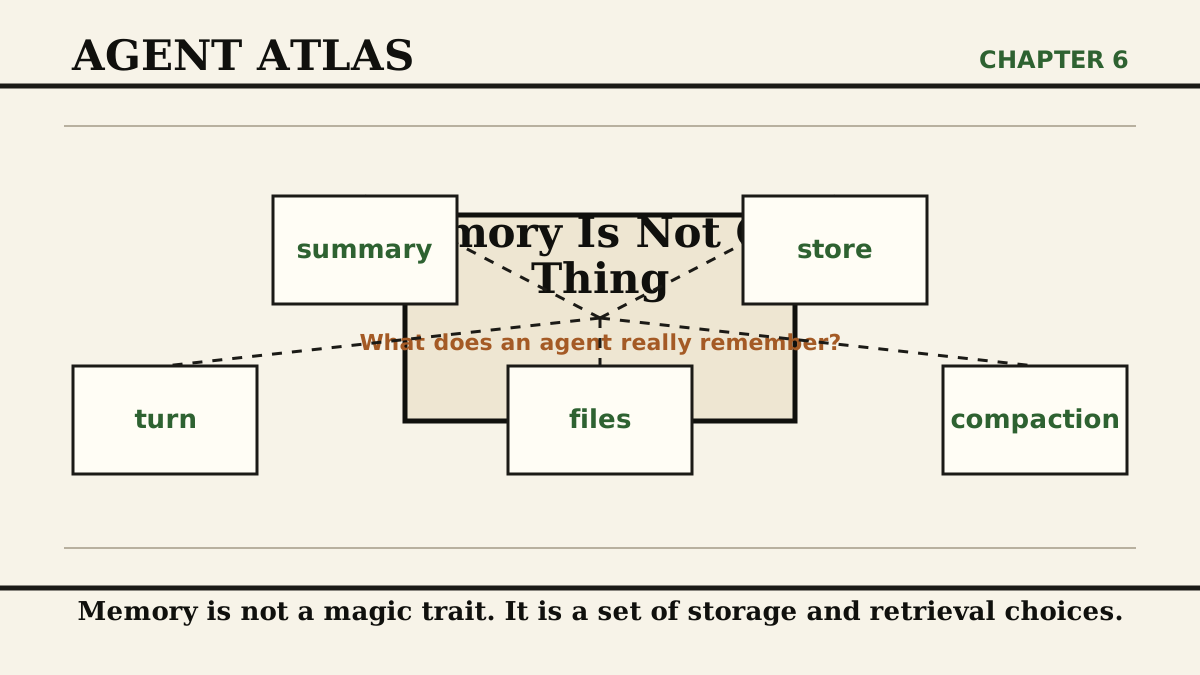
A useful inventory distinguishes active turn context, durable thread history, append-only notes, extracted memories, retrieval indexes, cached agents, archived sessions, and inactive transcript rows. Each needs an owner, schema, namespace, retention policy, rebuild rule, and authority model.
Codex's separate memory database makes pipeline state independently rebuildable while preserving thread metadata. OpenViking's abstract, overview, and full-content layers expose another typed distinction: different reads trade detail for context cost.
Writes need authority and conflict semantics
Codex's ad hoc note path validates filenames, rejects path-like names and empty notes, and uses create-new semantics. Those constraints prevent accidental overwrite and namespace traversal. The tool remains behind a disabled registration path, treating exposure as a separate rollout decision.
Every memory write should record source, author, trust class, scope, timestamp, and idempotency key. It also needs correction and conflict rules: append, supersede, reject, or merge. A model-generated note without provenance is an assertion, not durable knowledge.
Reads are selection and injection
Codex additionalContext entries carry trust kinds and support deduplication, reset, and truncation before hidden injection. Reading is an explicit selection pipeline, not an invisible dump of everything previously stored.
A read contract should identify the selected source version, trust class, retrieval score, token budget, and injection location. Stale or low-authority memories must not silently outrank current user instructions.
Forget is a family of operations
Soft deletion hides records from active reads while retaining audit history. Archive allows restoration. Hard deletion removes durable data. Cache eviction removes derived runtime state. Index deletion prevents retrieval. These operations are related but not equivalent.
Compaction is also not deletion. A summary can reduce context cost while preserving original archives, unsummarized tails, and sensitive or incorrect source records elsewhere.
Where the contract breaks
Cross-store forgetting mismatch
A row is hidden while caches, indexes, summaries, or backups still contain it.
Poisoned or conflicting write
Untrusted content is persisted without provenance or collision handling.
Lossy or stale read
Compaction omits a constraint or retrieval selects obsolete state.
What the product must prove
- Inventory every store with owner, schema, namespace, retention, rebuildability, and deletion guarantees.
- Trace one fact through write, index, cache, read injection, correction, archive, and forget operations.
- Verify telemetry records operation, scope, status, truncation, provenance, and compaction markers without leaking content.