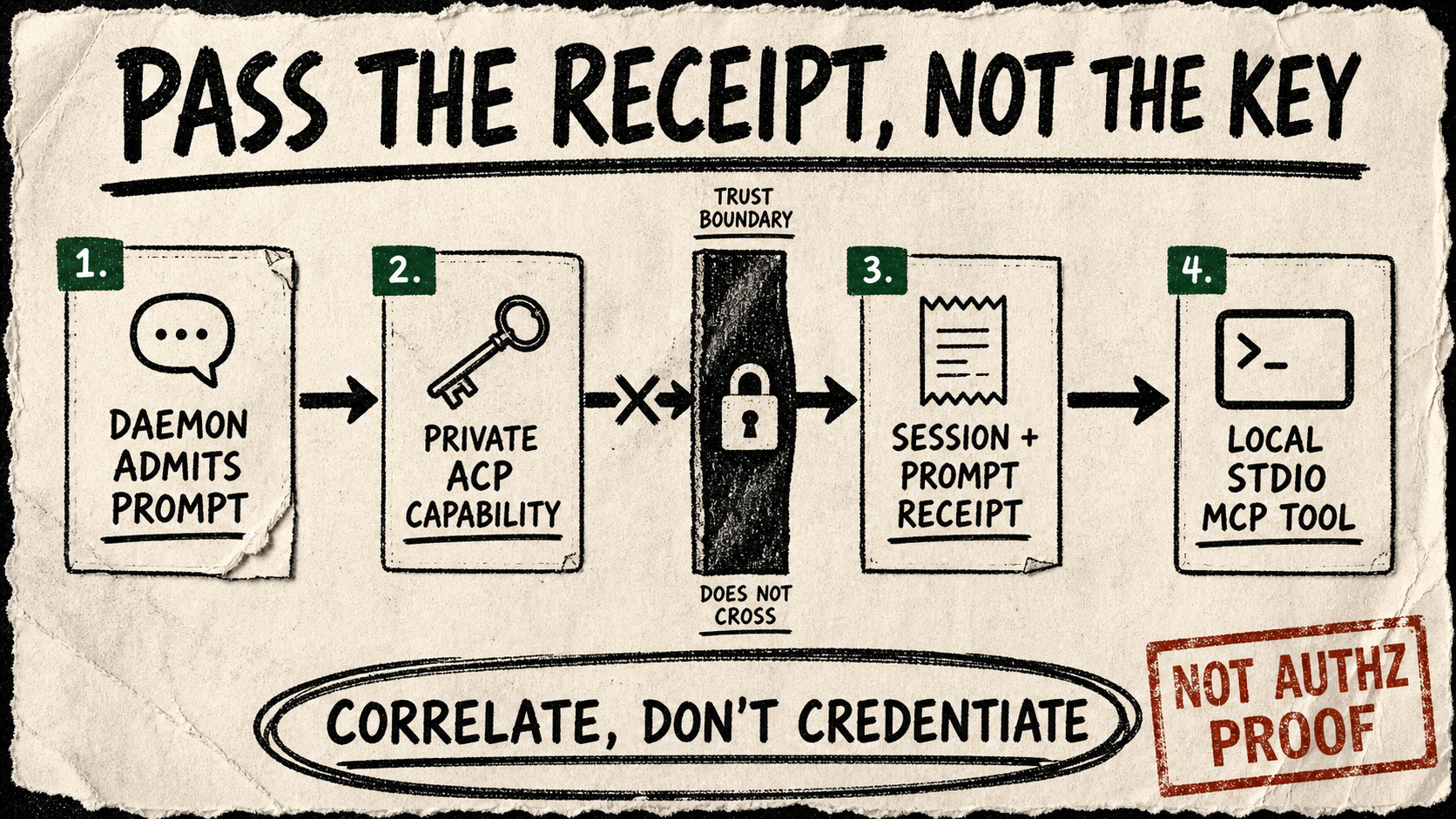
“Open-source, inside and out” is how Qwen Code describes the relationship between its framework and the Qwen model family. The phrase could invite an easy story about a model and a harness racing forward together. This week’s more revealing change is smaller: as Qwen Code’s experimental qwen serve mode lets more than one client share an agent session, the project is teaching that session to say where a tool call came from—without turning the label into a new credential.
The public change carries a versioned session and prompt identifier from a daemon-admitted root prompt to a Qwen-launched local stdio MCP tool. That is mundane-looking plumbing with a practical consequence: a tool server can correlate an action to the accepted prompt that caused it, rather than treating every request from a long-lived shared agent as anonymous runtime noise.
A label with a deliberately short leash
The important choice is where the new context stops. The project’s design note describes a narrow chain: daemon prompt admission, a privately authenticated ACP child, the root session turn, then tools/call metadata for tools Qwen itself launched over stdio. Qwen rebuilds the reserved metadata from its own session state instead of accepting a caller’s version. It rejects unknown fields, versions, and blank identifiers.
Just as consequential are the exclusions. The document calls the metadata correlation context, not an authorization credential; it says automatic cron turns, background notifications, resumed background agents, and subagent reasoning receive none. HTTP, SSE, WebSocket, reverse, SDK-provided, and client-hosted transports are outside the path too. The private per-process capability used to authenticate the child is a different thing—and is not meant to arrive in a shell command or MCP server environment.
The test is the argument
The commit does not merely add a metadata type. Its end-to-end test starts a daemon, connects through the bridge, makes a root prompt trigger a local echo MCP tool, and checks two separate facts: the tool receives a session-and-prompt record, while the private capability is absent from the tool process. That is a useful pattern for any team building a shared agent runtime: test the useful signal and the secret’s non-arrival in the same path.
It also corrects the first reading of the assignment. Qwen Code’s README says the project supports Qwen alongside OpenAI-, Anthropic-, Gemini-compatible and local providers. A daemon-bound provenance record does not show that Qwen models perform better, that a released build contains the feature, or that users will adopt the shared-session mode. It shows the project confronting a trust problem created by an agent surface that can outgrow a single terminal window.
The open-agent claim gets real at the handoff
An open model family and an open harness can evolve together without making every boundary a model question. Here, the work is about who admitted a prompt, which local tool may learn that fact, and which capability must remain private. For builders, the transferable lesson is to make provenance opt-in by transport, reconstruct it at the trusted boundary, scope it to one root turn, and pair every new correlation field with a test that a stronger secret did not hitch a ride.
The next signal worth watching is release inclusion and an operator-facing demonstration of the boundary under a real multi-client deployment. Until then, Qwen Code has published a source-level contract, not proof that shared agents are safe by default. But it is a clear sign that “one agent, many clients” needs more than a chat protocol: it needs an accountable path into every tool that can act.