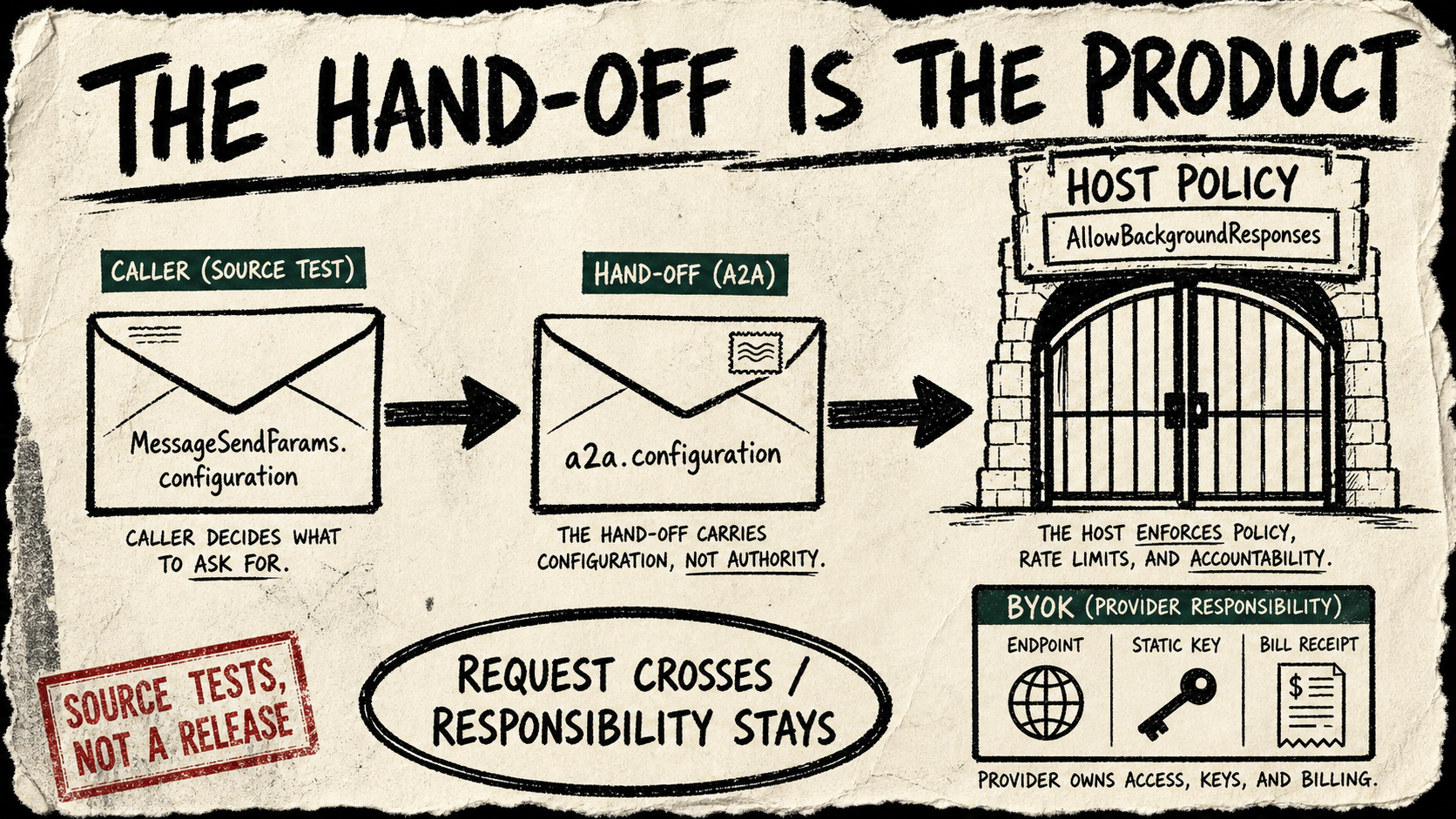
In the microsoft/agent-framework repository, a fresh A2A adapter commit changed how caller-supplied MessageSendParams.configuration enters a hosted-agent run: it is now forwarded as a2a.configuration. Its focused test keeps a host policy that disallows background responses in force even when a caller asks to return immediately. That small source fact draws a large line around responsibility.
The public microsoft/agent-framework repository puts migration from AutoGen and Semantic Kernel on its public map. Its fresh source work explains what a credible successor needs to preserve: configuration can cross the boundary, while the host's authority stays put.
That sounds small until an agent begins to work somewhere a human cannot see. Passing configuration is useful; passing authority by accident is not. The source draws a clean line between a request's context and the host's operating policy.
The provider is another boundary, not an abstraction detail
A new GitHub Copilot BYOK sample makes the same distinction in a different direction. It can route a session to an explicitly configured OpenAI, Azure, Anthropic, or compatible endpoint. But the sample also says what the route does not carry for you: the credential is static, availability depends on the provider, and usage is tracked by that provider rather than GitHub.
That is not a defect in a framework. It is the accounting that a responsible interface refuses to hide. A useful migration path moves code and context without pretending it has also moved the organisation's permissions, payment responsibility, or incident response.
The evidence is intentionally bounded to public commits and samples. It does not prove a release, a smooth application migration, or real-world interoperability with every A2A peer. For the detailed successor trail—including the migration sample surface—read the accompanying Microsoft Agent Framework deep dive. The next public test worth watching is one that follows a real workflow through all four boundaries: caller configuration, host policy, provider responsibility, and recovery.