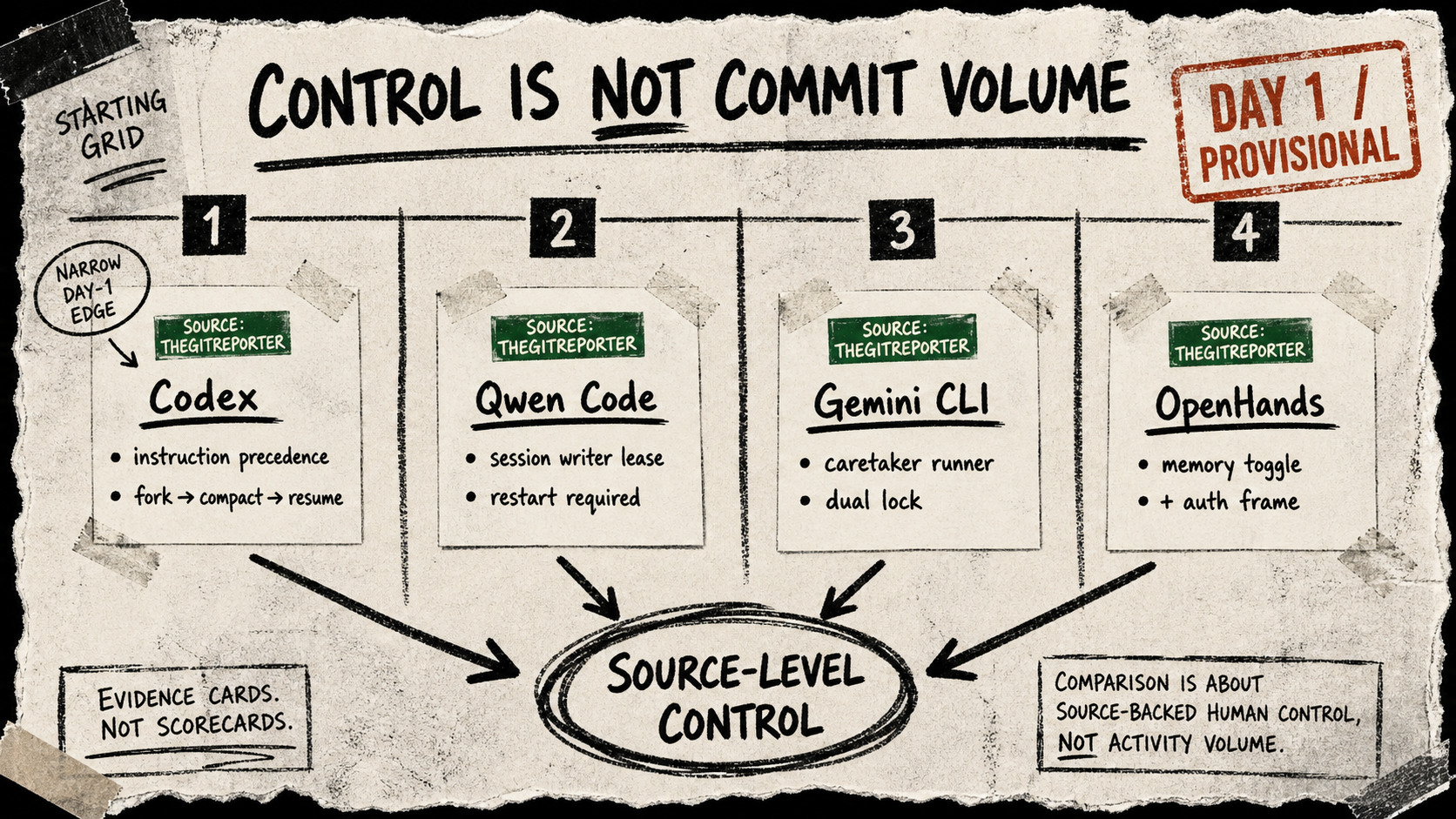
Four coding-agent repositories are now on a three-day public watch, but this is not a race counted in commits or lines changed. The question is narrower: which source-backed move makes an agent's work easier for a human to inspect, steer, constrain, or recover? The first answer is deliberately conditional. It can change tomorrow.
The first edge is about instruction authority
Codex's new multi-agent v2 change adds a configurable developer-instruction override for subagents. Its important detail is precedence: a role-specific instruction stays higher priority, an unset override inherits, and a blank override clears inherited instructions. The focused tests follow that decision through no-history, bounded-history, and full-history forks, plus compaction and cold resume. That makes Codex the narrow Day 1 front-runner: it is testing whether a human-set control remains legible when delegation changes the context around it.
Qwen Code is contending on a different boundary. Its session-writer lease fences concurrent ACP and daemon writers, pins the setting when the process starts, and stays default-off. The surrounding shutdown recovery work gives that lock a real consequence: a long-running agent needs a path to release and reacquire ownership without writing two incompatible histories. The counterweight is written into the project's own design note—mixed versions or settings are unsafe, and interactive and headless recorders remain outside the protocol.
OpenHands is also contending, but its opening receipts are separate controls: persistent memory is opt-in and carried through both inline and profile launches, while a WebSocket patch moves the session key out of the URL and tests authentication before application messages on reconnect. Those are concrete operator boundaries, not yet a unified supervision story.
Gemini CLI stays on watch. Its new caretaker runner spells out an agent loop with required edits, targeted tests, evaluation, and revision; an adjacent dual-locking change tackles coordination in that workflow. But both sit under a caretaker PR-generator path. The sources do not yet show a general operator control surface for Gemini CLI users.
What could overturn the grid
Codex's edge disappears if the configuration is confined to an unreleased v2 path, if a resume or role interaction breaks the claimed precedence, or if a rival supplies a more complete operator path with public migration and recovery tests. The Derby has no winner today. Tomorrow's useful signal is not more activity; it is a regression, a forced recovery, or a user-facing control that shows whether these mechanisms survive contact with a real operator.