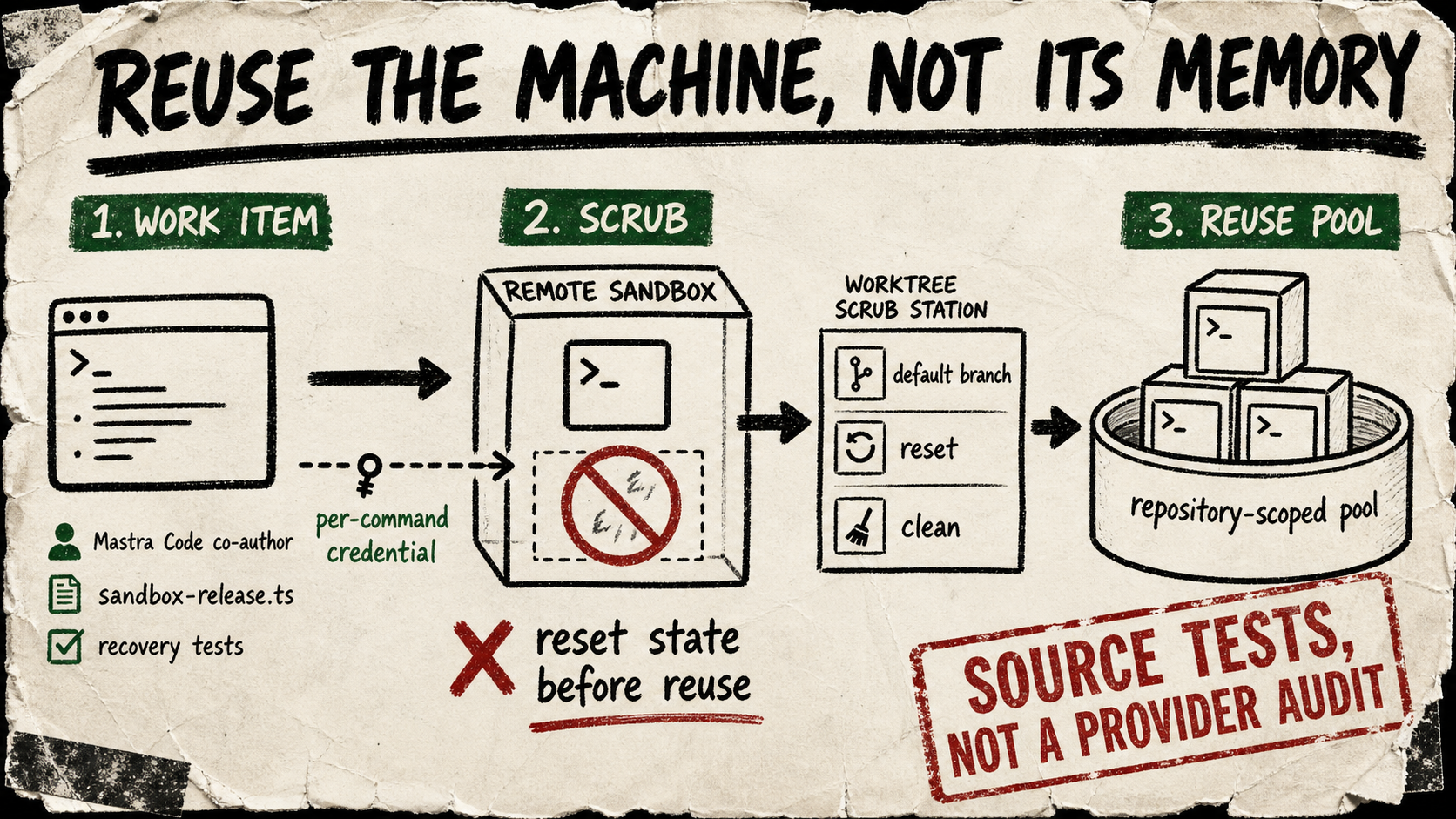
“Reuse the sandbox” sounds like an infrastructure efficiency win. Mastra’s new Factory patch makes a sterner argument: a remote VM is only reusable after the system knows what it is allowed to remember. The public commit credits Mastra Code as a co-author, then spends most of its engineering effort on the unglamorous boundaries behind that claim—repository linkage, terminal state, cleanup, fallback provisioning, and credential lifetime.
A pool is not a reset
The new release module returns remote sandboxes to a pool only after a work item reaches a terminal stage. The pool is scoped to a linked repository, not an abstract global bucket. Before release, it tries to reattach the VM and recycle the worktree to the repository’s default branch. On the next claim, the system recycles again and can fall back to a wipe-and-reclone path if that worktree is wedged. The repetition is the point: a cleanup attempt is helpful; a cleanup requirement belongs on the claim path.
The accompanying tests do more than count pool entries. They check that a released worktree is cleaned before pooling, that a missing VM does not leave a session binding behind, and that a foreign organization’s session is not touched. Those are small, concrete proofs that the team is treating the recovery path as part of the feature rather than a footnote after deployment.
Credentials must not become furniture
The sharpest design choice is about environment values. The commit says provider VMs can retain creation-time environment data for their lifetime, so the sandbox fleet no longer forwards credentials into VM creation. Instead, the fleet layer merges them into command execution. That is a useful distinction for any agent system: a token needed to run a task should travel with the task, not quietly become a property of the machine that happened to run it first.
Transferable building skill: design reuse as a chain of invariants
Builders can reuse this pattern without copying Mastra’s architecture. Write down four invariants before pooling anything: which repository identity may claim the resource; which session binding must be cleared; which state must be reset before the next claim; and which credential or authority may exist only for a single execution. Then test the unhappy paths—unreachable machine, interrupted cleanup, foreign tenant, wedged checkout—at the same boundary where reuse is granted. This turns “cache it” into a recovery discipline instead of a promise that idle infrastructure is clean.
The source does not prove rollout, speed, cost savings, or certified isolation at every provider. It does show a substantial, agent-assisted engineering receipt: pooling is paired with scrubbing, re-claim validation, and per-command authority. The next signal worth watching is a public end-to-end provider test that shows the wipe-and-reclone fallback while preserving that credential boundary.