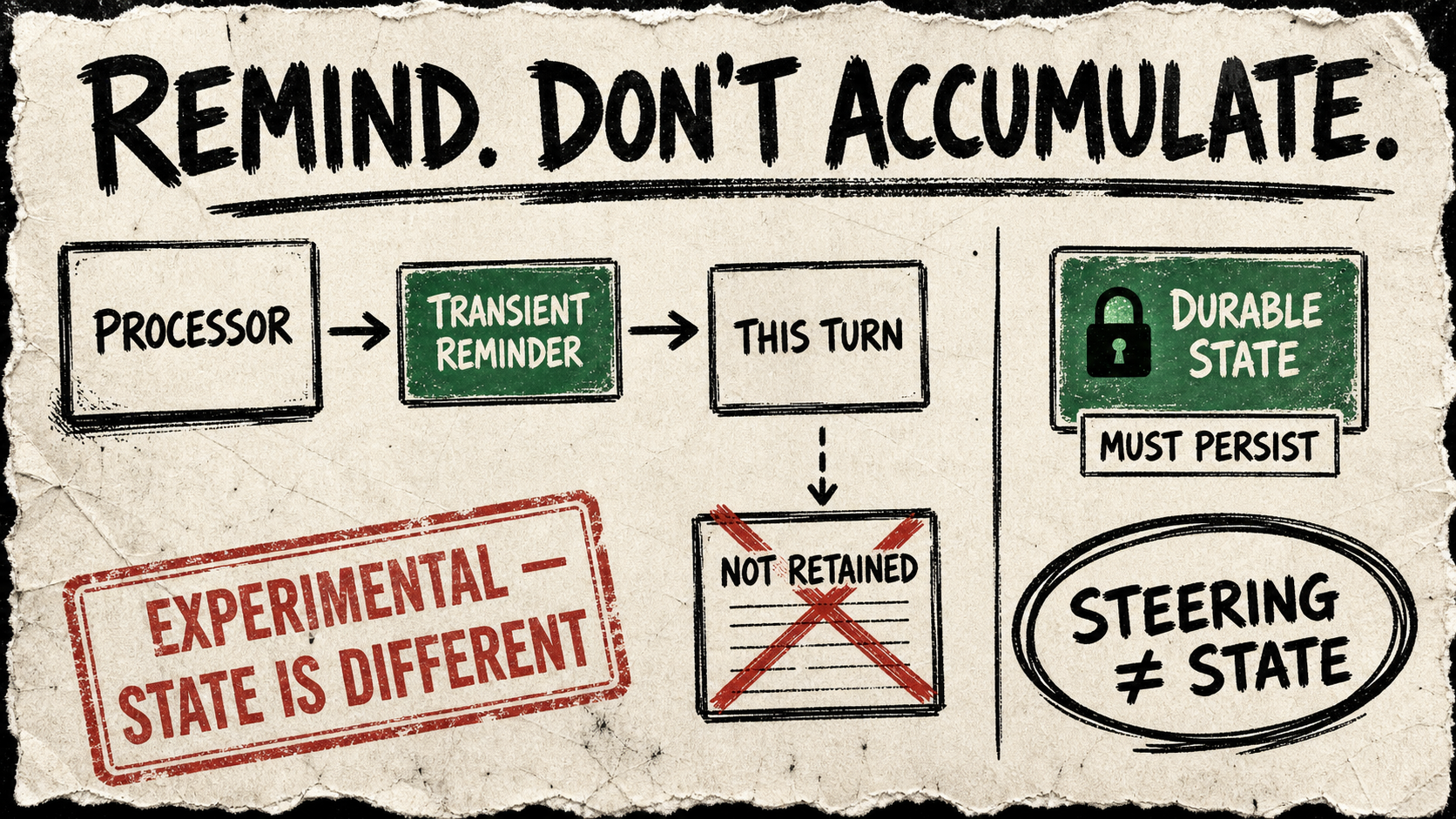
A useful agent reminder can become a bad memory. If an application re-injects “stay on this task” or a live policy constraint on every turn, storing each copy makes the model see a growing pile of its own old instructions. On August 5, mastra-ai/mastra added a transient: true option to agent signals so a processor can deliver a reminder for the current call without retaining it as conversation history.
This is Builder Work rather than a release note because the public commit credits Claude Opus 4.8 and Mastra Code as coauthors, then exposes the engineering underneath the claim. The change reaches signal types, message-list handling, memory, server schemas, streaming, and focused tests. That public record proves coding-agent participation in the patch; it does not tell us how the human and agent work was divided.
The repo evidence
In the signal contract, non-state signals may be transient: the model receives the contents for this call, but the signal is not retained for later turns. The design draws a sharp line around state signals. They cannot be transient because their versioning, cache keys, and active copies are rebuilt from persisted history; a delivery-only state update would make deduplication lie.
The accompanying tests make the distinction concrete. They check that a transient signal is still projected into the current model message, survives the conversion formats correctly, and rejects the illegal state-signal combination. The broader agent tests also expect transient signals not to be written or recalled. This is what turns a seemingly small flag into a contract across context, storage, and recovery.
Transferable building skill: separate steering from state
Before adding another reminder to an agent loop, classify it. If it is a current constraint that should be freshly evaluated each turn—such as a length limit, a current task, or a condition computed from live application state—send it on a transient lane and test two things: the model sees it now, and storage cannot recall it later. If the value must coordinate future turns—such as a browser snapshot, an approval state, or an objective—make it durable, give it explicit ownership and deduplication rules, and test recovery instead. Mastra’s processor example shows the first half of that discipline.
The limit
The source describes an experimental API and its intended repository behavior, not a released package, measured cache savings, or a production deployment. A transient signal is also not a universal solution: Mastra rejects it for state signals on purpose. The next useful signal is a public release note or end-to-end example that shows a long-running agent keep fresh steering context without losing the durable facts its next turn genuinely needs.