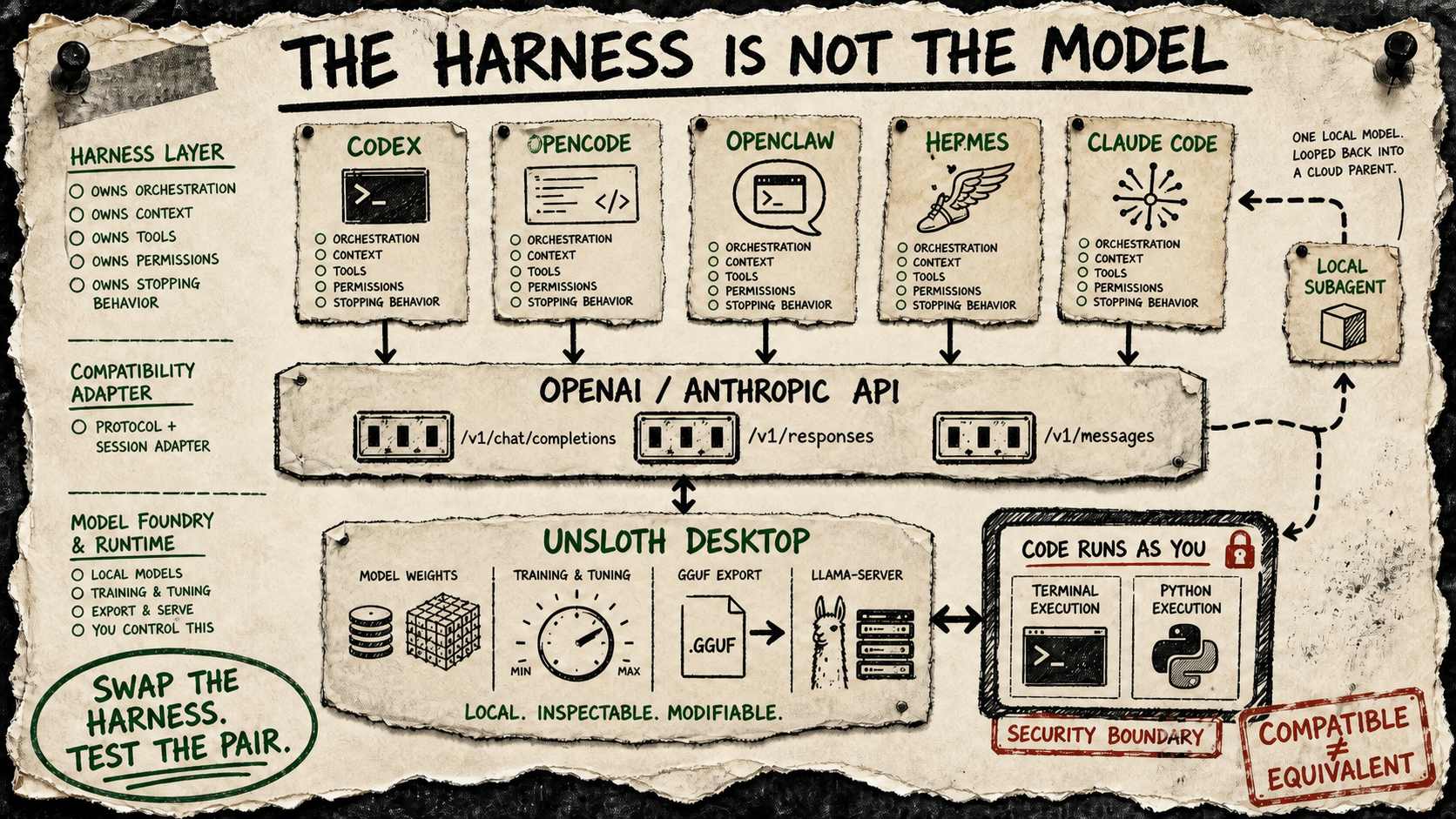
Unsloth’s August 11 Desktop release arrives with the usual local-AI attractions: download a model, run it on Windows, macOS, or Linux, train it without constructing the entire stack by hand, and keep the weights close. The more consequential part sits behind the interface. The same machine can serve a local model through OpenAI Chat Completions, OpenAI Responses, or Anthropic Messages, then point Claude Code, Codex, OpenCode, OpenClaw, Hermes, or Pi at it.
That changes the shape of a local agent experiment. The harness—the program that assembles context, exposes tools, applies permissions, compacts history, delegates work, and decides when to stop—no longer has to arrive welded to its model provider. Unsloth can own the weights, quantization, runtime, and model lifecycle underneath. An open harness can own the work above.
But “compatible” is not “equivalent.” The source makes that warning unavoidable. Unsloth does not write one generic configuration and rename it six times. Its unsloth start implementation adapts a different protocol, context model, configuration hierarchy, compaction rule, workspace, and permission vocabulary for each harness. The interesting product is therefore not a universal local agent. It is a model foundry beneath a set of explicitly different agents.
The desktop is really four layers
At the bottom, Desktop is a model workshop. The launch-tag feature contract combines local model search and loading, GGUF and safetensors support, LoRA and full fine-tuning, reinforcement learning, hardware placement, and export. A builder can start from a public checkpoint, adapt it to a task, export a quantized artifact, and run that artifact without leaving the application’s model lifecycle.
Above that is the inference runtime. Local GGUF models are served through llama-server; other model paths use their appropriate backend. Unsloth exposes /v1/chat/completions, /v1/responses, and /v1/messages. Those routes are a compatibility boundary, not three native brains. The Responses and Messages routes translate provider-specific requests into the chat backend and translate the result back.
The third layer is the session adapter. unsloth start <agent> finds or starts a local server, selects a model, obtains an API key, writes isolated configuration, and launches the requested harness. This is where the abstraction becomes practical: a user does not have to rediscover every client’s base-URL, key, model, context, or config precedence.
The harness remains the fourth layer. It decides what the model sees, which tools it may call, how results return, when context is compacted, which approvals block execution, and how a failed turn recovers. Unsloth supplies the model and adapter; it does not erase those decisions.
Six harnesses, six pieces of glue
The differences in the adapter file read like a compact field guide to harness engineering:
| Harness | Wire path | Adapter work beyond a base URL |
|---|---|---|
| Claude Code | Anthropic Messages | Sets the Anthropic endpoint and served model, suppresses unrelated traffic, aligns auto-compaction to the real window, and keeps delegated work on the local model. |
| Codex | OpenAI Responses | Creates an unsloth_api provider, supplies an unknown-model catalog and fallback prompt, declares the actual context window, and isolates the session home. |
| OpenCode | OpenAI-compatible | Registers an AI SDK provider, pins context and output limits, reserves roughly ten percent for compaction, respects project permissions, and can expose the local model only as a named subagent. |
| OpenClaw | Chat Completions | Creates a provider and workspace, skips personal-assistant bootstrap in a coding project, and maps the optional yolo mode into both OpenClaw execution policy and its approvals file. |
| Hermes | OpenAI-compatible | Registers a named custom provider and corrects Hermes’s context assumptions; for a small local window it adjusts compression so the agent does not wait for a fictional 64K budget. |
| Pi | Chat Completions | Writes a custom model with the real context and output cap, and bundles a separate local-subagent extension when requested. |
These are not cosmetic details. If a 16K model is presented to a harness as 128K, compaction starts too late and the server fails precisely when the task becomes interesting. If a model unknown to Codex has no fallback instructions or capability record, the client can make bad assumptions about tools and truncation. If a temporary launch silently modifies a user’s global provider or permission state, a local experiment becomes a persistent security and debugging problem.
Unsloth’s answer is mostly session scope. It writes private, managed configuration; relocates state for several clients; merges instead of blindly overwriting; and removes only the permissive settings that its own earlier --yolo run created. That is valuable engineering in a command marketed as one line. It is also proof that an “OpenAI-compatible endpoint” is only the beginning of a usable agent integration.
A local model can be the worker without becoming the boss
The most interesting combination does not replace a cloud model at all. Claude Code, Codex, OpenCode, and Pi can keep their current parent model while Unsloth registers the local model as a subagent. The parent receives a new bounded delegation tool; Unsloth launches a local child against the same project and returns its result.
That arrangement creates a different optimization surface. A builder can reserve an expensive remote model for planning, ambiguous decisions, or review, while sending repetitive codebase search, test triage, mechanical implementation, or private-domain work to a local specialist. The local model can be fine-tuned, quantized, and changed independently of the parent harness. The harness still chooses when to delegate and how much authority the child receives.
The implementation does not pretend every client has the same subagent primitive. Claude gets a session plugin with MCP tools and a plan-mode gate. Codex gets an MCP server and a private child home. OpenCode gets a named @unsloth subagent in its agent configuration. Pi gets a bundled extension. The shared concept is local delegation; the mechanics remain harness-native.
Tool-call healing repairs the seam, not the model
Local models often fail at the exact boundary an agent cares about. A smaller GGUF can produce a visually plausible <tool_call> block as prose instead of a structured tool call. To a chat UI that is ugly. To a coding harness it is a dead turn: the client never invokes the tool.
Unsloth’s response-side healer is narrower than the launch language about self-healing suggests, and that narrowness is a strength. It activates only when the client supplied tools. It promotes a text-form call only when its function name exactly matches a declared tool. It removes only the markup span it successfully promoted; undeclared, malformed, or ambiguous content stays visible. It does not rewrite the upstream request or issue another generation, and callers can disable it.
The initial healing change included translations and a large regression surface for parsers, streaming, strict tools, and the Responses path. Optional nudging can retry a non-streaming turn when a call still cannot be healed. That can recover a transport-shaped failure. It cannot make a weak model choose the right tool, reason about a repository, obey an approval policy, or notice that it should stop.
This is why the release’s “up to 50%” tool-calling improvement should be treated as a product claim, not a portable benchmark result. The public source proves a defensively bounded repair mechanism. It does not prove the same gain across models, quants, schemas, prompts, or harnesses.
The harness is an independent variable
The temptation is to load one local coding model, run it under whichever client is convenient, and call the result a model evaluation. Public evidence now argues against that shortcut. A preliminary 50-task study of Goose, OpenCode, and OpenHands-SDK found harness-specific failure fingerprints across two models and up to a 40-fold difference in tokens per solved task. Its paired pass-rate differences were much smaller—zero to eight percentage points—and most intervals included zero. The paper is preliminary and under review, but its methodological point is sound: the unit a user experiences is the harness-model pair.
A harness can spend tokens through an oversized system prompt, repeat state after compaction, wait through no-action turns, stop before verification, or keep going after the useful work is done. It can serialize tools a model expected to call in parallel. It can expose a different schema or omit a tool entirely. Those effects do not disappear because two clients speak to the same /v1 endpoint.
This is where an open-harness layer becomes more than ideology. The separate Open Harness project, for example, treats Claude Code, Codex, and OpenCode as swappable execution backends and records runs for replay and comparison. Put a fixed Unsloth model below that kind of experiment and the stack gains two controlled axes: hold the model constant while changing the harness; hold the harness constant while changing the model or fine-tune.
Desktop can close the build–test–train loop
Unsloth’s unusual advantage is that the serving layer sits beside the model workshop. A failed agent run can become more than a prompt tweak. A team could collect consented failure cases, build a narrow training recipe, create an adapter or new checkpoint, export a GGUF, and rerun the same harness matrix. That does not guarantee improvement—fine-tuning can overfit the test or damage unrelated behavior—but it makes the model layer operable by the same builders who observe the failure.
The opt-in MCP control plane pushes that idea further. An authenticated local client can inspect models and GPU state, validate a recipe, start or stop training, inspect output, load a checkpoint, and export GGUF. The endpoint is disabled by default and requires a bearer token because these are not read-only conveniences: they consume GPU memory, write artifacts, and can interrupt active work.
A disciplined evaluation loop would keep those powers separated:
- Pin the model revision, quant, context window, sampling, tool schema, and Unsloth release.
- Run identical tasks through each harness with equivalent permissions and a recorded execution budget.
- Measure completion, tokens, latency, tool errors, compactions, verification behavior, and human interventions—not only a final pass rate.
- Change one layer: a harness version, a model, or a controlled fine-tune. Then rerun the matrix instead of comparing anecdotes.
That is the potential of Desktop combined with open harnesses: not one magical private agent, but a local laboratory where the model, adapter, harness, and policy can be varied without pretending they are the same thing.
Local is not the security model
The safest part of unsloth start is a subtle default. When it auto-starts a server for a coding harness, Unsloth’s own web-search and code-execution tools are off unless the user explicitly enables them. The harness’s client tools pass through instead. Approval remains in the harness, and Unsloth maps its convenience --yolo switch into each client’s own permission mechanism rather than inventing a universal bypass.
That does not make Desktop harmless. In ordinary Studio/API use, server-side web search, Python, and terminal tools may be enabled. The launch-tag remote-access warning says they run as the host user. A Cloudflare --secure tunnel keeps the raw port on loopback and fails closed if the tunnel cannot start, but anyone with the public link and API key can reach what that key authorizes. The README’s instruction is blunt: protect the key and use --disable-tools when exposing the service.
The compatibility routes also have real edges. At launch, the Responses bridge translates client function tools but drops built-in Responses tools such as hosted web search, file search, and MCP because llama-server does not implement them. Streaming Responses requires a GGUF backend. The Anthropic route has its own rules for which server tools can run without a confirmation UI. A green connection test proves transport, not feature parity.
The practical security boundary is therefore the whole pair: which model generates a call, which adapter promotes or translates it, which harness declares the tool, which approval policy accepts it, which process executes it, and which filesystem or network that process can reach. “It runs locally” answers only the location question.
What would prove the open stack works
Desktop is still a beta, and its launch window was moving quickly enough that many fixes landed around the tagged release. No live GPU, model, tunnel, or agent session was run for this article. The implementation and tests prove that the layers exist; they do not prove stable operation on every supported machine or superior agent performance.
The next convincing artifact is not another compatibility badge. It is a reproducible harness-by-model matrix: one exact local model and quant, one task set, several open harnesses, recorded prompts and tool schemas, equal permissions, and full token, latency, compaction, intervention, and failure receipts. Then change the model—perhaps with a task-specific Unsloth fine-tune—and run the same matrix again.
If that work shows a local model improving under one harness and regressing under another, Desktop will have made an important point visible: open weights are only one replaceable layer in an agent system. If the same model can move among harnesses with its differences measured rather than hidden, local AI gains something more useful than another chat window. It gains an experimental architecture.