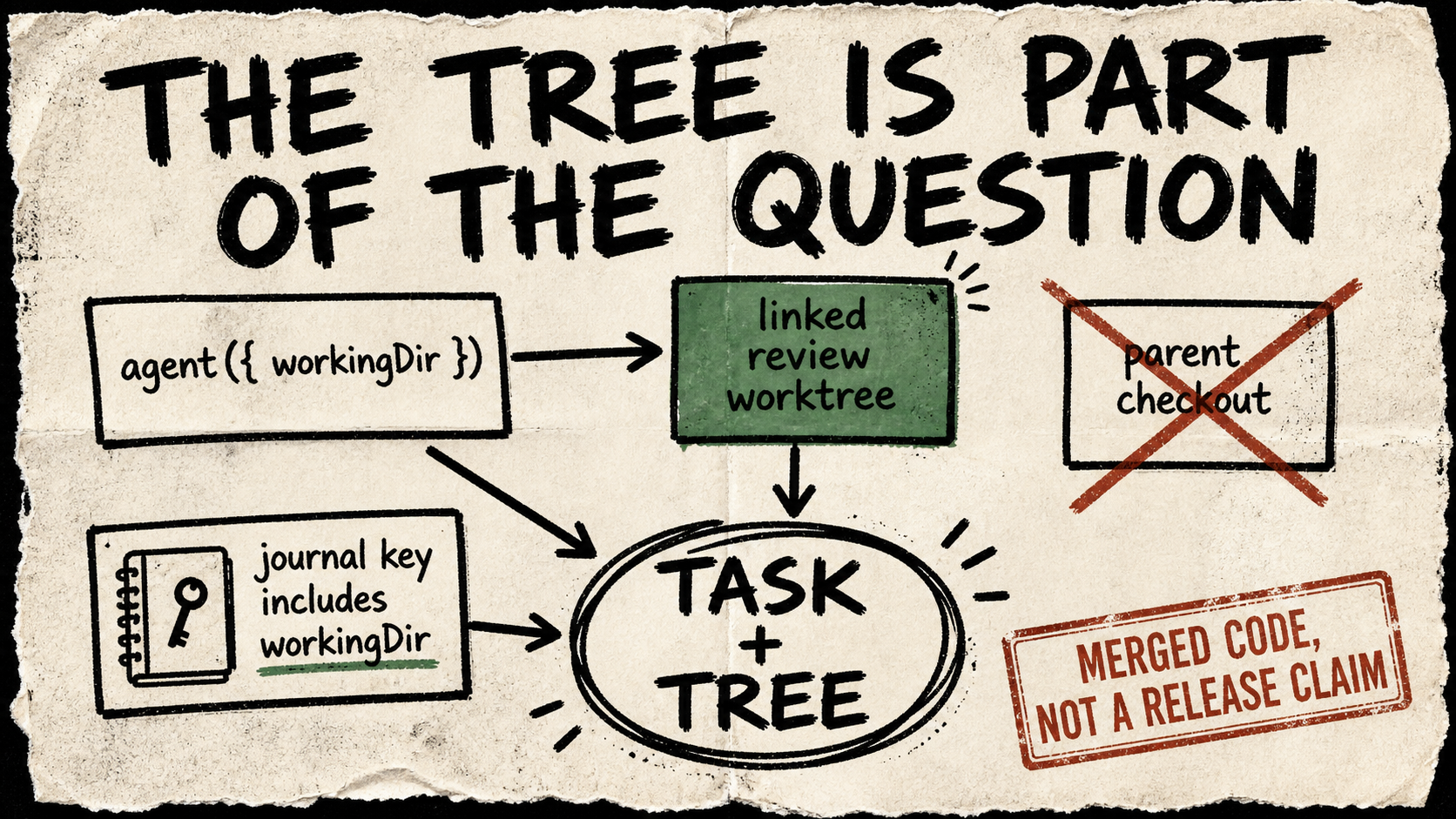
A review agent can be diligent, fast, and completely wrong if it opens the parent checkout while the changes that matter sit in a linked worktree. Qwen Code’s freshly merged workflow change makes that risk explicit: a script can now name an existing worktree with workingDir, but the runtime refuses to treat that directory as a casual preference.
The public commit routes a pinned workflow away from a fast path that would otherwise leave the child on its parent configuration. It then checks that the target is a registered linked worktree of the same repository, not a convenient directory with a familiar name. That matters most where uncommitted state is the point: a review checkout, or a tree prepared by an earlier step.
Isolation and identity are not the same thing
Creating an isolated worktree and binding an agent to one already owned by the caller solve different problems. Qwen’s documentation says a regular subagent may reuse an existing linked tree, while workflow scripts reject workingDir plus isolation: one option preserves the caller’s workspace, the other creates and cleans up a new one. The refusal is useful because silently choosing either would change what the agent can see and who owns the result.
The less visible safeguard may be the more consequential one. The workflow journal now includes workingDir in its canonical options. A resume asking the same prompt about a different tree gets a different identity instead of replaying the first tree’s answer. In other words, the checkout is evidence, not scenery.
The next review question is embarrassingly concrete
Teams building agent workflows should ask a basic question before trusting a cached or resumed result: which exact tree did this agent inspect? The new code also lets operators raise bounded per-subagent turn and time limits, but only within a hard ceiling; that is a reminder that longer work needs an identity and a budget, not merely more patience.
This is merged source and test evidence, not proof that a released Qwen Code build—or another agent system—already has the same guarantee. The next useful signal is a release or an issue report that exercises the contract in a real multi-worktree review pipeline.