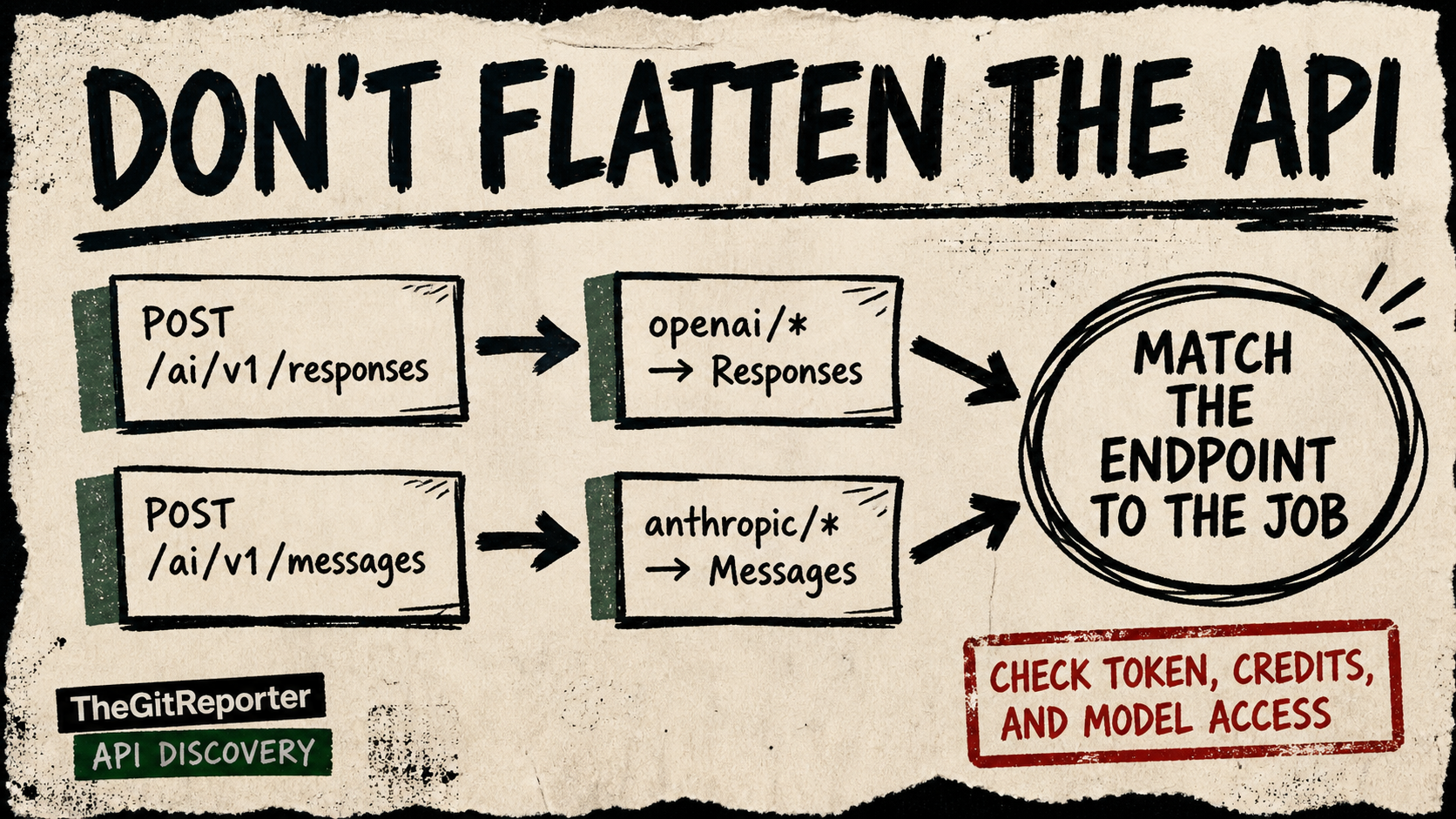
API discovery: Cloudflare documents POST /ai/v1/responses as its OpenAI Responses-compatible surface for agentic workflows, alongside a separate Messages endpoint. That distinction became newly practical in OpenCode's merged gateway routing: OpenAI models are sent through a native Responses path and Anthropic models through a native Messages path, rather than both being squeezed through a compatible chat endpoint.
The consequence is plain. A coding or repair agent that depends on the Responses API's request semantics should be tested on the route that speaks Responses, not on a translation layer that happens to accept a similar model name. Cloudflare says those public REST routes apply its configured gateway controls while authenticating through the account.
Practical example: a bounded repair rehearsal
Build a disposable one-turn repair rehearsal: ask an OpenAI Responses-compatible model to turn a fictional bug report into a short patch plan and a test checklist, then inspect the request and response shape before connecting it to a repository. The useful experiment is not “does an LLM answer?” but whether your agent harness preserves the endpoint and model semantics you intended.
Copy-paste agent instruction
In a new disposable project, prepare but do not execute a minimal OpenAI Responses API smoke test for Cloudflare AI Gateway. Use the documented REST base URL ending in /ai/v1, read the Cloudflare token only from an environment variable, and send one fictional bug report to an openai/ model through responses.create. Produce: (1) a short setup README, (2) code that redacts credentials from logs, and (3) an assertion that the response can be recorded without sending repository contents. Do not create tokens, do not call a live endpoint, and flag the account, credit, and model-access checks the operator must complete first.Access and test caveat
This is a preparation recipe, not a claim that the request will run everywhere. Cloudflare access requires the right account token and credits, and model availability can differ by provider and account. The OpenCode change is merged-source evidence with a stubbed network test; verify the installed version, keep the first call synthetic, and never place provider or gateway credentials in an agent prompt or source-control file.