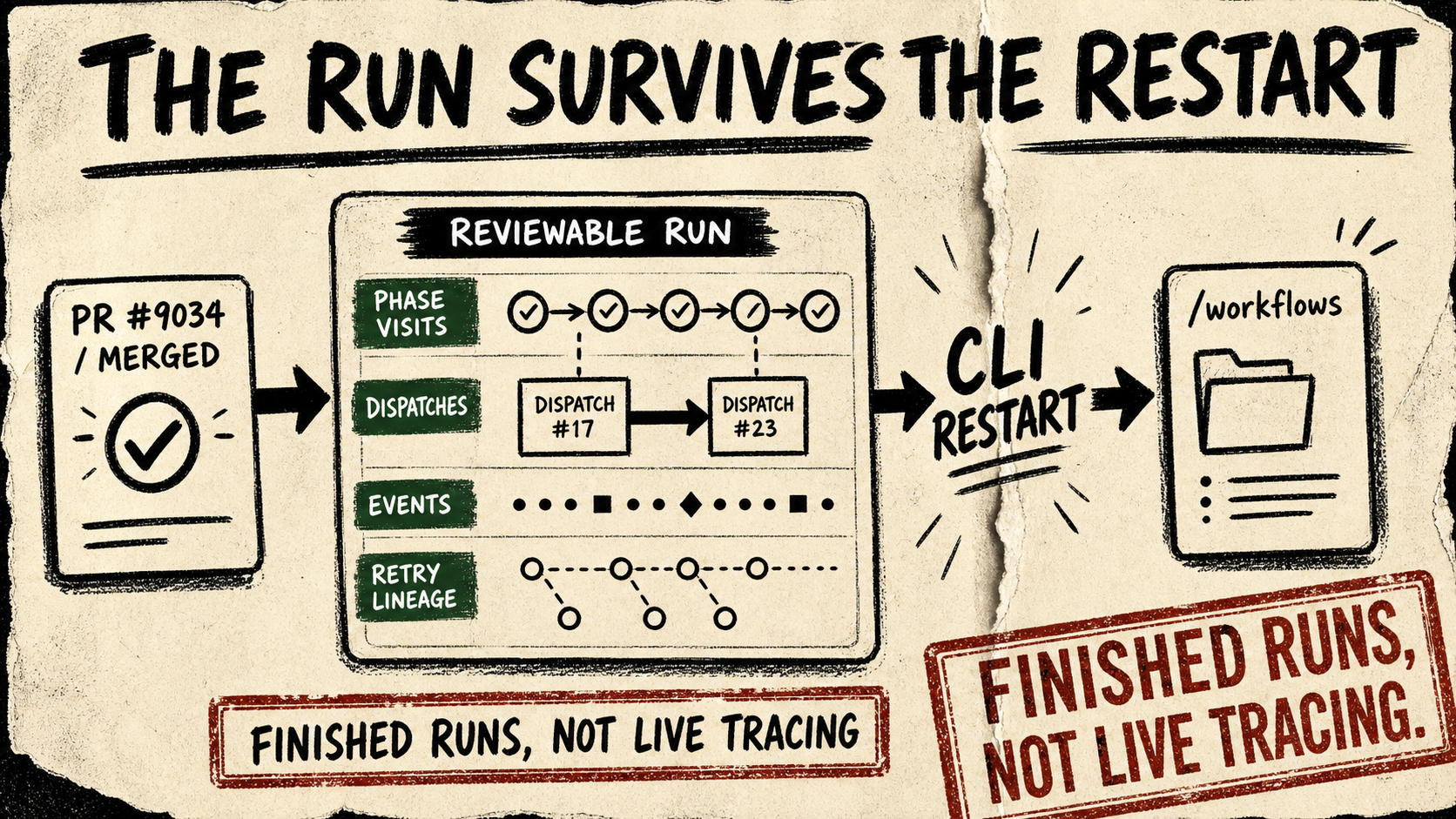
On August 20, QwenLM/qwen-code merged PR #9034, a 14-commit change that gives its workflow runtime a structured record of state. The merge reaches the registry, runner, orchestrator, command surface, snapshots, and focused tests.
When a workflow fans work across subagents, a restart can erase the useful part of the story: not merely what printed, but which phase led to which dispatch, what was retried, and where a run actually ended.
The important move is not that QwenLM/qwen-code added more history. It decided what a workflow history has to remember. Its persisted snapshot carries the run that a retry or rerun came from, visits to phases, dispatch traces and their dependencies, event records, token accounting, the recent log tail, and the final result or error.
The file describes this as a whole-run summary that survives the CLI process. After a terminal run, /workflows can reconstruct a recent record instead of asking an operator to infer a graph from a transcript.
A restart becomes a review point
That changes the failure conversation. A task can now carry a visible lineage back to the run it retried; a dispatch can retain what it depended on; and lifecycle events can distinguish queued, running, completed, failed, or cancelled work.
Those are the pieces an operator needs to ask a concrete question after the screen is gone: did a branch finish, was it cancelled, or did the next attempt start from a known predecessor? The pull request's public description names the same design in plainer terms—run and step events, persisted journal state, reconstructed snapshots, cancellation, and retention for downstream consumers.
There is a modest but meaningful engineering lesson here for anyone building an agent runtime: persist the topology, not just the output. An answer and a log line can tell a reader that something happened. They rarely identify the phase, dependency edge, or predecessor that lets a human safely decide what to rerun.
The new source-level tests cover restart-boundary reconstruction and workflow event handling. That is a stronger receipt than a UI mock—but still only a receipt for the implementation's intended behavior.
Not a live debugger—yet
The first reading of this merge was too generous: “workflow execution state” can sound like full observability while work is running. Qwen Code's own public tracing analysis draws a harder boundary. It identifies gaps around approval waits, hooks, subagent trace trees, and stable parent-child wiring.
The snapshot code is candid about its limit too: it is written on a terminal transition and is a convenience rather than a correctness dependency. This is a record of a finished run, not a promise that an active one can be inspected or recovered without ambiguity.
That makes the next signal unusually clear. Watch for release documentation and a public end-to-end reproduction in which a workflow crosses a restart boundary, retains its phase and dispatch record, and lets an operator explain the result without replaying an uncertain external effect.
If that arrives, Qwen Code will have turned a useful post-mortem artifact into a sturdier operational contract. For now, it has made one valuable choice visible: a workflow should leave behind more than its last words.