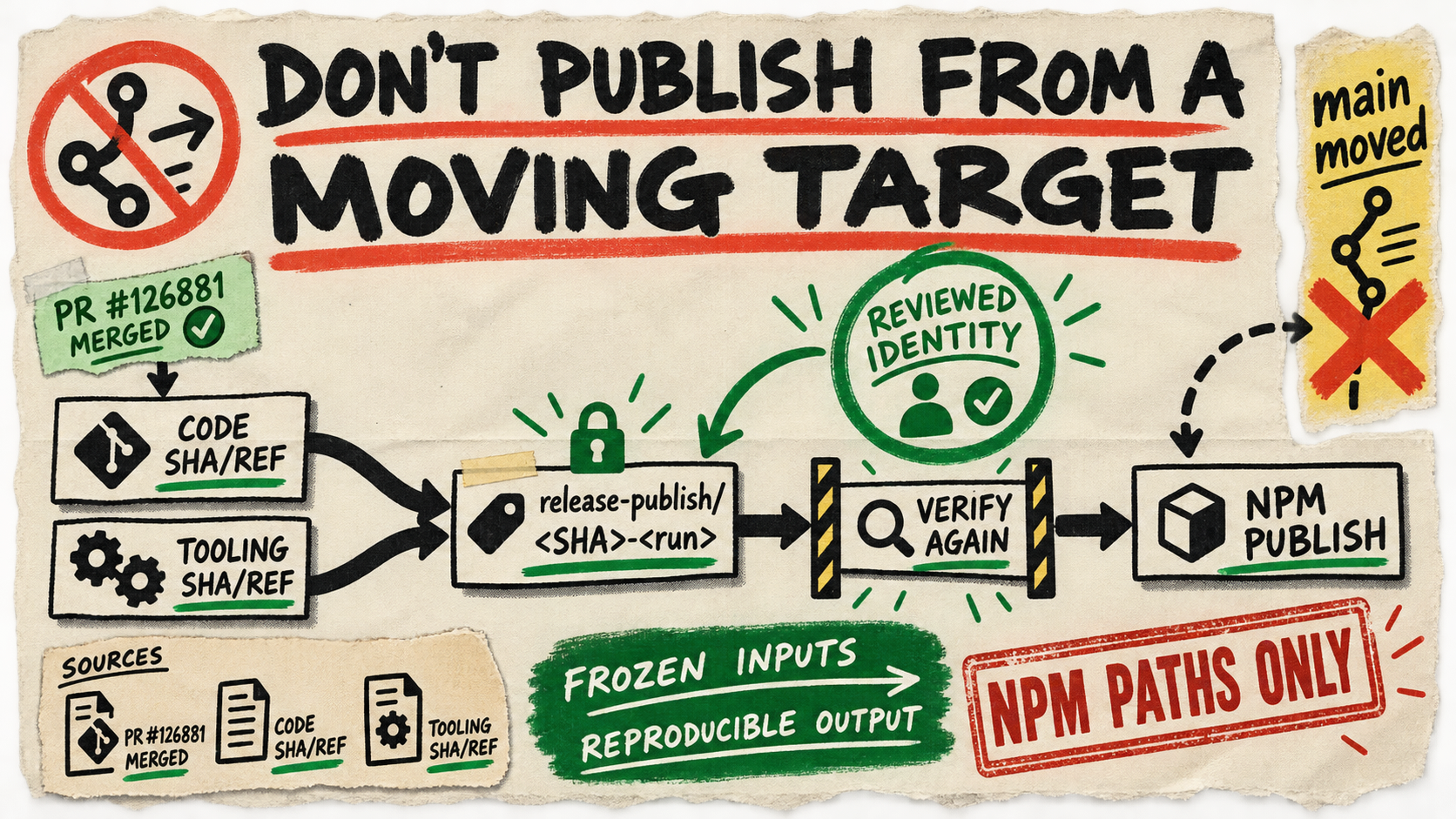
A release can be ready while the repository around it is not still. A maintainer may freeze a product commit, complete review, and begin validation; then ordinary work lands on main. If the release workflow asks current main what it is allowed to run, the work that received review and the work that publishes are no longer necessarily the same program.
That is the race OpenClaw says it addressed in merged PR #126881. The public write-up describes SHA-pinned release tooling losing trust merely because main had moved past that revision. Its remedy is not to trust an old branch more loosely. It records a frozen Code SHA/ref separately from a Tooling SHA/ref, then lets the covered release route rely on an exact lightweight release-publish/<sha>-<run> tag that still resolves to the reviewed tooling commit.
The tag has to answer twice
The interesting part is when the answer is checked. The new identity verifier distinguishes an ordinary main route from a protected-tag route. For the latter, it asks GitHub for the live tag reference and requires a lightweight commit tag at the exact full ref, with the expected SHA. A missing, moved, annotated, or wrong-SHA tag does not count. Nor does a branch that happens to have the same name.
That identity is joined to a second receipt: the exact Release Publish workflow run and attempt. The verifier checks its repository, event, head branch, head SHA, workflow path, and state policy before allowing the covered path to continue. In plain language, the tag’s creation record is not being used as a substitute for the current publish authorization. The release has to show both which tooling was frozen and which approved run is now asking to use it.
The focused tests make the intended boundary unusually concrete. They reject a moved tag, deleted tag, annotated tag, wrong SHA prefix, and same-name branch; they also preserve a separate ancestry test for the normal main route. This is a small but important release-engineering habit: do not confuse a convenient ref with the identity that a privileged action is meant to trust.
A foundation is not the whole building
The first reading of a 3,000-line release patch was too broad: “immutable tooling” can sound like a blanket claim about every way a project ships. OpenClaw’s own release guide and the PR narrow it. The protected-tag enforcement in this merge covers core and plugin npm publication and dist-tag mutations. Other privileged writers—including the paths around GitHub releases, Windows promotion, ClawHub, Docker, and VCR—need their dependent enforcement changes before the route is complete.
That limit is the story’s useful discipline, not a footnote. A release system is only as reproducible as the exact code that validates and mutates it at each boundary. The PR says no beta candidate, package, release tag, or active release run was changed, so this is evidence of a merged control and focused tests—not a receipt for a shipped package.
For anyone running a release pipeline, the next audit is direct: freeze the workflow revision with the candidate, then try to substitute a moved tag, an annotated tag, a look-alike branch, or the wrong approving run in a dry-run path. The next public signal for OpenClaw is a release record showing the covered npm route survives an unrelated main advance while rejecting every substituted identity. Until then, the strongest claim is also the modest one: the project has made the question “which code is allowed to publish?” much harder to answer by accident.