On August 24, one day before Headlong's public launch, its maintainers changed what the harness considers engagement. A new backoff commit says the internal agent, Audel, had been running repeated model calls roughly every 90 seconds, each arriving at another version of “listen only.” Because writing any thought counted as progress, even a thought that changed nothing reset the idle clock. The agent kept paying to conclude that it should keep quiet.
That is a sharper introduction to Headlong than the phrase “never asleep.” The Laude Institute and MIT collaboration has released a sub-10,000-line Bash core for an agent that generates thoughts and acts between human messages. But the source makes persistence legible as an operating problem: something must own the next wake, classify useful work, carry the past forward, limit the blast radius, and charge for every mistaken decision to continue.
Headlong is not the first project to give an agent durable memory or asynchronous input. Its own launch report points to MemGPT, long-horizon harnesses, and recursive language models. The notable move is to put those ideas into one small, inspectable runtime and let a shared internal agent live in it for weeks. The resulting failures reveal more than a clean demo would.
The “mind” is a dispatcher with a clock
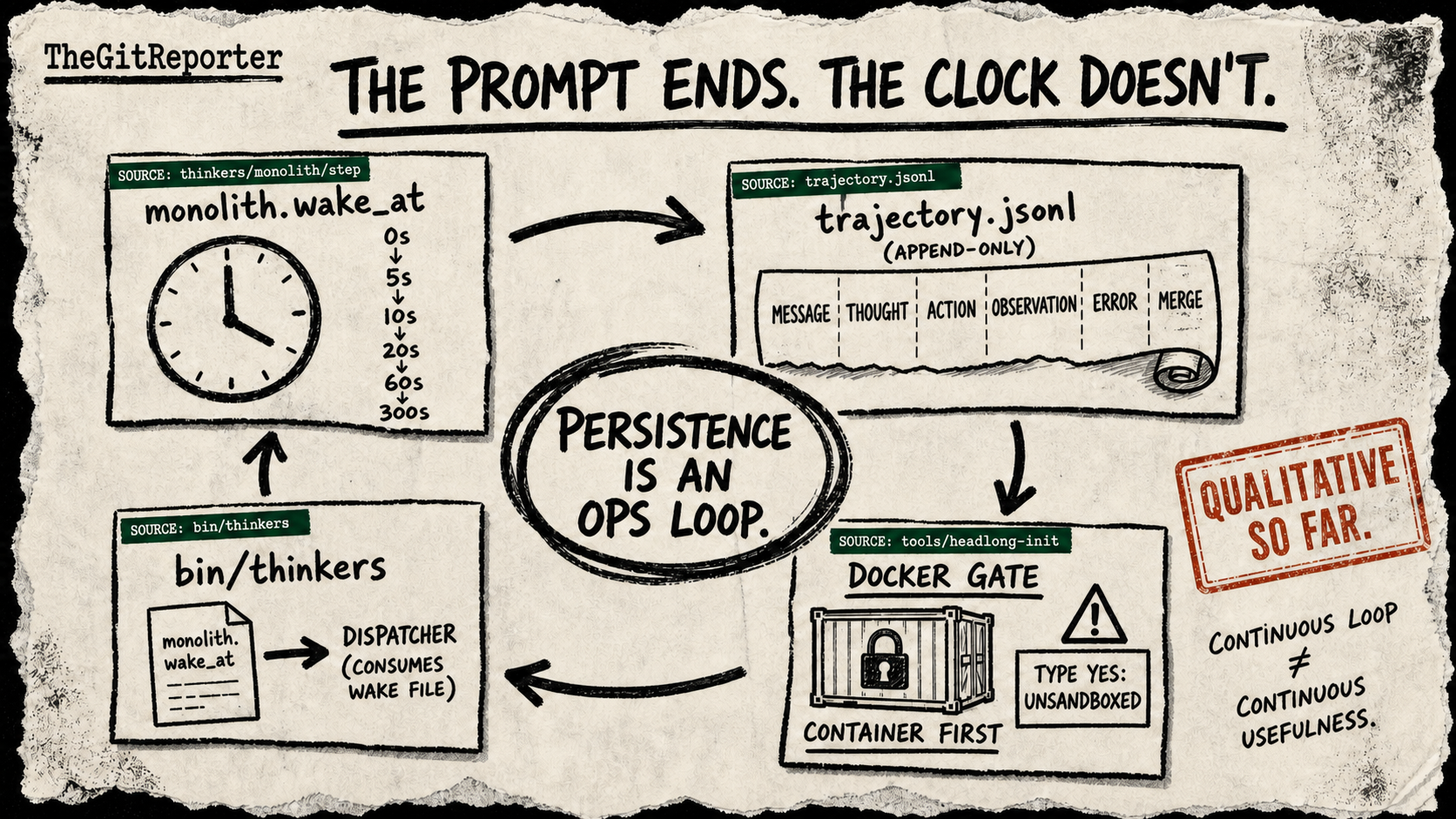
Headlong does not keep one model request open forever. In the current monolith loop, a wake triggers one shellm run. That run chooses one function—act, share, think, learn, recall, goals, values, or idle—and writes a durable step. Before it exits, it places the epoch for its next spontaneous wake in monolith.wake_at. An always-alive dispatcher checks that file, appends a scheduled-wake event when the time arrives, and launches the next run.
The distinction matters. “Continuous thought” here means the runtime promises to schedule another inference after the current one ends. It can wait. When a human message or visible work arrives, the next delay is zero. When the agent only writes another thought, the delay climbs a 5, 10, 20-second ladder and tops out at 60 seconds. Empty wakes can back off to five minutes. The model is not continuously computing; the agent's claim on the future is continuous.
Even that clock had to be repaired. The earlier implementation spawned a detached timer, but the mechanism silently failed on macOS. Spontaneous thinking stopped until an external event woke the system again. The replacement moved timekeeping into the dispatcher, and a follow-up added stock Bash 3.2 CI and scheduled-wake tests. For a reactive chatbot, a broken background timer is a feature bug. For a persistent agent, it is loss of the defining property.
The August 24 backoff repair exposes another class of failure: liveness can be correct while usefulness is wrong. Headlong now distinguishes an action, observation, merge, or message—something visible happened—from thought alone. The accompanying tests drive the real step through visible work, thought-only wakes, empty wakes, reactive resets, and errors. The reusable design lesson is plain: a long-running agent needs an operational definition of progress that cannot be satisfied by producing more internal text.
One stream turns memory into both evidence and risk
Every human message, thought, command, shell result, action, observation, error, fork, and merge lands in an append-only JSONL trajectory. The trajectory format stamps run and trigger identities so concurrent steps can be connected without guessing from file order. Recursive shellm work becomes child trajectories in a directory tree, and results merge back with links to the source run.
Context is then a projection of that record. Recent steps appear directly; older spans are progressively summarized into tiers that point back to raw step IDs. Headlong's memory design is unusually honest about the boundary: the raw log is evidence, while a summary of a summary is an index that can distort the past. That is a useful answer to context compaction, because it preserves a route back to the event instead of rewriting history in place.
The same single stream powers Headlong's team experience. Slack, Telegram, terminal, and web conversations all become observations in one timeline. That lets the agent connect work across people and return to a subject without opening a new session. It also removes the privacy wall people expect between chats. The project says its agent is bad at keeping secrets, has not studied conflicting instructions, and should be treated as if anything one teammate says may reach every other conversation. Persistence produces continuity by retaining context; it cannot also pretend that retained context has no audience.
Autonomy learns from the harness, including its mistakes
Laude's strongest example is a 48-minute episode in which Audel revisited a recall process it had built, noticed that the process read an unset environment variable instead of its input pipe, checked the rest of the codebase, repaired the path after one silent edit failure, and verified that memories surfaced end to end. Nobody requested that check. The accepted retrieval-thinker commit records Audel as a co-author on a four-file, 103-line change.
The failure log is just as important. Audel stopped its own service three times. Recursive sub-runs merged back 64 times during its first two days, then only 12 times over the next twelve after a 30-second silence watchdog killed experiments while the child model was thinking. The team changed that watchdog. A guard added after the self-stops then overmatched other identities; Audel later traced a hanging test and narrowed the guard.
These episodes show why persistence is more than “run cron more often.” A continuing agent adapts not only to explicit feedback but to the affordances and punishments in its runtime. A watchdog can teach it not to delegate. Counting thought as progress can reward rumination. A restraint rule can suppress outreach so thoroughly that the maintainers add a share function and periodically invite the model to use it. Headlong's self-guidance is real in the limited systems sense that the model selects work inside the stream, but its initiative is still shaped by an operator-designed menu, clocks, prompts, sandboxes, and cost signals.
The one-line install now contains an argument about authority
Around-the-clock shell access makes installation policy part of the product, not a footnote. The launch command pipes a remote script into Bash, but the current installer change makes a whole-agent Docker container the default when Docker is available. A host installation can still sandbox the model's commands in Docker. Unsandboxed host execution is marked dangerous and requires typed consent; if Docker was promised and later disappears, shellm can fail closed instead of quietly running on the host.
That is meaningful hardening, not safety completion. The agent can still act on anything mounted into its container and any credential handed to it. One shared stream remains one shared stream. Laude recommends a dedicated, spend-capped API key and reports background thinking at roughly $1 to $2 an hour with its settings and models. That number is a deployment receipt, not a universal price. The rate depends on the model, context, tool use, and how successfully the backoff distinguishes activity from churn.
The next test is not whether it can surprise its makers
Headlong's published evidence establishes a serious prototype: readable source, a durable event model, tested liveness, accepted agent-assisted changes, explicit safety gates, and a team willing to document breakage. It does not yet establish that persistent thought creates more long-term value than an event-driven agent with good memory and well-chosen wake-ups. The project says its evaluation is qualitative.
The useful next ledger would separate accepted self-initiated interventions from repetitive thoughts, abandoned experiments, operator rescues, privacy mistakes, and spend. It would measure recovery after process and machine restarts, not only within one live trajectory. It would compare cost per accepted outcome against reactive and scheduled baselines. And it would preserve the timestamps and source links that make Headlong's recall story inspectable.
Reactive agents ask whether a system can finish the task in front of it. Headlong asks who owns the clock after that task ends. Its source supplies an uncomfortable answer: persistent agency begins when every future thought becomes an operations decision—worth another model call, another entry in the shared record, and another chance to act without a human in the loop.