A private term sheet and a request for current market comparisons belong to the same job. They do not have to belong to the same computer.
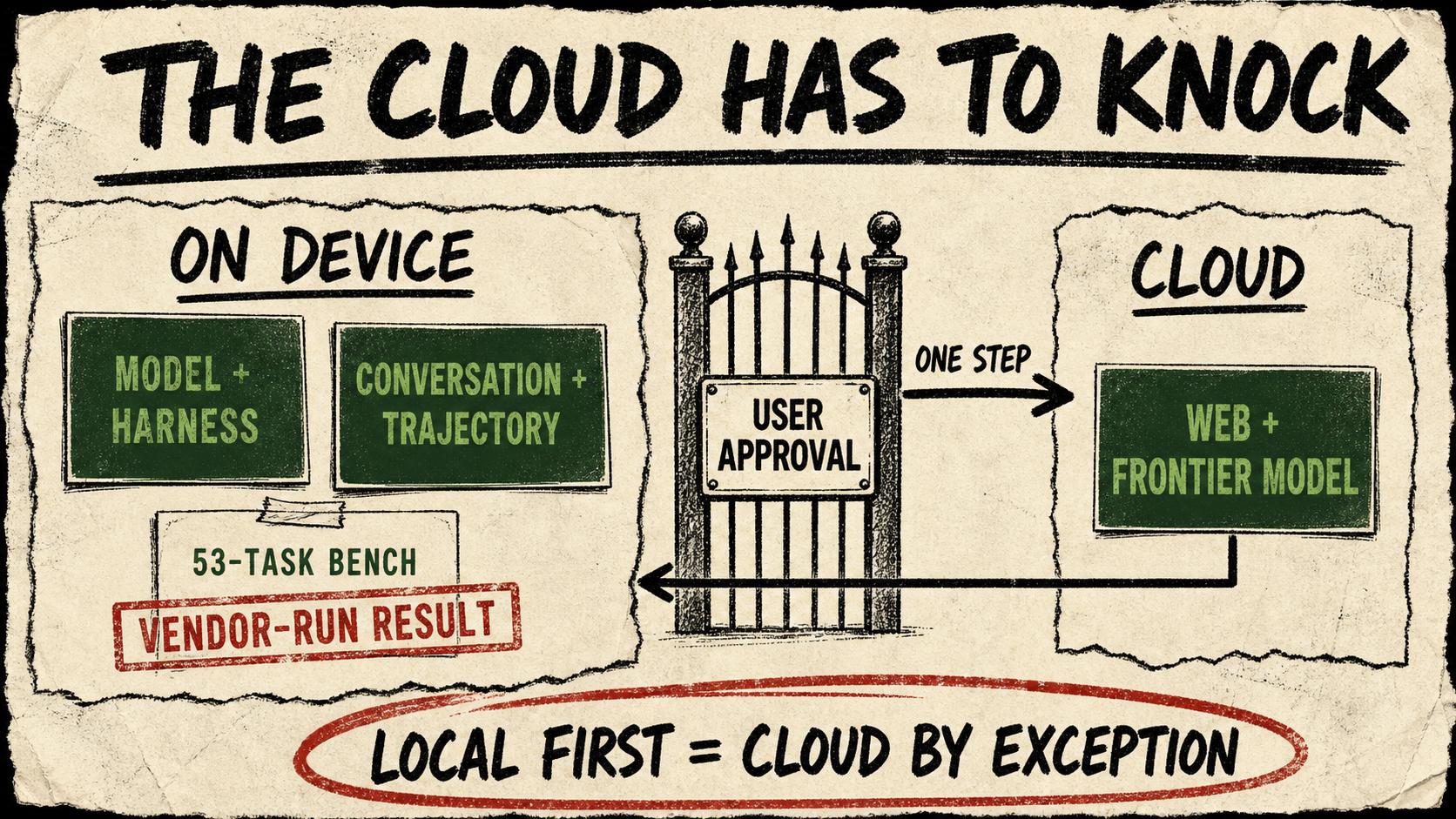
That is the useful tension inside Perplexity's new research on Portable Computer. The company has moved its Computer agent's model, harness, conversation, and task trajectory onto an NVIDIA DGX Spark. Work starts there. When a step needs current web information or more powerful reasoning, the system can still call the cloud—but Perplexity says it asks the user before content leaves the device.
The first headline is that a 27-billion-parameter model can now do credible agent work on a desktop box. The more consequential claim is about control: a local-first agent can make remote disclosure a scoped decision during the work, instead of the invisible default for the whole job.
Privacy is a map, not a label
Portable Computer is not an offline appliance. Perplexity's product architecture places the agent harness, orchestrator, planner, tool router, task state, and local search on the machine. It offers Qwen 3.8 27B and PPLX 27B, a version Perplexity post-trained for its harness. Conversation state and the trajectory—the running record of what the agent has done—stay local by default.
The boundary appears when the local run needs something the machine does not have: the live web, a connected cloud application, or one of more than 15 frontier models. The orchestrator asks for approval, sends that step out, and brings the result back into the local run. The cloud has not vanished. It has become an escalation path with a human at the crossing.
For readers deciding whether an agent may touch contracts, source trees, customer records, or internal research, that topology is more informative than a green “private” badge. Ask four concrete questions: which state stays on the machine, what exact material a remote step receives, who approves the crossing, and what receipt remains afterward. Perplexity's public material answers the first and describes the approval. It does not yet provide an independent security audit or a public implementation that lets outsiders verify every path.
The benchmark says the harness matters
Perplexity also reports a result worth examining without turning it into a verdict. Its Local Knowledge Work Bench contains 53 tasks drawn from day-to-day research, analysis, and document work. The published figure says each task was run three times on DGX Spark and reports 95% confidence intervals.
With the same Qwen 3.8 27B base model and hardware, Perplexity says its Computer harness scored 82.6%, compared with 77.6% for Pi and 74.0% for Hermes. Replacing the base model with PPLX 27B lifted Computer to 85.4%. The fair reading is not “Perplexity beat two agents.” It is that orchestration and post-training can materially change what one local model accomplishes. Model size alone does not describe the system.
The challenge is ownership of the measuring stick. Perplexity designed the benchmark, ran the systems, and published the scores. Fifty-three tasks can expose real differences while still missing other professions, longer jobs, awkward failures, and the cost of human correction. Until the tasks, graders, harness configurations, and model artifact can be inspected and rerun, the numbers are a promising vendor evaluation—not public proof of general superiority.
The meter moved; it did not disappear
Local inference carries no per-token cloud charge. That can matter for organizations with a steady volume of sensitive work: the machine can keep reading, drafting, parsing, and revising without turning every token into a remote billable event. It can also keep working when policy forbids sending the underlying documents away.
But “zero token cost” is not “free.” Portable Computer initially targets dedicated NVIDIA hardware; the buyer still bears the machine, electricity, administration, and a qualifying Perplexity subscription. Approved cloud escalations return to metered services. Whether this is cheaper depends on workload volume, hardware utilization, and how often the local agent asks to cross the boundary—measurements the research post does not settle for a particular reader.
A design pattern, awaiting receipts
Portable Computer earns attention because it gives “local-first” an operational meaning: keep the working set nearby, make remote capability exceptional, and stop for consent at the moment of disclosure. That is a stronger pattern than either cloud denial or a vague privacy promise. It lets a person use current information without silently surrendering the whole context that made the question sensitive.
The next evidence should make that boundary inspectable. Publish the 53-task benchmark and exact comparison setup. Release enough of the harness and model work for others to reproduce the result. Show durable records of what every approved cloud step sent, where it went, and what came back. Perplexity's research has drawn a useful door between the machine and the cloud. Users still need a peephole and a receipt.