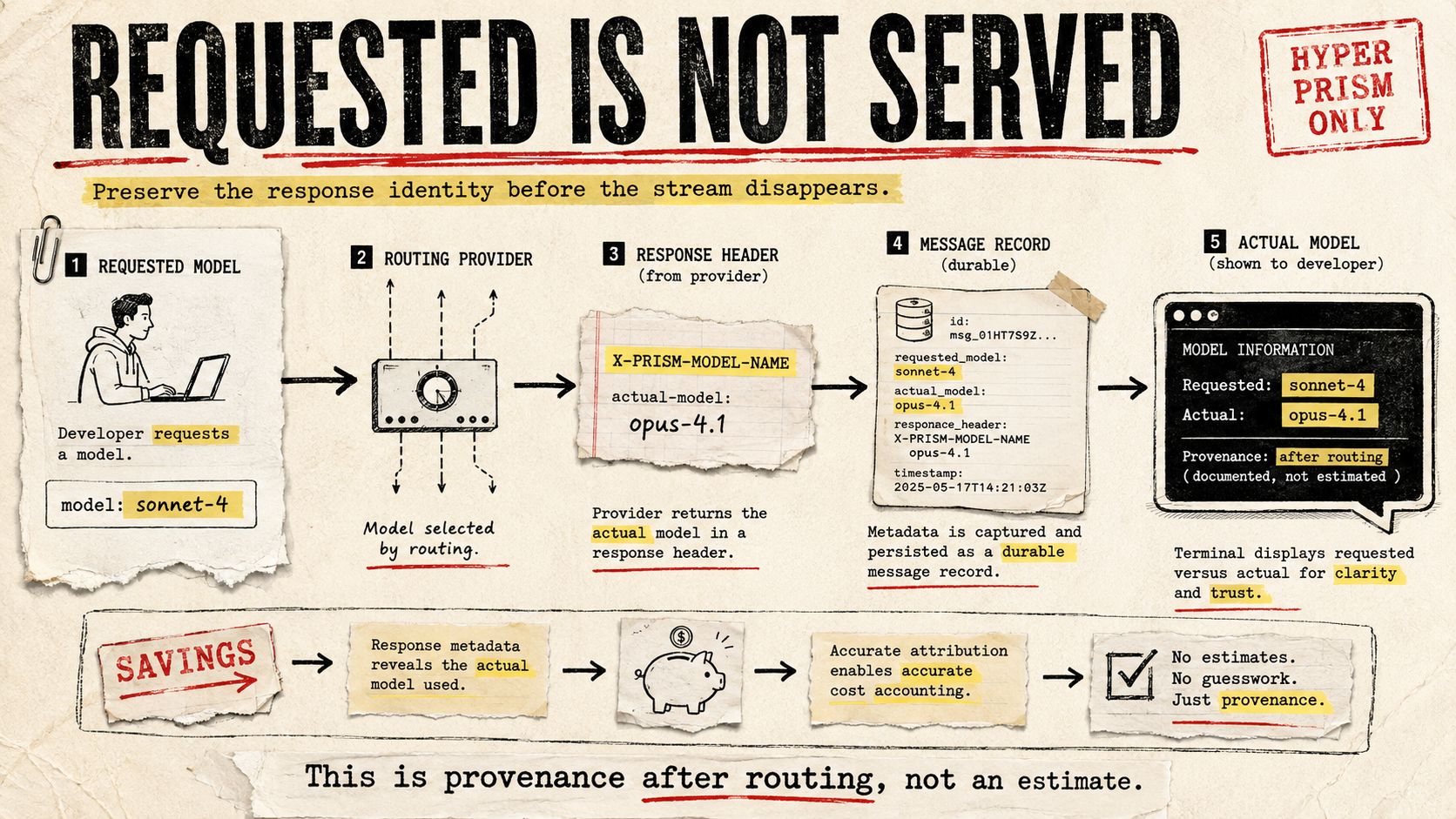
A model picker can be truthful at the moment a request leaves a client and still be misleading after a router takes over. Crush’s public #3713 commit, marked Assisted-by: Crush:glm-5.3, builds a durable answer to that problem for Hyper Prism turns: show the model that actually served each response, not only the model a person selected.
The repo evidence
The interesting work is not the arrow in the terminal footer. In internal/agent/hyper/provider.go, Crush copies Prism’s routed-model identifiers and savings information from response headers—and, for streaming responses, trailers—into provider metadata. The message layer then writes those values into new database columns, the event layer carries them to clients, and the chat renderer puts the requested model beside the routed name and any reported savings. A past session can therefore retain the outcome even after a router or pricing table changes.
The accompanying public PR is a useful engineering receipt: it includes a schema migration, generated message queries, server events, mid-turn UI handling, and focused tests. One test verifies that a routed name appears for an intermediate tool-use turn; another checks how a savings suffix behaves when Prism reports hypercredits, dollars, both, or neither. That is a real data path from an observable response to a reader-visible record.
The transferable skill
Transferable building skill: record post-routing provenance at the boundary that can see it. If an upstream request can be transformed by a model router, cache, proxy, or policy layer, capture the returned identity and outcome before the stream disappears. Put it on the durable turn object, move it through every transport, and test the display from persisted values. Reconstructing “what probably ran” from the request label later is tempting—and loses the very fact an operator needs when a result, bill, or evaluation looks surprising.
The limit
The public source shows agent participation and a substantial implementation; it does not prove that a coding agent authored every line, that Hyper Prism’s savings figures are independently audited, or that the feature is already deployed to every Crush user. The next test is whether the same provenance survives another provider whose routing metadata arrives differently—or not at all.