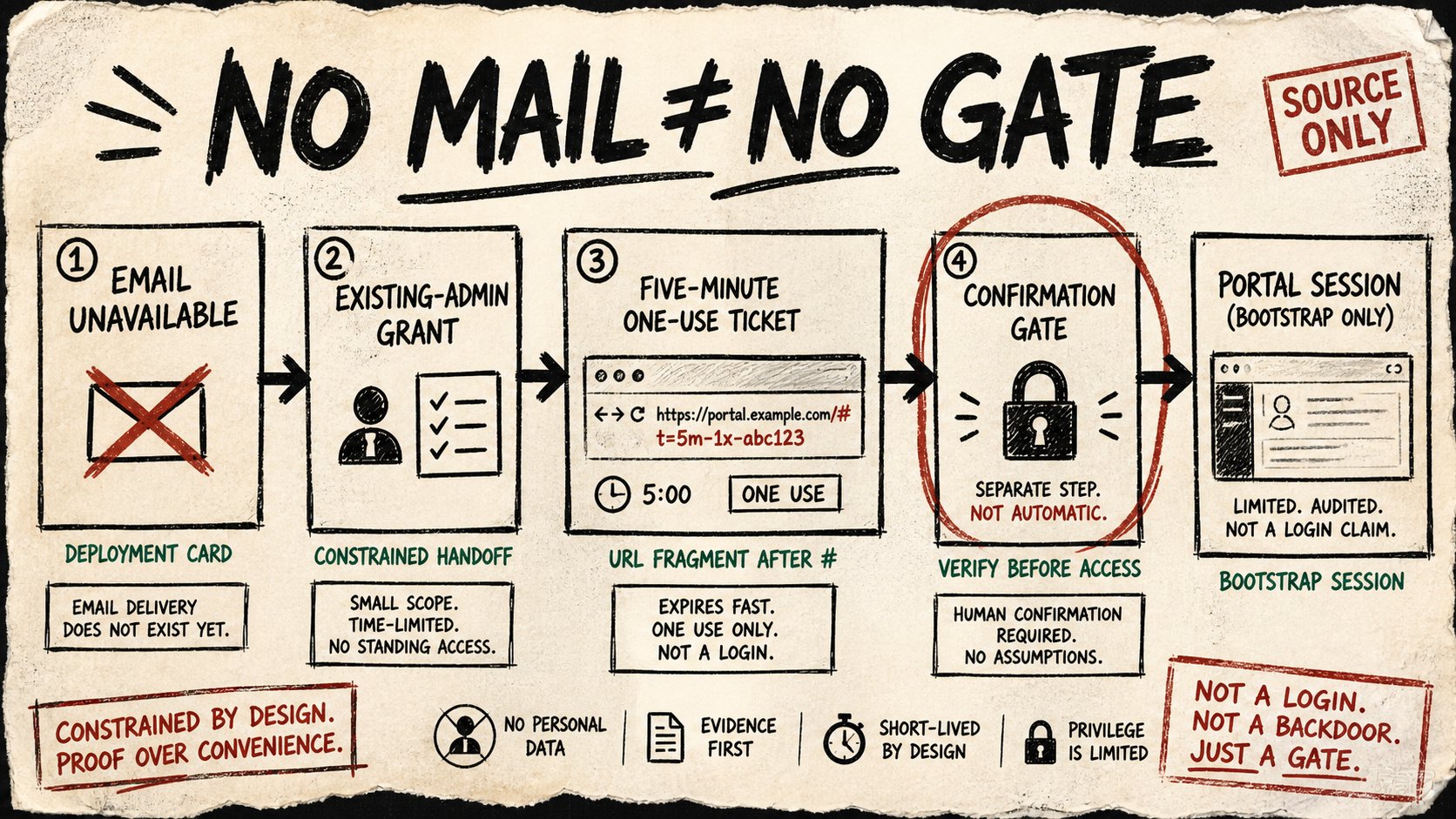
QM’s September 5 administrator-login commit meets an awkward deployment fact: the control room may be live before the mail server. The new command can mint a private link for an existing administrator when no email can be sent; it does not make that setup gap a reason to let anyone in.
The change takes a narrower route. Its operator command can mint a private link for a person already named as an org_admin; it does not create an account or grant a role. The project’s new deployment guidance is blunt about the trade: ordinary email sign-in can wait, but the link is a temporary credential—not a shared log entry.
The missing inbox is not the permission
That distinction is where the implementation earns attention. The CLI accepts only a configured administrator, then signs a payload whose purpose is admin-login, whose audience is the configured public origin, and whose lifetime is five minutes. It includes a fresh identifier and places the credential after the URL’s #, so the initial request does not carry it as a normal query string. The public token source also refuses unsafe public URLs and weak deployment secrets before it prints anything.
The page is not a magic sign-in. Its browser script removes the fragment from the displayed address, shows the account the token claims to name, and leaves the confirmation button disabled until it can read a plausible token. Redemption is a same-origin POST, not a passive page view. On the server, the portal verifies the purpose, origin, time window, and identifier; asks whether that account is currently an administrator; and stores the identifier as claimed before issuing a session. A second click on the same credential should meet the project’s “invalid, expired, or already used” path instead.
A bootstrap needs a visible boundary
The first reading of this feature could be “passwordless login without email.” That would be too broad. It is a recovery route for an operator who already controls the deployment and an administrator who already has a grant; it still relies on keeping the link private long enough to redeem it. The token tests reject other origins, expired payloads, altered purposes, malformed identifiers, and a token signed for a different use. The portal route additionally refuses a cross-origin redemption and fails closed if current admin access or one-time claim storage cannot be checked.
That is a useful pattern beyond QM: solve a setup gap with a smaller, inspectable handoff—not a vague exception named “bootstrap.” The source proves the intended command, handler, and tests, not a released deployment or flawless operator practice. The next signal is whether the same set of checks survives the moment a team adds normal email or an external identity provider, when convenience becomes even more tempting.